
LSA-1105
Columnar base for statue of Galerius, emperor. Caesarea Maritima (Palaestina I). 293-303
Record details
Photographs
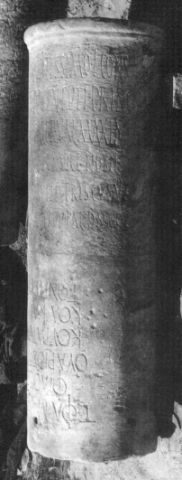
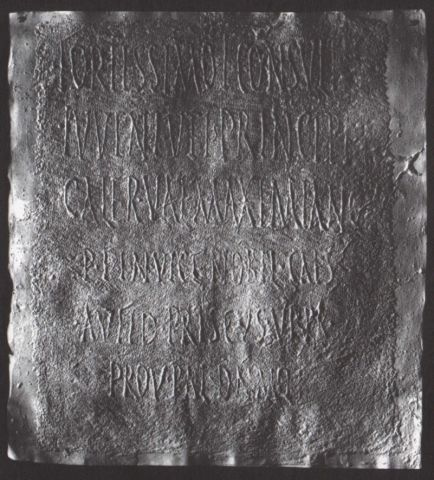
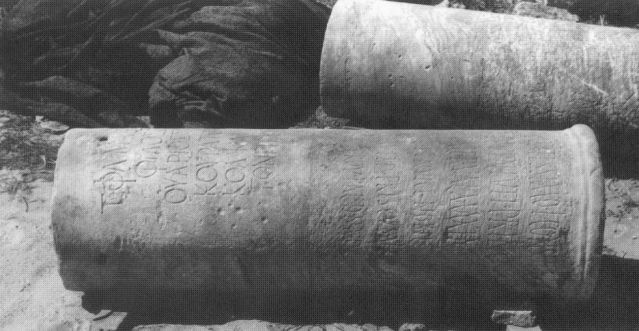
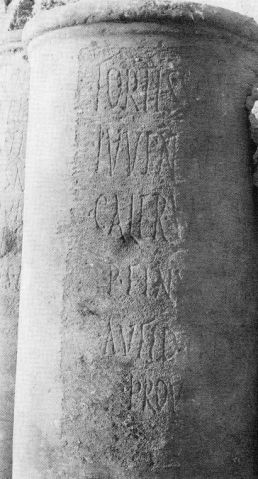
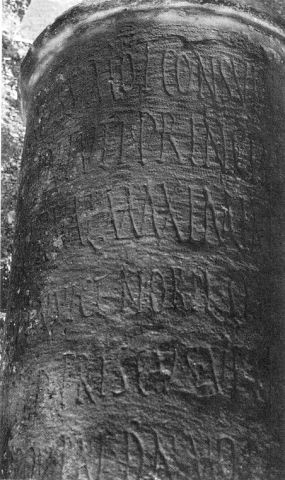
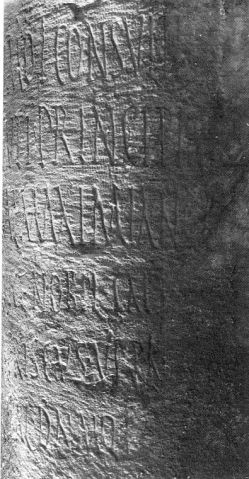
Inscription
Fortissimo et consult(issimo) / iuventutis principi, / Galer(io) Val(erio) Maximiano, / p(io), f(elici), invict(o), nobil(issimo) Caes(ari), / (5) Aufid(ius) Priscus, v(ir) p(erfectissimus), pr(aeses) / prov(inciae) Pal(aestinae), d(evotus) n(umini) m(aiestati)q(ue) e(ius).
Inscription translation
To the most powerful and wisest leader of youth, Galerius Valerius Maximianus, pious, fortunate, unconquered, most noble Caesar; Aufidius Priscus, of perfectissimus rank, governor (praeses) of the province of Palaestina, devoted to his divine spirit and majesty, [set this up].
Bibliography
- Lehmann, C. M. and K. G. Holum, The Greek and Latin inscriptions of Caesarea Maritima, Boston 2000, 49 no. 14
Discussion
INSCRIPTION
In six lines:
Fortissimo et consult(issimo) / iuventutis principi, / Galer(io) Val(erio) Maximiano, / p(io), f(elici), invict(o), nobil(issimo) Caes(ari), / (5) Aufid(ius) Priscus, v(ir) p(erfectissimus), pr(aeses) / prov(inciae) Pal(aestinae), d(evotus) n(umini) m(aiestati)q(ue) e(ius).
'To the most powerful and wisest leader of youth, Galerius Valerius Maximianus, pious, fortunate, unconquered, most noble Caesar; Aufidius Priscus, of perfectissimus rank, governor (praeses) of the province of Palaestina, devoted to his divine spirit and majesty, [set this up].'
Letter height 5 - 9 cm.
The inscription, with the honorand in the dative and the name of the awarder in the nominative, displays the crucial features of Latin statue base inscriptions.
DESCRIPTION (from Lehmann & Holum, Burrell 1993, and the published photos)
Column of grey and blue marble with double necking ring at the top. H 152, diameter 52 cm at top (43 below the necking ring) and 48 at bottom (these measurements are slightly different in Burrell 1993). Top and bottom are finished with a point, the bottom more roughly than the top.
The column carries three inscriptions of different dates. The first, in Greek, was set up by Varius Seleucus for his patron, the philosopher Titus Flavius Maximus, and is dated between the late 1st (after the 70s) and the 3rd century. It is cut on the unmoulded end of the column, with the moulded necking ring (at the top of our inscription) as its base. For the second inscription, in Latin, to the emperor Probus (276-82), the first inscription was partly erased, the column rotated and the inscription carved on the opposite side of the column, the moulding still at the bottom. For our inscription, the last of the three, the column was turned upside down, the necking ring now at the top, and the inscription carved on the same side as the earliest (Greek) inscription.
The surface, originally smoothly finished, was prepared with a claw chisel for our inscription. Close to the bottom end (the original top) three round holes are evenly spaced around the column. One of these impinges the first use inscription; the holes must therefore be associated with the later uses of the column. They possibly served to fix an additional element, presumably a crowning element if they date from the first re-use, or a base if from the second.
PROVENANCE AND CURRENT LOCATION
The column was found in 1990 on the eastern side of the Promontory Palace (see map in Lehmann & Holum 2000, p. 5 fig. 4). Together with another column carrying a honorific inscription to Constantius I (LSA-1106), it lay within the building destruction debris (Lehmann & Holum 2000, 47). Today in the courtyard of the Caesarea Museum (no published inv. no.).
HONORAND, AWARDER AND DATE
Galerius, the honorand, was Caesar 293-305.
The governor (praeses) Aufidius Priscus dedicated another inscription on a very similar base from the same findspot, to Constantius I (LSA-1106). He is known from these inscriptions and from a military inscription honoring the tetrarchs at Yotvata in the Wadi Araba (I. Roll, Israel Exploration Journal 39, 1989, 239-260; W. Eck, Klio 74, 1992, 395-400 ); he has no PLRE entry. The date-range for our inscription, provided by Galerius' and Constantius I's reigns as Caesar (293-305), can be shrunk slightly to 293-303, since the praesides of 303-305 are known (PLRE I, 343, Flavianus 1 (303), and his successor, PLRE I, 983, Urbanus 2 (304/7)).
It is possible that the awarder was the same man as either Priscus, the proconsul of Asia in 286/305 (PLRE I, 729, Priscus 1), or Priscus, proconsul of Europa in 303/5 (PLRE I, 729, *!Priscus*! 2).
FURTHER DISCUSSION
This columnar base and the similar one found alongside it (LSA-1106), both with dedications to the Caesars of the first tetrarchy, both received their latest inscriptions as a result of a second re-use. In both cases the first use was in the high imperial period, and the first re-use for the emperor Probus (276-82). Both are examples of late antique re-use after a relatively short period of time.
The findspot of the columns could be an indicator that the Promontory Palace in Caesarea was an official residence in Late Antiquity, perhaps even the praetorium of Caesarea (Burrell 1993, 295).
It is a striking feature of the honorific inscriptions in Caesarea that many of them were carved on free standing columns (our inscription, LSA-11, LSA-12, LSA-1090, LSA-1100, LSA-1106, LSA-1107). There is no reason to doubt that these were statue bases, with statues set on top of the columns.
Discussion references
- Burrell, B., Two Inscribed Columns from Caesarea Maritima, Zeitschrift für Papyrologie und Epigraphik 99, pp. 287-95, Bonn 1993, pp. 287-8, 293-4
- Jones, A. H. M. et al., The Prosopography of the Later Roman Empire. Vol. I 260-395, Cambridge et al. 1971 (1975)
Cite: Last Statues of Antiquity, LSA-1105 (Ulrich Gehn).