
LSA-1107
Lost fragment of columnar base for statue of emperor, probably a tetrarch (Diocletian, Maximian, Galerius, or Constantius I). Caesarea Maritima (Palaestina I). 284-305 ?
Record details
Photographs
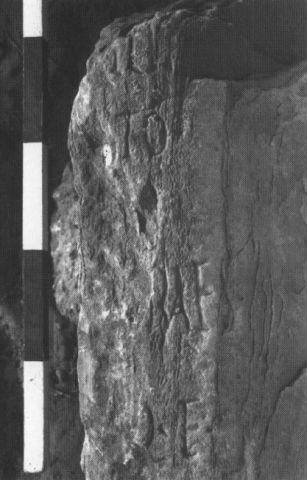
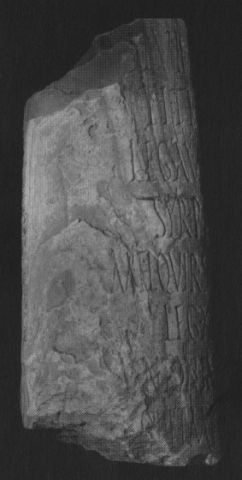
Inscription
[----] / [----]to / [----] /[----]praes /[----] /[-d(evotus) n(umini) m(aiestati)]q(ue) e(ius).
Inscription translation
... governor (praeses) ... devoted to his divine spirit and majesty, [set this up].
Bibliography
- Lehmann, C. M. and K. G. Holum, The Greek and Latin inscriptions of Caesarea Maritima, Boston 2000, no. 19
Discussion
INSCRIPTION
Probably once in six lines, three of which remain partly legible:
[----] / [----]to / [----] / [----]praes / (5) [----] / [-d(evotus) n(umini) m(aiestati)]q(ue) e(ius)
'...governor (praeses) ... devoted to his divine spirit and majesty, [set this up].'
Letter height 4 - 6.5 cm.
DESCRIPTION (from Lehmann & Holum 2000 and the published photos)
Fragment of a column of bluish grey marble: H 93, W 42, D 18 cm. The fragment bears the traces of two inscriptions, the first to the governor (legatus Augusti pro praetore) of Syria Palaestina Caius Iulius Titianus from the early 3rd century (for the date see Lehmann & Holum 2000, 53 no. 18). The second, our inscription, is from the late 3rd or early 4th century.
The fragment is broken and lost on the left, leaving only the final letters of lines 2, 4, and 6 of our inscription legible. The surface is weathered and covered with chips and cracks. Nonetheless the different structures of the two respective epigraphic fields are still visible. The first inscription was engraved into the smoothly finished original surface, whereas for our inscription the epigraphic field has been chiselled. This is the same technique used for the two tetrarchic dedications in Caesarea to the Caesars Galerius (LSA-1105) and Constantius I (LSA-1106).
PROVENANCE AND CURRENT LOCATION
The fragment is reported to have been found in the vicinity of Caesarea in the 1940s. According to Lehmann & Holum 2000 it was in the Caesarea Museum until the 1980s, but has since disappeared.
HONORAND, AWARDER AND DATE
About the honorand no more can be said but that he was an emperor. This is clear from the extant letters in the last line, belonging to a dedicatory formula almost universal on imperial dedications of the late 3rd and the 4th centuries.
Given that the honorand is an emperor, the extant letters in line 4, praes<i/>, are reasonably interpreted as referring to a governor (praeses).
The inscription cannot be precisely dated with any degree of confidence, since the final dedicatory formula and the title of praeses both appear in Caesarea Maritima already in 276/82, on dedications to the emperor Probus (Lehmann & Holum 2000, nos. 13, 16), as well as later, in the tetrarchic period (LSA-1105, LSA-1106). However, the identical treatment of the epigraphic field to that on the dedications in Caesarea to Galerius and Constantius I (LSA-1105, and LSA-1106 respectively) speaks in favour of a tetrarchic date, and it is even possible that this columnar base once formed part of a group of dedications to all four tetrarchs, of which only those to Galerius and to Constantius survive.
FURTHER DISCUSSION
It is a striking feature of the honorific inscriptions in Caesarea that many of them were carved on free standing columns (our inscription, LSA-11, LSA-12, LSA-1090, LSA-1100,LSA-1105, LSA-1106). There is no reason to doubt that these were statue bases, with statues set on top of the columns.
Cite: Last Statues of Antiquity, LSA-1107 (Ulrich Gehn).