
LSA-111
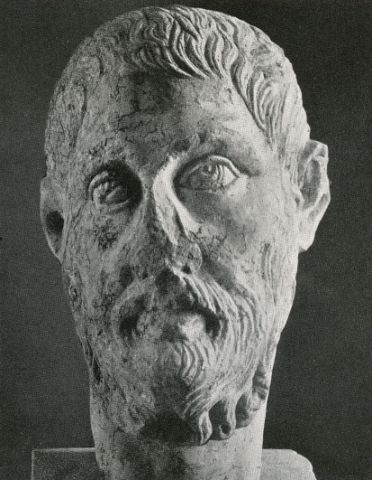
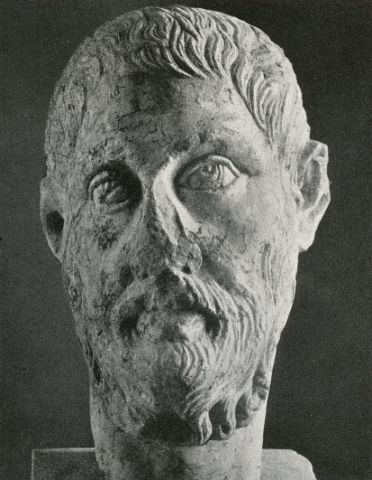
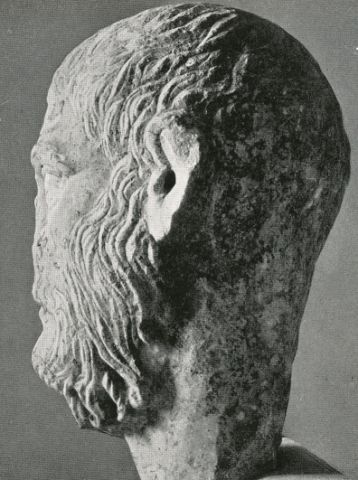
Portrait head of bearded man in 'Iamblichus-type'. Delphi (Achaea). Later third century.
Record details
Photographs
Bibliography
- L'Orange, H. P., Studien zur Geschichte des spätantiken Porträts, Oslo 1933, 42-43, 124-125 nr. 60 fig. 111, 113
- L'Orange, H. P., Some remarks on late Greek portraiture, especially regarding the Jamblichos type, Acta ad archaeologiam et artium historiam pertinentia, 6, 1975, 59-63, 60-61 pl. VI a, b
Discussion
DESCRIPTION (Object)
The marble head is broken at its neck. The tip of the nose and the adjacent portion of the upper lip is chipped off, and the rear portion of the neck (and possibly of the head; hard to assess from the published images) is broken. There are chips on the eyebrows, the earlobes and on the right eye. The surface is covered with traces of roots.
The head has a stretched oval shape. The hair is arranged into short lunular compartments by thin chisel lines. The beard is arranged by chisel work into long, parallel, almost vertical strands on the cheeks and around the mouth. Under the chin it tapers out into thick compartments which are separated from each other by drill work. The ends of these compartments are curling up and are marked with large drill holes.
The pupil is marked by a broad channel; the iris is circumscribed by two concentric incised lines. The eyebrows are regularly arching.
The left side of the face is broader than the right and the right eye is sitting lower; the head is slightly turned and bent to the right side.
PROVENANCE AND CURRENT LOCATION
The head was found in Delphi, south of the temple. It is now in the Delphi museum, inv. no. 4040
DESCRIPTION (Subject)
The portrayed is a man of mature age as is indicated by the full beard and the somewhat saggy cheeks. His hair is arranged into short lunular locks and is brushed forward. Around the brow and temples it forms a trapezoidal line. His long beard is tapering out into spiral locks below the chin; similar fashion beards reoccur on other portraits of the region (LSA-112, LSA-113, LSA-114, LSA-115, LSA-116, LSA-123) (see below, ‘Date’ and ‘Further Discussion’).
DATE
The longish beard tapering out under the chin was apparently a widespread fashion; beyond the Greek heads quoted above (‘Description (Subject)’) it is displayed by a bust from Rome in the Louvre (de Kersauson no. (not on shelve, 4-5-12)) and on the post-Gallienic so-called ‘Annona-sarcophagus’ in Rome (Giuliano 1985, 46-8 no. II, 1 (L. Musso); Goette 1990 cat. no. S 46 pl. 77,1). Coin portraits of the emperor Tacitus show the same fashion beard and provide the dating evidence in the 3rd quarter of the 3rd century for our head (Delbrueck 1940 pl. 25).
The date proposed here would exclude the head from our database; however, different proposals have been made by earlier scholarship; L'Orange 1933 (repeated in L'Orange 1975) dated the head to ca. 300 (see below, ‘Further Discussion’).
FURTHER DISCUSSION
Our head belongs to a much discussed group of similar heads associated with the neo-platonic philosopher Iamblichus of Apamea (PLRE I, 450-1 Iamblichus 1) by H. P. L'Orange; for a detailed account on earlier scholarship’s discussion of the group I refer to LSA-110, ‘Further Discussion’.
Discussion references
- de Kersauson, K., Les portraits romains II; de l’année de la guerre civile (68-69 après J-C) à la fin de l’Empire , Paris 1996
- Delbrueck, R., Die Münzbildnisse von Maximinus bis Carinus (Das römische Herrscherbild III. Abteilung Band 2), Berlin 1940
- Giuliano, A. (ed.), Museo Nazionale Romano. Le Sculture I,8. Parte I, Roma 1985
- Goette, H.R., Studien zu römischen Togadarstellungen, Mainz 1990
- L'Orange, H. P., Some remarks on late Greek portraiture, especially regarding the Jamblichos type, Acta ad archaeologiam et artium historiam pertinentia, 6, 1975, 59-63, 60-61 pl. VI a, b
Cite: Last Statues of Antiquity, LSA-111 (Ulrich Gehn).