
LSA-1112
Base for statue of Constans, emperor. Ulpia Augusta Traiana (Thracia). 341
Record details
Photographs
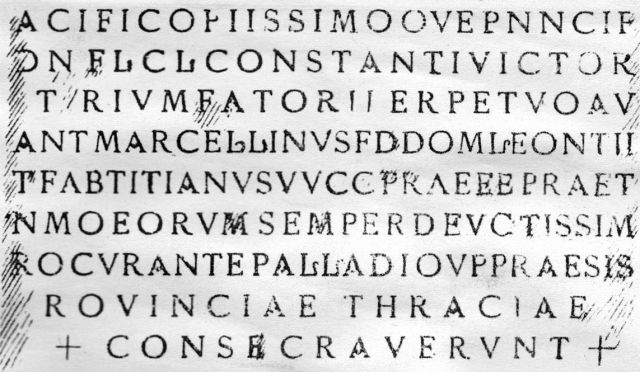
Inscription
[P]acifico piissimo[q]ue pṛịncip[i], / d(omino) n(ostro) Fl(avio) Cl(audio) Constanti, victor[i / e]t ṭriumfatori (sic), p̣erpetuo Au[g(usto)]. / Ant(onius) Marcellinus, ẹṭ Dom(itius) Leontiụ[s, / e]t Fab(ius) Titianus, vv(iri) cc(larissimi), praeff(ecti) praet(orio), / n(umini) m(aiestati)q̣̣(ue) eorum (sic) semper devọtissim[i, / p]rocurante Palladio, v(iro) p(erfectissimo), praesiḍ[e] / provinciae Thraciae, / (cross) consecraverunt. (cross)
Inscription translation
To our peace-bringing and most pious lord, Flavius Claudius Constans, victorious and triumphant, eternal Augustus. Antonius Marcellinus, and Domitius Leontius, and Fabius Titianus, men of clarissimus rank [and] praetorian prefects, most devoted to their divine spirit and majesty consecrated [this]. Palladius, of perfectissimus rank, governor (praeses) of the province of Thrace, took charge.
Bibliography
- Corpus Inscriptionum Latinarum; , III suppl 2, 12330
- Beševliev, V., Spätgriechische und spätlateinische Inschriften aus Bulgarien , Berlin 1964, p. 130 no. 191 pl. 81 fig. 215 (facsimile)
Discussion
INSCRIPTION
In nine lines:
[P]acifico piissimo[q]ue pṛịncip[i], / d(omino) n(ostro) Fl(avio) Cl(audio) Constanti, victor[i / e]t ṭriumfatori (sic), p̣erpetuo Au[g(usto)]. / Ant(onius) Marcellinus, ẹṭ Dom(itius) Leontiụ[s, / e]t Fab(ius) Titianus, vv(iri) cc(larissimi), praeff(ecti) praet(orio), / n(umini) m(aiestati)q̣̣(ue) eorum (sic) semper devọtissim[i, / p]rocurante Palladio, v(iro) p(erfectissimo), praesiḍ[e] / provinciae Thraciae, / (cross) consecraverunt. (cross)
'To our peace-bringing and most pious lord, Flavius Claudius Constans, victorious and triumphant, eternal Augustus. Antonius Marcellinus, and Domitius Leontius, and Fabius Titianus, men of clarissimus rank [and] praetorian prefects, most devoted to their divine spirit and majesty consecrated [this]. Palladius, of perfectissimus rank, governor (praeses) of the province of Thrace, took charge.'
The final word of the inscription is flanked by two crosses.
DESCRIPTION (from Beševliev 1964)
Tall marble base: H 190 cm, W 55 cm, D 16 cm. No published photo. Beševliev describes it as built into a wall (hence presumably its shallow recorded depth). He calls it a base (not a plaque).
PROVENANCE AND LOCATION
According to CIL, the base was found in the region of Nova Zagora, c. 35 km east of Stara Zagora (the ancient Augusta Traiana, from which it probably came). Beševliev in 1964 describes it as built into the western wall of the church in the village of Novoselec.
HONORAND, AWARDER, AND DATE
The honorand, Constans, the youngest son of Constantine I, was Augustus 337-350. He was in his early teens when the empire was divided among Constantine's three extant sons, on the emperor's death in 337. Although he was formally in charge of Illyricum, Italy and Africa, his older brother Constantine II attempted to assert authority over him (Cameron & Garnsey 1998, 4-5), which led to conflict, and Constantine II's defeat and death in 340. The victor title in our inscription probably refers to these events.
Antonius Marcellinus was praetorian prefect of Italy in 340-1 and consul in 341 (PLRE I, 548-9 Marcellinus 16). Domitius Leontius was praetorian prefect of the East in 340-44 and consul in 344 (PLRE I, 502-3 Leontius 20). Fabius Titianus was praetorian prefect over the Gallic provinces 341-9 (PLRE I, 918-19 Titianus 6). Since they were all prefects when our statue was erected, the year must have been 341.
Flavius Palladius, the governor in charge of the erection of the monument is known also from another inscription dedicated by the city of AugustaTraiana to Constantine II (LSA-1665). That inscription gives his full name (whereas in our inscription he is recorded only as 'Palladius') (PLRE I, 661 Palladius 17). Despite the wording of the inscription, which attributes to the three praetorian prefects the main impetus behind the dedication of this statue, Palladius is likely to be the man behind it, since it is hard to imagine the three prefects acting in concert to set up a statue in a Thracian town. Palladius presumably named them all as an act of homage and flattery.
FURTHER DISCUSSION
The plural in the dedicatory formula ('numini maiestatique eorum', devoted to their divine spirit and majesty) suggests there was another monument set up alongside this one. This would have been to Constantius II, Constans' sole colleague at the time. Moreover, the diocese of Thrace, in which Augusta Traiana lay, formed part of Constantius II's domain when the emperor was divided after Constantine I's death in 337 amongst his three sons (Cameron and Garnsey 1998).
Strangely the consulship of Antonius Marcellinus, which fell in the year our statue was dedicated, is not mentioned; presumably this was through a wish to present the three praetorian prefects as equals in the inscription.
Discussion references
- Cameron, Av. & Garnsey, P., The Late Empire, A.D. 337-425 (The Cambridge Ancient History Vol. XIII), Cambridge 1998, p. 4
- Jones, A. H. M. et al., The Prosopography of the Later Roman Empire. Vol. I 260-395, Cambridge et al. 1971 (1975)
- Kalinka, E., Antike Denkmäler in Bulgarien (Schriften der Balkankommission, Antiquarische Abteilung, IV), Vienna 1906, pp. 69-70 no. 75
Cite: Last Statues of Antiquity, LSA-1112 (Ulrich Gehn).