
LSA-1114
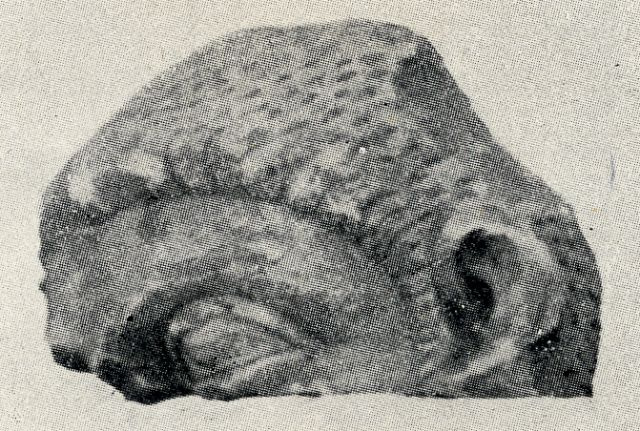
Fragmentary head of man (Tetrarch?) with short-cropped hair. Minturnae (Campania). Late third to early fourth century.
Record details
Photographs
Bibliography
- Adriani, A. 'Regione I (Latium et Campania). Minturno. Catalogo delle sculture trovate negli anni 1931-1933', Notizie degli scavi di antichità 16, Milan 1938, 220, no. 75, fig. 41(third c.)
Discussion
DESCRIPTION (Object)
Fragment of over life-size head. H: 13 cm. White marble.
The fragment preserves the left side of the brow, the left eye, and most of the left ear as well as some of the top and side of the head.
Short strokes of a large chisel are used to denote the hair; slightly finer strokes are used in the sideburn in front of the ear. A semicircular iris has been roughly engraved into the eyeball.
PROVENANCE:
Excavated on a street in November of 1931. Three similarly-re-worked heads were excavated between 1931 and 1932 at Minturnae; see LSA-1113 found in April 1932 south of the via Appia (of which there is no published photograph but which is described as similar to this one), LSA-1115 and LSA-1116, both found in late 1931.
DESCRIPTION:
The fragmentary head shows a mature man with short-cropped hair and probably a beard. The fringe over the brow falls in small but separate locks. The fringe follows a low arch across the brow.
DATE AND COMMENTARY
The rendering and fashion style place this head in the later third century.
Furthermore three heads of similar fashion and style were found at Minturnae: LSA-1113 , LSA-1115 and LSA-1116. LSA-1116 is particularly close not only in the pecked, flat-chisel, rendering of the beard and hair but also in the crude marking of the iris. A possible set of two or even four such heads suggests a monument to the Tetrarchs. Three statues for Tetrarchs (Constantius I, LSA-2037, Maximinus Daia, LSA-2580, and Severus, LSA-2581) are securely recorded as having been erected by colonia Mint(urnensium). Similarly-conceived and styled portraits in the same geographical zone, from Alba Fucens (LSA-1045, LSA-1046, LSA-1047, LSA-1048, LSA-1049 ) and Sperlonga (LSA-1043) , are also to be associated with the Tetrarchs.
Cite: Last Statues of Antiquity, LSA-1114 (J. Lenaghan).