
LSA-1115
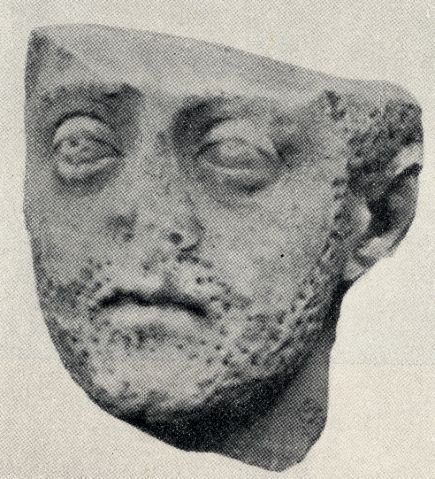
Head of man with short-hair and stubble beard, re-cut from Antonine portrait. Minturnae (Campania). Later third to early fourth century.
Record details
Photographs
Bibliography
- Adriani, A. 'Regione I (Latium et Campania). Minturno. Catalogo delle sculture trovate negli anni 1931-1933', Notizie degli scavi di antichità 16, Milan 1938, 220-221, no. 76, fig. 42
Discussion
DESCRIPTION (Object)
Life-size head. H: 19.5 cm. White marble.
The head is broken unevenly through the neck, preserving the left side and not the right side. The top of the head is missing from the level of the eyebrows. The nose is also missing.
The point of a chisel has been used to indicate short hair on both the raised cap on the head and in the area of the moustache and beard on the face. The pupils appear to be drilled but the irises are not clearly indicated.
The head has been re-cut from an earlier Antonine portrait (as the heavy upper eyelids indicate). Beard, moustache, and hair seem to have been taken down and then gone over with a point.
PROVENANCE:
From Excavation I in November of 1931. Three similarly-re-worked heads were excavated between 1931 and 1932 at Minturnae; see LSA-1113 found in April 1932 south of the via Appia (of which there is no published photograph but which is described as similar to this one), LSA-1114 and LSA-1116 , both found in late 1931.
DESCRIPTION:
The head shows a man with short hair and a short beard. Short combed forward locks seem to form the sideburns, and the beard appears to have been intended as stubble. He has heavy upper eyelids and no signs of age. The mouth has a downturned appearance because it follows the shape of the heavier moustache of the earlier portrait.
DATE AND COMMENTARY
The head has been cut down to show a man with a short beard and short hair. The re-cutting and use of the point of a chisel to indicate the beard suggest a late third century date.
Three heads of similar fashion and re-cutting were found at Minturnae: LSA-1113 , LSA-1115, and LSA-1116. Three statues of Tetrarchs (Constantius I, LSA-2037, Maximinus Daia, LSA-2580 and Severus, LSA-2581) are securely recorded as having been erected by colonia Mint(urnensium). Thus it is tempting to imagine a monument to the Tetrarchs.
Cite: Last Statues of Antiquity, LSA-1115 (J. Lenaghan).