
LSA-1116
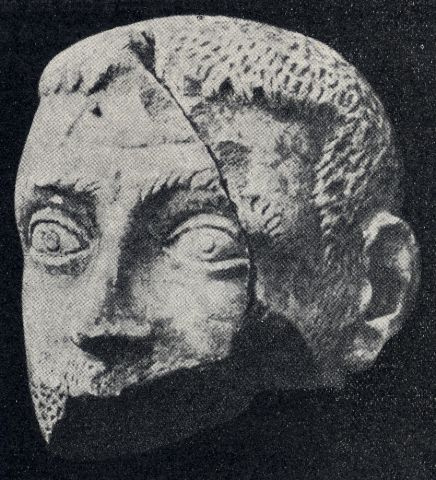
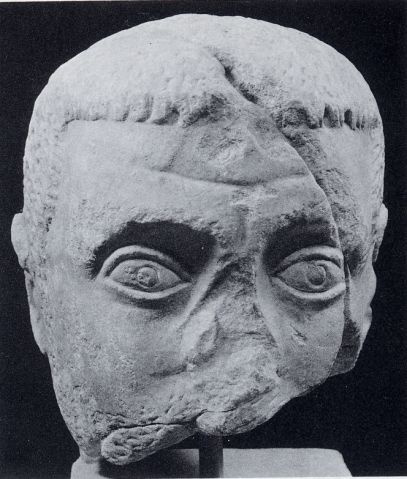
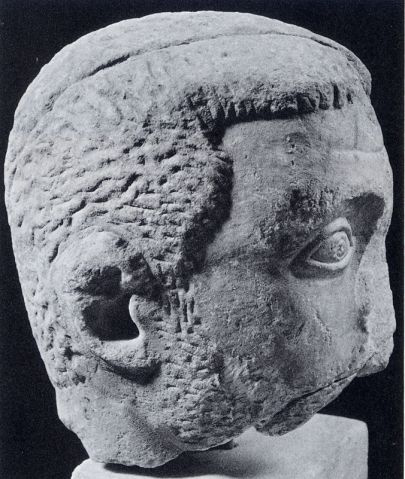
Portrait head of man (Tetrarch?) with short-cropped hair and stubble beard. From Minturnae. Late third to early fourth century.
Record details
Photographs
Bibliography
- Adriani, A. 'Regione I (Latium et Campania). Minturno. Catalogo delle sculture trovate negli anni 1931-1933', Notizie degli scavi di antichità 16, Milan 1938, 221-2, no. 77, fig. 43
- Comstock, M.B. and C.C.C. Vermeule, Sculpture in Stone. The Greek, Roman, and Etruscan Collections of the Museum of Fine Arts Boston, Boston 1976, 241, no. 378
Discussion
DESCRIPTION (Object)
Over life-size head. H: 24.7 cm. Fine-grained white (Vermeule, ‘Greek’) marble.
The head is preserved in two fragments; (1) the back left portion with the left side of the brow and left ear and (2) the face and back right side of the head . The nose, mouth, chin, and lower left cheek are missing. According to Vermeule, there is a hole in the back of the head, possibly to affix it to a wall.
The head has been re-cut from an earlier portrait. The earlier portrait had fuller hair which has been taken down roughly. A chisel has been used to denote the current hairstyle; it is used more carefully and in smaller strokes around the brow. The ears are disproportionately large, and the upper right ear, which originally had hair touching it, has been rounded out but remains awkwardly thick. The eyebrows and cheeks have been given hair by cutting into the extant surface of the original portrait with a flat chisel. A circular iris has been crudely engraved into the eyeball. A small point on the right side indicates the pupil. A deep furrow has been added across the brow.
PROVENANCE:
Excavated in cuniculum of via Appia in December of 1931.
DESCRIPTION:
The over life-size head shows a mature man with short hair and a short beard. The fringe over the brow falls in small separate locks which are triangular in shape. They recall the locks of Julio-Claudian fringes; for example those ofTiberius and Claudius. A similar fringe can be seen in another re-cut portrait from Rome (now Copenhagen, LSA-811).
The physiognomy does not seem individualized. The brow is tall and square which is probably that of the earlier portrait. There is a crease across the forehead.
DATE AND COMMENTARY
The inorganic style of representation and the short military hairstyle and beard place this head in the later third century. It bears obvious similarities to portraits of Tetrarchs (see LSA-523 and LSA-836. Vermeule identifies it as Maximian. The fifth century date proposed by Adriani in 1938 is unlikely.
Three similarly-re-worked heads were excavated between 1931 and 1932 at Minturnae; see LSA-1113 found in April 1932 south of the via Appia (of which there is no published photograph but which is described as similar to LSA-1114), LSA-1114 and LSA-1115 both found in November of 1931. All of these show men with short-cropped hairstyles and short beards. LSA-1114 is particularly close not only in the pecked, flat-chisel, rendering of the beard and hair but also in the crude marking of the iris. A set of four such heads suggests a possible monument to the Tetrarchs. Three statues of Tetrarchs (Constantius I, LSA-2037, Maximinus Daia, LSA-2580 and Severus, LSA-2581) ar securely recorded as having been erected by colonia Mint(urnensium). Similarly-conceived and styled portraits in the same geographical zone, from Alba Fucens (LSA-1045, LSA-1046, LSA-1047, LSA-1048, LSA-1049 ) and Sperlonga (LSA-1043) have also been associated with the Tetrarchs.
Discussion references
- L'Orange, H. P., Das spätantike Herrscherbild von Diokletian bis zu den Konstantin-Söhnen, 284-361 n. Chr. Das Römische Herrscherbild. III. Abteilung ; Bd. 4 , Berlin 1984, (Maximian)
Cite: Last Statues of Antiquity, LSA-1116 (J. Lenaghan).