
LSA-1118
Seated porphyry statue of Tetrarch. Šarkamen. Early fourth century.
Record details
Photographs
Bibliography
- Jankovic, D. 'Etudes des monuments de Vrelo Šarkamen', Starinar. Arheološki institut Beograd, 31, Belgrade 1980, 91-3, fig. 4, pl. 2
- Popović, I. (ed.), Šarkamen [Eastern Serbia]: A Tetrarchic Imperial Palace. The Imperial Complex, Belgrade 2005, 51-6, figs. 39-40
Discussion
DESCRIPTION (Object)
More than 300 fragments of seated statue. Estimated H: 160, W: 100, D: 80 cm. Porphyry.
The statue was deliberately smashed at an unknown time. Most of the fragments are small and from the interior of the statue;only a few are sizeable and/or with a worked surface.
PROVENANCE AND CURRENT LOCATION
The fragments have been recovered at different times starting in 1972; most in the area of the ‘building F’ ca 80 m west of the fortified imperial palace of Šarkamen (map in Popović 2007, 84 fig. 5), but others were found elsewhere scattered outside the Palace and Mausoleum.
A small square shaped building (ca 4.5 x 4.5 m) was excavated which surrounded a large square shaped pedestal (Popović 2007, 84 fig. 5G and 87 with fig. 7). In this room one fragment of the porphyry statue was found. The building, as the statue (and unlike the rest of the structures in Šarkamen), was deliberately destroyed; Popović therefore suggests that it hosted the statue and that the pedestal was the foundation of the statue base.
DESCRIPTION (Subject)
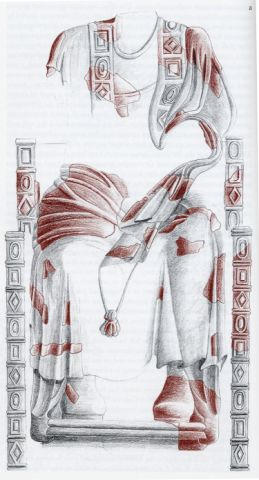
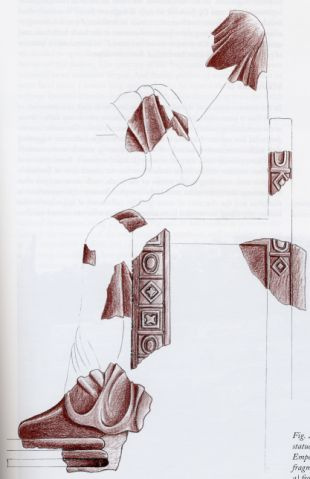
The statue clearly represented a male (a foot wearing a boot with a rounded and not pointed tip is preserved) who sat on a throne adorned with jewels. The throne is like that of the statue at Alexandria (LSA-1003).
A secure reconstruction from the few fragments with a worked surface is difficult. The statue had been reconstructed as an emperor in a tunica, long chlamys and jewelled belt (Jankovic 1980) in the way that Diocletian is represented on the Arch of Thessaloniki. The more recent reconstruction takes the statue at Alexandria (LSA-1003) as a model, but also supposes that there were trimmings of gold and jewels on parts of the robe itself, where they are not otherwise known. Evidently the fragments need further study.
HONORAND AND DATE
The date and name of the emperor represented in the statue depends on the interpretation of the whole complex, which is a double or a copy of the palace and mausolea of Romuliana/ Gamzigrad, a residence built by Galerius and named after his mother Romula. The complex of Šarkamen, which was never finished and never used (apart from the mausoleum) is usually connected with Maximinus Daia, son of Galerius’ sister, Caesar from 305 to 310, and Augustus from 310-313. The mausoleum with an adjacent cremation area (tumulus), as in Gamzigrad, is supposed to be the tomb of Galerius’sister.
Until now the only absolute dates have been gathered from a gold- and jewellery find in the mausoleum. Besides female jewellery of 3rd century types it contained votive gold leafs with the impressions of coins presumably from the mint of Nikomedeia in the years 293-300, well before Daia became Caesar (Popovic 2005, 59.82; Boric-Breskovic 2005, 83-93).
Discussion references
- Kent, J. P. C., Overbeck, B. & A. U. Stylow, Die römische Münze, München 1973
- Popović, I., Šarkamen – Eine Residenz und Begräbnisstätte aus der Zeit des Maximinus Daia, Brandl, U. & M. Vasić (eds.), Roms Erbe auf dem Balkan. Spätantike Kaiservillen und Stadtanlagen in Serbien,, 80-95, Mainz 2007
Cite: Last Statues of Antiquity, LSA-1118 (Marianne Bergmann with U. Gehn).