
LSA-112
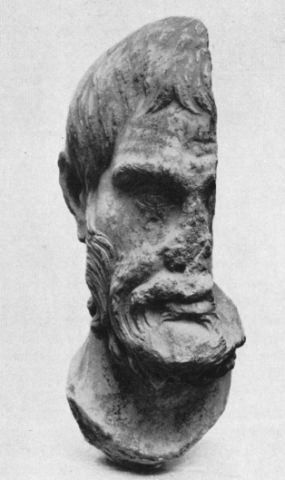
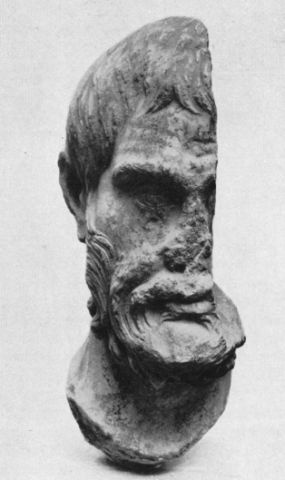
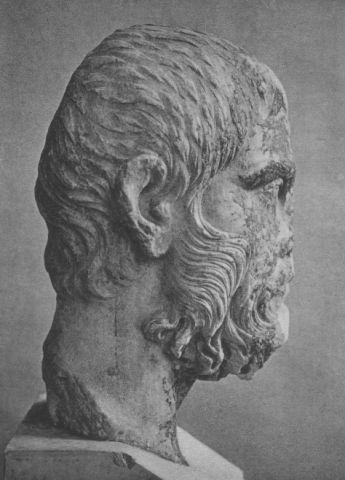
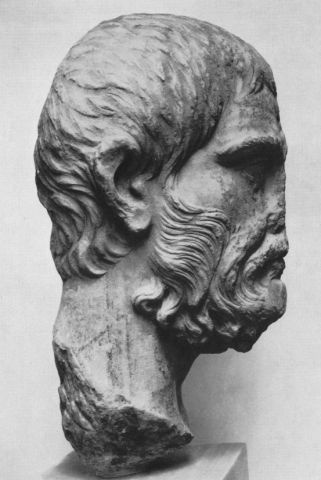
Fragment of portrait head of bearded man in 'Iamblichus-type'. Athens. Later third century.
Record details
Photographs
Bibliography
- L'Orange, H. P., Studien zur Geschichte des spätantiken Porträts, Oslo 1933, pp. 40-3, 125 no. 62
Discussion
DESCRIPTION (Object)
The head is worked for insertion, H 39 cm. The left side is broken off in a vertical line, leaving only the jaw bone. The nose is chipped off, the chin is flaked. There are chips on the moustache and right eye (eyebrow, pupil, and lower lid). The surface is mantled with traces of roots and sinter stains; it is, however, where not afflicted by the damages described, in a good state of preservation.
The hair is equally worked out on the front, sides and back. Single strands are divided by chisel-lines, broad and shallow on side(s) and back, narrower around the face. The long beard is indicated by parallel narrow, long, chisel strokes on the cheeks and around the mouth whereas under the chin it tapers off into spiral locks separated from each other and subdivided by short, broad and deeply cut drill channels.
The eyebrow is smoothly arched and rising to the outer side; it is marked by short, irregular chisel strokes. The iris is carved in the form of a segment of a circle; the horse-shoe shaped pupil is circumscribed by an incised line. The lower lid is horizontally subdivided by a thin chiselled line.
The forehead is furrowed by three horizontal groves paralleling the line of the eyebrows. In the middle of the forehead there is a plain area, possibly an ashlar or a measure point (see also below, 'Description (Subject)').
PROVENANCE AND CURRENT LOCATION
The head is today in the storerooms of the National Archaeological Museum in Athens, inv. no. 580. There is no published record of its provenance (unknown according to L'Orange 1975, 63)
DESCRIPTION (Subject)
The head represents an elderly man as is indicated by the long beard, the flabby cheeks, the wrinkled brow and the receding hair. His hair is arranged into short flamy strands. It is brushed forward; above the right eye two strands form a fork motif. The ears are uncovered. The heavy beard is brushed forward on the cheeks; there it is stopped by a bulge of flesh running from the nostrils to the jaw. Under the chin the beard tapers off into spiral locks.
Our head takes up a widespread fashion which can be observed also in Italy (see below, ‘Date’; on evidence from Italy see LSA-111). Apparently this fashion was en vogue notably in the broader region of Athens (our head, LSA-111, LSA-113, LSA-114, LSA-115, LSA-116, LSA-123); it was obviously considered an appropriate habit by the local and regional notables who were fit to be honoured with a portrait monument (see also LSA-116).
Our head belongs to a much discussed group of portraits first studied by Rodenwaldt 1919, then by L’Orange 1933, by Harrison 1953, then again by L'Orange 1975 and by Voutiras 1981 (see below, ‘Further Discussion’).
DATE
Rodenwaldt 1919 dated our head (and the entire group) to the end of the 4th century, allowing for 'some decades' of higher or lower dating. As to the honorands, he thought of Athenian intellectuals of that period, orators and philosophers of the neo-platonic school (Rodenwaldt 1919, 12-15).
L'Orange 1933, 40-4 assessed the group as developmental series from an Athenian workshop between the time of Gallienus and Constantine. Our head, so he argued, represented the Constantinian style of around 325 or immediately after ('konstantinischer Reichsstil'). L'Orange 1975 confirmed this approach.
Harrison 1953, 102 compared our head to the portraits of the so called 'brother-sarcophagus' in Naples which is conformingly dated to the late- or postgallienic era (Wrede,H., Senatorische Sarkophage Roms (Mainz 2001) 70-3 pl. 17,1; Koch-Sichtermann 102-3 fig. 101). She supported her early dating of the whole group to the 2nd half of the 3rd century with a head from the Athenian Agora, added to that group by her (Harrison 1953 cat. no. 49 and 101 no. IX; not in our database). The burned condition of the Agora head she attributed to the Herulian incursion of 267.
Harrisons early dating of the group was supported by v. Sydow 1969, 105-7 (our head is v. Sydow l. c. no. 8) and Voutiras 1981.
Coin portraits of the emperor Tacitus (275-6) show the same fashion beard and provide the best dating evidence for our head, in the 3rd quarter of the 3rd century (Delbrueck 1940 pl. 25, 1-12).
FURTHER DISCUSSION
The group of heads introduced above (‘Description (Subject)’) contains the following numbers of our database: LSA-79, LSA-110, LSA-111, LSA-112, LSA-113, LSA-114, LSA-115, LSA-116, LSA-894. Harrison 1953, 101 extended it by a further head, from the Athenian Agora (Harrison 1953 no 49 and 101 no. IX; not in our database). For a detailed account on the group and its consideration in scholarship see LSA-110, ‘Further Discussion’.
Discussion references
- Delbrueck, R., Die Münzbildnisse von Maximinus bis Carinus (Das römische Herrscherbild III. Abteilung Band 2), Berlin 1940
- Harrison, E. B., Portrait Sculpture: The Athenian Agora I, Princeton, N. J. 1953, pp. 101-5 no. III pl. 47 a
- Jones, A. H. M. et al., The Prosopography of the Later Roman Empire. Vol. I 260-395, Cambridge et al. 1971 (1975)
- Koch, G. & H. Sichtermann, Römische Sarkophage (Handbuch der Archäologie), München 1982, 102-3 fig. 101
- L'Orange, H. P., Some remarks on late Greek portraiture, especially regarding the Jamblichos type, Acta ad archaeologiam et artium historiam pertinentia, 6, 1975, 59-63, pp. 61-3 pl. X, XI a
- Rodenwaldt, G., Griechische Porträts aus dem Ausgang der Antike: 76. Programm zum Winckelmannsfeste der archäologischen Gesellschaft zu Berlin, Berlin 1919, p. 5 no. 3 pl. IV
- Von Sydow, W., Zur Kunstgeschichte des spätantike Porträts im 4. Jahrhundert. n. Chr, Bonn 1969
- Voutiras, E., Ein wiedergewonnenes attisches Porträt der Spätantike, Mitteilungen des Deutschen Archäologischen Instituts, Athenische Abteilung, 96 (1981)
- Wrede, H., Senatorische Sarkophage Roms: der Beitrag des Senatorenstandes zur römischen Kunst der hohen und späten Kaiserzeit, Mainz 2001, 70-3 pl. 17,1
Cite: Last Statues of Antiquity, LSA-112 (Ulrich Gehn).