
LSA-1120
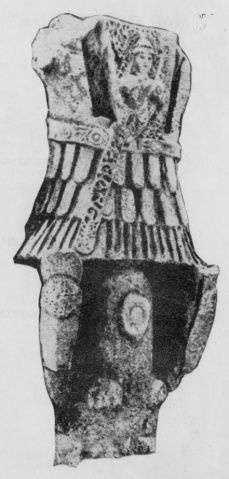
Dedication to Constantine I and Licinius on city gate, probably crowned with statue of a Trophy. Tropaea (Moesia Secunda); currently in the National History Museum, Bucarest. 315-317
Record details
Photographs
Inscription
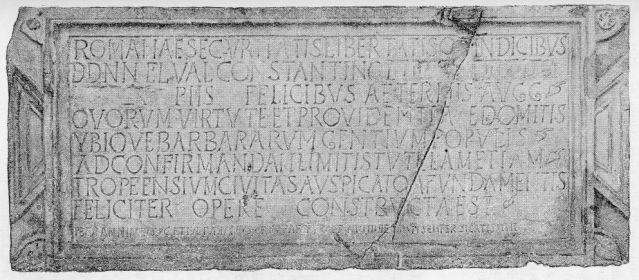
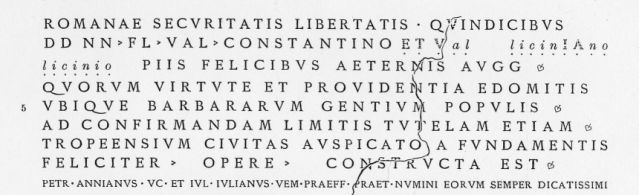
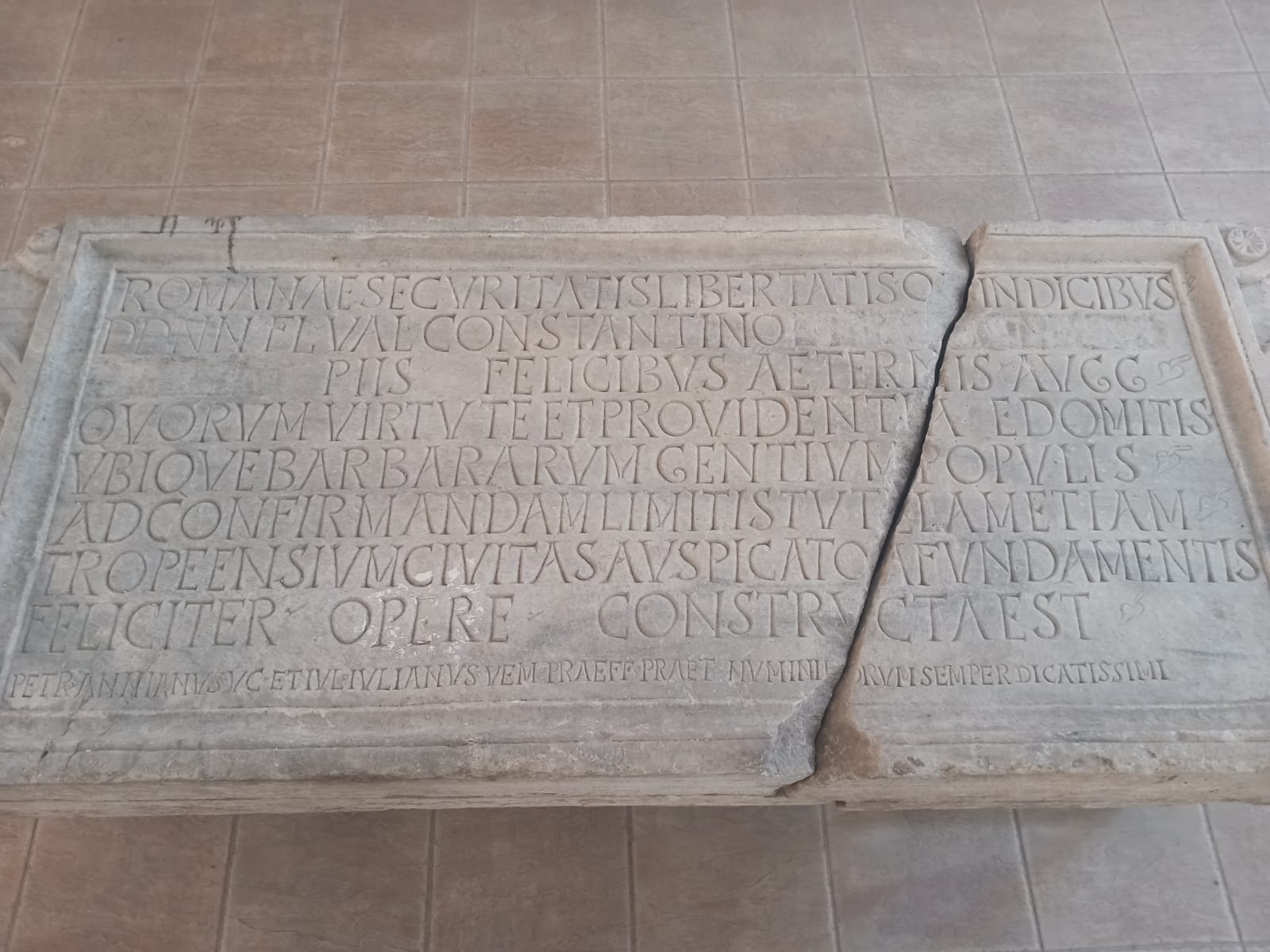
Romanae securitatis libertatisq(ue) vindicibus, / dd(ominis) nn(ostris) Fl(avio) Val(erio) Constantino [[et Val(erio) Liciniano / Licinio]], piis, felicibus, aeternis Augg(ustis), / quorum virtute et providentia edomitis / (5) ubique barbararum gentium populis, / ad confirmandam limitis tutelam etiam / Tropeensium civitas auspicato a fundamentis / feliciter opere constructa est. / (9) Petr(onius) Annianus, v(ir) c(larissimus), et Iul(ius) Iulianus, v(ir) em(inentissimus), praeff(ecti) praet(orio), numini eorum semper dicatissimi.
Inscription translation
To the defenders of Roman security and liberty, our Lords Flavius Valerius Constantinus and Valerius Licinianus Licinius, the pious, fortunate and eternal Augusti, by whose virtue and providence, having everywhere tamed the peoples of the barbarian tribes, in order to strengthen the defence of the border the city of the Tropaeans has also been fortified, by a work built auspiciously from the foundations. Petronius Annianus, of clarissimus rank, and Iulius Iulianus, of eminentissimus rank, praetorian prefects (set this up) always most devoted to their divine spirit
Bibliography
- Corpus Inscriptionum Latinarum; , III suppl. 2, 13734
- Popescu, E., Inscripțiile grecești și latine din secolele IV-XIII descoperite în România, Bucarest 1976, pp. 183-5 no. 170
Discussion
INSCRIPTION
In nine lines:
Romanae securitatis libertatisq(ue) vindicibus, / dd(ominis) nn(ostris) Fl(avio) Val(erio) Constantino [[et Val(erio) Liciniano / Licinio]], piis, felicibus, aeternis Augg(ustis), / quorum virtute et providentia, edomitis / (5) ubique barbararum gentium populis, / ad confirmandam limitis tutelam, etiam / Tropeensium civitas auspicato a fundamentis / feliciter opere constructa est. / (9) Petr(onius) Annianus, v(ir) c(larissimus), et Iul(ius) Iulianus, v(ir) em(inentissimus), praeff(ecti) praet(orio), numini eorum semper dicatissimi.
'To the defenders of Roman security and liberty, our lords Flavius Valerius Constantinus and Valerius Licinianus Licinius, pious, fortunate and eternal Augusti, by whose virtue and providence, having everywhere tamed the peoples of the barbarian tribes, in order to strengthen the defence of the frontier, the city of the Tropaeans has also been fortified, with work built auspiciously from the foundations. Petronius Annianus, of clarissimus rank, and Iulius Iulianus, of eminentissimus rank, praetorian prefects, always most devoted to their divine spirit [set this up].'
Letter height not recorded. The letters are classicising and very regular; they are much smaller in the last line (line 9), where the dedicators' names are recorded. In lines 2-3, the name of Licinius has been erased (after his defeat and death at the hands of Constantine in 324).
DESCRIPTION (from the published photo)
Rectangular plaque, broken, but completely preserved, except for some very minor damage; no measurements are given in the published accounts. The inscription is carved on a tabula ansata, the epigraphic field is cut back from the surface and framed by a double moulding. The spandrels are filled with decorative elements (rosettes and leaves).
A limestone statue of a trophy, 265 cm high, was found together with our inscription, and probably stood over the gate on which our inscription was set (Tocilescu 1894, 108). The trophy consists of a tree trunk, from which are suspended two greaves, a tunic, a cuirass and a sword belt (balteus). Tocilescu also mentions holes, presumably to attach metal shields and helmets (not visible on the published drawing). The breastplate of the cuirass is decorated with a helmeted bust in relief. The breastplate and the belt are also decorated with a pattern in cloisonnée-technique which was possibly once filled with coloured stones or glass. The crowning of the rebuilt gate with the statue of a trophy would not only celebrate Roman victory, but also echo the name of the settlement, 'Tropaea' (named after a famous victory monument erected by Trajan).
PROVENANCE AND LOCATION
Both the inscription and the trophy statue were found in 1893 during the excavations of the eastern gate of the city. Giacomo Presciuttini has kindly informed us (by email on 31/07/2024) that the inscription is currently in the Lapidarium of the National History Museum of Bucarest.
HONORANDS, AWARDERS, AND DATE
Of the two honorands, Constantine I was Augustus 306-337, and Licinius 308-324.
Iulius Iulianus was praetorian prefect in 315-24 (PLRE I, 478-9 Iulianus 35). His colleague Petronius Annianus was consul in 314 and praetorian prefect 315-17 (PLRE I, 68-9 Annianus 2). Annianus' period of office provides the most secure date for the inscription.
Since Constantine's sons, Constantine II and Crispus, and Licinius' son, Licinianus, who were all proclaimed Caesars in 317, are not mentioned in the inscription, it is possible that it was set up before 317.
Discussion references
- Canarache, V. & A. Radulescu, Adamclisis Cetatea (Muzeul de Arheologie Constanța), Constanța 1968, p. 14
- Jones, A. H. M. et al., The Prosopography of the Later Roman Empire. Vol. I 260-395, Cambridge et al. 1971 (1975)
- Topilescu, Gr. G., Neue Inschriften aus Rumänien, Archäologisch-epigraphische Mittheilungen aus Oesterreich-Ungarn XVII, 81-113, Wien 1894, pp.108-9
Cite: Last Statues of Antiquity, LSA-1120 (Ulrich Gehn).