
LSA-1121
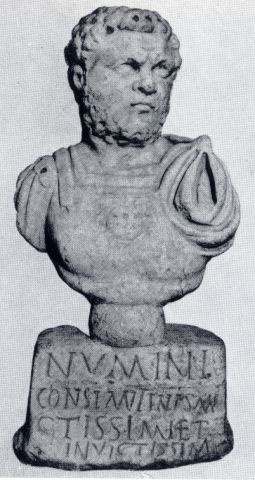
Portrait bust of Caracalla dedicated to Constantine. From Rusicade. Second quarter of fourth century.
Record details
Photographs
Inscription
Numini / Constantini san/ctissimi et / invictissimi
Inscription translation
To the divine spirit of the most sacred and invincible Constantine.
Bibliography
- Corpus Inscriptionum Latinarum; , VIII, 7974
- Blanck, H., Wiederverwendung alter Statuen als Ehrendenkmäler bei Griechen und Römern, Rome 1969, 26-7, no. A 1, pl. 4a
- Pflaum H.-G., Inscriptions latines de l'Algérie. 2, Inscriptions de la confédération cirtéenne, de Cuicul et de la tribu des Suburbures. [1, Rusicade et région de Rusicade, Cirta, Castellum celtianum, Caldis, Castellum tidditanorum], Paris, 1957, no. 25
Discussion
INSCRIPTION
In four lines:
Numini / Constantini san/ctissimi et / invictissimi
’To the divine spirit of the most sacred and invincible Constantine.’
Letter height 1 - 1.8 cm.
DESCRIPTION
Our inscription is carved onto the foot of a bust carrying a portrait of Caracalla (Augustus 211-17) dressed in cuirass (lorica) and military cloak (sagum); H 33, W 17 cm. Constantine’s name is carved over an erased name of that emperor (Antoninus; Caracalla’s full name was Marcus Aurelius Severus Antoninus). Remarkably the facial features of Caracalla were left untouched.
PROVENANCE AND CURRENT LOCATION
The inscription and the associated bust were found in a mithraic cave in Skikda (then Philippeville), the location of ancient Rusicade, in 1845 (Gsell 1898; Tantillo 2003, 1017).
The bust is now kept in the Lycée D. Luciani, or perhaps in the Skikda museum (without published inv. no.).
HONORAND, AWARDER AND DATE
The honorand is Constantine I, Augustus 306-37. The inscription addresses the emperor sanctissime invictissime, thereby invoking epithets of the god Sol (deus sanctus et invictus). Constantine’s veneration of that god can be traced in the numismatic evidence from 310, and is testified to by a panegyric of the same year (Salama 1998, 147-8); we have taken this as our terminus post quem. A possible terminus ante quem is 324 when the title of invictus/ invictissimus was replaced by victor in official inscriptions to Constantine. However, as Tantillo 2003, 1019-20 points out, the epithets were possibly considered appropriate in a location dedicated to the veneration of the god even at a time when a new nomenclature had to be obeyed in official inscriptions.
The awarder of the inscription is not stated.
FURTHER DISCUSSION
A doublet of our inscription is on record in Collo (LSA-1087).
Discussion references
- Dondin-Payre, M., Le buste de Caracalla/Constantin de Philippeville (Rusicade), Algérie, Un discours en images de la condamnation de mémoire (Benoist, S. and A. Daguet-Gagey, eds.), Metz 2008, 40-1
- Gsell, S., Musée de Philippeville, Paris 1898, 19 n. 1; 62-4 pl. IX, 5
- Salama, P. 'Les provinces d’Afrique et les débuts du monogramme constantinien', Bulletin de la Société nationale des antiquaires de France, Paris 1998, 147-8
- Tantillo, I. 'Riflessioni su Costantino e il sole', Mélanges de l'Ecole française de Rome. Antiquité. 115.2
, Rome 2003, 1015-22
Cite: Last Statues of Antiquity, LSA-1121 (Gabriel de Bruyn with Ulrich Gehn).