
LSA-1122
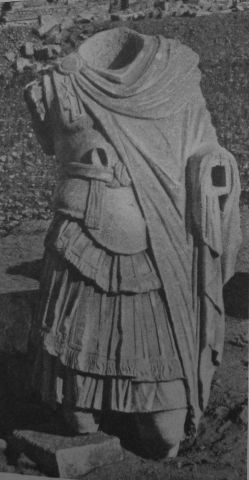
Cuirassed portrait statue of Constans or Constantius II, with LSA-739, 1123, 2079. From Ephesus. 340-350.
Record details
Photographs
Bibliography
- Heberdey, R. 'IX. Vorläufiger Bericht über die Grabungen in Ephesos 1907-1911', Jahreshefte des Österreichischen Archäologischen Institutes in Wien 15, Vienna 1912, Beibl. 177, fig. 137
Discussion
DESCRIPTION (Object)
Torso of an overlife-size cuirassed statue. H: 160 cm. Coarse-grained greyish white marble.
Broken underneath knees. Right shoulder with the beginning of the right upper arm and left arm without hand are preserved. Some minor damages here and there.
Deep neck-hole for insert the head. Back rough chiselled. Square dowel-hole in the left forearm for attaching the hand, also dowel-hole in the right upper arm to attach the arm.
PROVENANCE
Found at the Fontäne, on the Upper Agora in 1908. The torso was found together with LSA-1123. Inscription on the architrave (IK no. 1317) records that Caelius Montius restored for Constantius II and Constans. Two bases were set up in the balustrade of the nymphaeum ( LSA-739, LSA-2079).
DESCRIPTION (Subject)
Standing cuirassed statue. Weight over his right leg. Right arm is lifted, left arm holds the falling down military cloak the paludamentum. The paludamentum is fixed on the right shoulder and covers nearly the whole left side of the body.
No decoration of the cuirass is seen, he is wearing a belt, the cingulum. At the lower edge of the cuirass there are two rows of pteryges, underneath them tunica is visible above the knees.
DATE
Because of stylistical reasons the date of the torso ranges in Antonine time.
Heberdey was the first who assumed a reuse of the statue in Constantinian time, as Constantius II or Constans. Bieber assumes a date in Antonine time, for the late antique reuse she likes to put the heads of these two emperors in the statues (for the other one see LSA-1123) . Blanck assumed that both statues were originally made for Marc Aurel and Lucius Verus.
Discussion references
- Bauer, F. A., Stadt, Platz und Denkmal in der Spätantike, Mainz 1996, 292
- Blanck, H., Wiederverwendung alter Statuen als Ehrendenkmäler bei Griechen und Römern, Rome 1969, 37, no. A 11
Cite: Last Statues of Antiquity, LSA-1122 (J. Auinger).