
LSA-1123
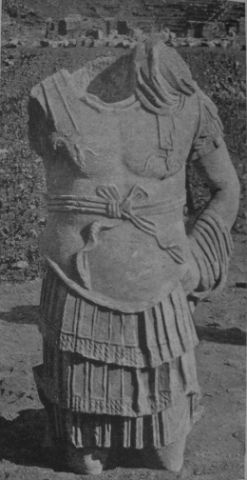
Cuirassed portrait statue of Constantius II or Constans, with LSA-739, 1123, 2079. From Ephesus. 340-350.
Record details
Photographs
Bibliography
- Heberdey, R. 'IX. Vorläufiger Bericht über die Grabungen in Ephesos 1907-1911', Jahreshefte des Österreichischen Archäologischen Institutes in Wien 15, Vienna 1912, Beibl. 177 Abb. 138
Discussion
DESCRIPTION (Object)
Torso of an overlife-size cuirassed statue. H: 134 cm. Coarse-grained greyish marble.
Broken above knees. Right arm and military cloak the paludamentum falling from left arm down are broken off. Whole surface corrode.
Deep neck-hole for insert the head. Back rough chiselled, tooth-chisel. Some deep folds worked with the drill. Square dowel-hole in the left forearm for attaching the hand, also dowel-hole in the right upper arm to attach the arm.
PROVENANCE
Found at the Fontäne, on the Upper Agora in 1908. The torso was found together with LSA-1122. Inscription on the architrave (IK no. 1317) records that Caelius Montius restored for Constantius II and Constans. Two bases were set up in the balustrade of the nymphaeum ( LSA-739, LSA-2079).
DESCRIPTION (Subject)
Cuirassed statue. Standing on his right leg, right arm is lifted, left arm holds the military cloak the <paludamentum>, hand on the hip. The <paludamentum> is lying on the left shoulder, leading at the back to the left arm.
No decoration of the cuirass is seen, he is wearing a belt, the <cingulum>. At the lower edge of the cuirass there are two rows of <pteryges>, underneath them <tunica> is visible above the knees.
DATE
Because of stylistical reasons the date of the torso ranges in antonine time.
Heberdey was the first who assumed a reuse of the statue in constantinian time, as Constantius II or Constans. Bieber assumes a date in antonine time, for the late antique reuse she likes to put the heads of these two emperors in the statues (for the other one see LSA-1123) . Blanck assumed that both statues were originally made for Marc Aurel and Lucius Verus.
Discussion references
- Bieber, M., Ancient Copies. Contributions to the History of Greek and Roman Art , New York 1977, 257
- Blanck, H., Wiederverwendung alter Statuen als Ehrendenkmäler bei Griechen und Römern, Rome 1969, no. A 12
- Cadario, M., La corazza di Alessandro : loricati di tipo ellenistico dal IV secolo a.C. al II d.C, Milan 2004, 394-5, pl. 52,1-2.
- Stemmer, K., Untersuchungen zur Typologie, Chronologie und Ikonographie der Panzerstatuen, Berlin 1978, 172 no. 192
Cite: Last Statues of Antiquity, LSA-1123 (J. Auinger).