
LSA-1125
Base for statue, with dedication to one or more emperors. Heraclea Perinthus (Europa). 293-324
Record details
Photographs
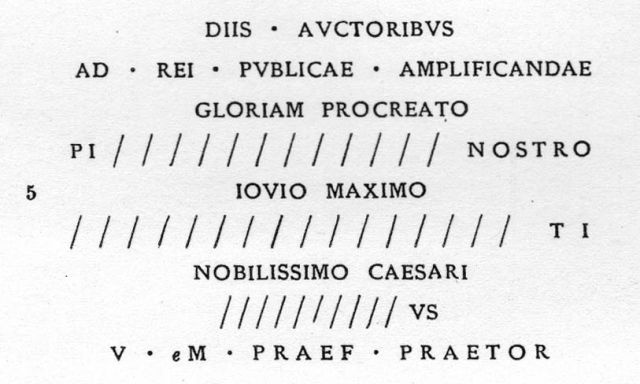
Inscription
Diis auctoribus / ad rei publicae amplificandae / gloriam procreato / pi [---] nostro / (5) Iovio Maximo / [----] ti / nobilissimo Caesari / [---]us / (8) v(ir) ẹm(inentissimus) praef(ectus) praetor(io).
Inscription translation
To him born by the will of the gods to the glory of the expanding commonwealth (rei publicae amplificandae), our Iovius Maximus ... most noble Caesar. ...us, of eminentissimus rank, praetorian prefect [set this up].
Bibliography
- Corpus Inscriptionum Latinarum; , III suppl. 2, 12326
Discussion
INSCRIPTION
In nine lines:
Diis auctoribus / ad rei publicae amplificandae / gloriam procreato / pi [---] nostro / (5) Iovio Maximo / [----] ti / nobilissimo Caesari / [---]us / (8) v(ir) ẹm(inentissimus) praef(ectus) praetor(io).
'To him born by the will of the gods to the glory of the expanding commonwealth (rei publicae amplificandae), our Iovius Maximus ... most noble Caesar. ...us, of eminentissimus rank, praetorian prefect [set this up].'
This is the version of the text published by CIL in 1902, following Dessau 1892, who proposed v(ir) em(inentissimus) in line 8, instead of v(irum) c(larissimae) m(emoriae) suggested by earlier editors. It is not clear whether the substantial recorded damage to the inscription was accidental, or deliberate as part of a process of damnatio memoriae.
DESCRIPTION
No description of the block and no measurements are given by CIL. It was almost certainly a statue base, since the wording of the dedication, with the honorand in the dative and the awarder in the nominative, follows the usual formula of Latin statue base inscriptions.
PROVENANCE AND CURRENT LOCATION
The block is said by CIL 1902 to have been extant in Perinthus ('Perinthi'). There is no published record of its present location.
HONORAND, AWARDER, AND DATE
The inscription was thought to be a dedication to two emperors, an Augustus and a Caesar, by Dessau (1962, no. 665). Dessau did not justify this assessment, but an argument to this effect can be constructed from the titles in the inscription. The dedication to a Caesar is explicit in line 6, but in line 4 the first two letters probably belong to the epithet pius which was reserved to Augusti (Kolb 1988, 85). The Augustus would then be a Iovius (line 5), hence Diocletian, Galerius, Maximinus Daia or Licinius. Maximinus Daia can be excluded since his time in office as an Augustus was not associated with a Caesar. However, against the argument for a double dedication, should be noted the singular form 'procreato (born)', in line 3, which refers to only one emperor.
The Caesar honoured by the inscription could be Galerius (Caesar 293-305), Maximinus Daia (Caesar 306-10), or Licinius' son Licinianus (Caesar 317-24), who were all entitled Iovius. However, although the imperial name is erased, two final letters, 'TI', apparently survive (in line 6), and these match none of the possible names.
Although the honorand, or honorands, are uncertain, this is certainly a dedication of the tetratchic period or early Constantinian period, 293-324. A secure terminus post quem of 293 is supplied by the reliable reference to a Caesar, while a terminus ante quem of 324 is given by the use of the name Iovius, which was never again used after Licinius' defeat in 324. The same terminus ante quem of 324 is also provided by the rank of the honorand. He was a praetorian prefect, stated to be of equestrian (eminentissimus) rank (line 8). The praetorian prefecture was an equestrian office throughout the tetrachy, but was elevated to clarissimus rank under Licinius in 324 (Chastagnol 1982, 169).
Discussion references
- Chastagnol, A., La carrière sénatoriale du Bas-Empire depuis Diocletien, Epigrafia e ordine senatorio, 1. Atti del Colloquio intenazionale AIEGL, Roma 14 - 20 maggio 1981, pp. 167-92, Roma 1982, p. 169
- Dessau, H., Inscriptiones latinae selectae, Berlin 3rd ed. 1962, no. 665
- Jones, A. H. M. et al., The Prosopography of the Later Roman Empire. Vol. I 260-395, Cambridge et al. 1971 (1975), p. 1003 Anonymus .........us
- Kolb, F., Diocletian und die erste Tetrarchie, Berlin - New York 1987
Cite: Last Statues of Antiquity, LSA-1125 (Ulrich Gehn).