
LSA-1128
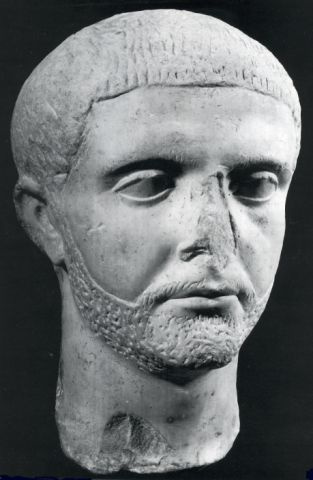
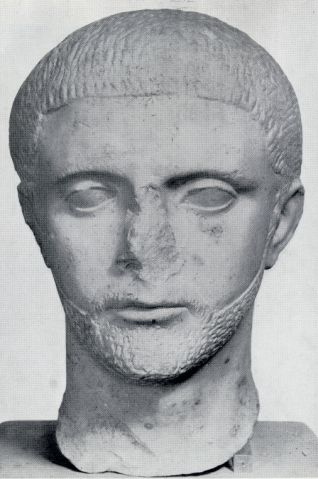
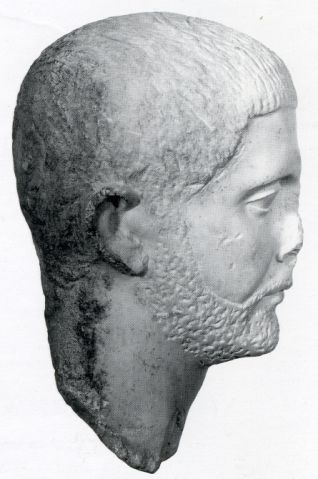
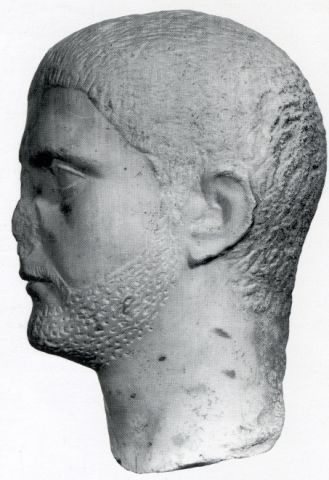
Re-cut portrait head of young man. From Tarentum. Late third to early fourth century.
Record details
Photographs
Bibliography
- Belli Pasqua, R. , Catalogo del Museo Nazionale Archeologico di Taranto. IV, 1 Taranto, La scultura in marmo e in pietra, Taranto 199?, 141-3, no. V 16
Discussion
DESCRIPTION (Object)
Over life-size head, separately worked. H: 30 cm. White marble.
The head is preserved with its neck which has only minor chips around the bottom edge. It seems most probable to this author that it has been re-used as a separately worked head.
The head has been re-cut from an earlier portrait. Traces of the original hair can be found behind the right ear. The original hair has been worked down to an even volume which has been, from the ears forward, engraved irregularly with a large flat chisel in order to represent short hair. The fringe hair has also been removed until an even horizontal line across the brow. The eyebrows have etched in with a fine chisel. The perimeter lines of the beard have been cut into the cheeks. The hair of the beard has been irregularly engraved but that of the moustache has been neatly incised in parallel curving lines. The eyes are unmarked.
PROVENANCE
No specific find location within Taranto is cited by R. Belli Pasqua.
DESCRIPTION (Subject)
The over life-size head portrays a young man with short hair and a short beard. Only the light moustache gives any sense of age. The hair is brushed forward and cut high across the brow. The face has a Julio-Claudian classicizing aspect. It has a broad flat brow, subtly modulated skin around the eyes, wide-set eyes, bow-shaped lips, and a slight overbite.
DATE
The lack of eye markings and the form of the eye and the hair behind the right ear indicate that this was originally a portrait of the first century AD. The current hairstyle and the clearly defined beard belong, in contrast, to the late third century or early fourth century. A head, now in Copenhagen, LSA-811 has been similarly re-worked from a Julio-Claudian portrait. Two portraits from Campania, LSA-1203 and LSA-2144 provide comparable examples of first century heads re-used in the late third- or early fourth-century with no alteration to the original eyes.
Discussion references
- Blanck, H., Wiederverwendung alter Statuen als Ehrendenkmäler bei Griechen und Römern, Rome 1969, no. A 29, pl. 19a
Cite: Last Statues of Antiquity, LSA-1128 (J. Lenaghan).