
LSA-113
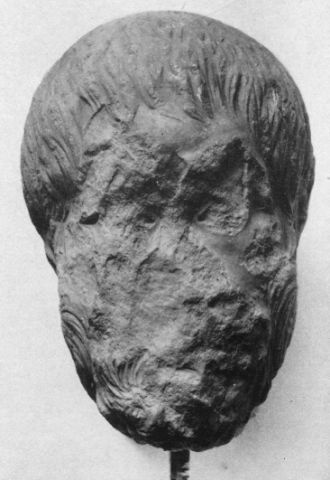
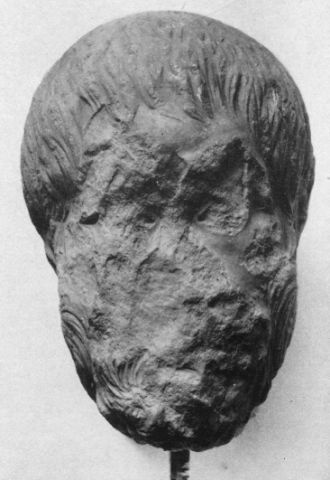
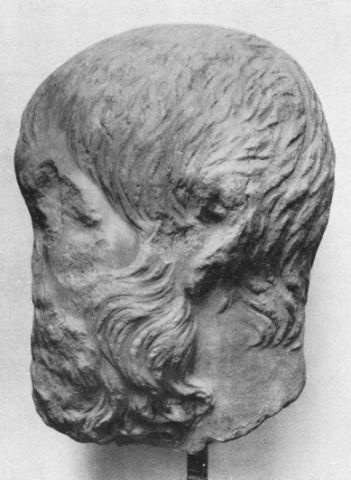
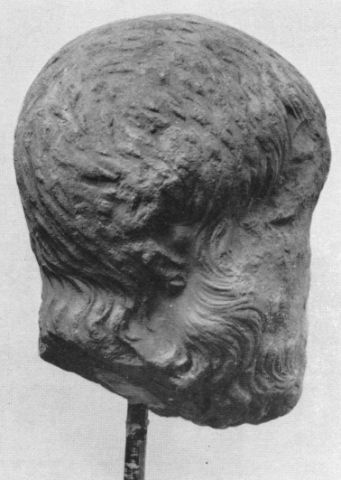
Portrait head of bearded man in 'Iamblichus-type'. Athens. Later third century.
Record details
Photographs
Bibliography
- L'Orange, H. P., Studien zur Geschichte des spätantiken Porträts, Oslo 1933, pp. 41-3 no. 11, p. 125 cat. no. 63
- L'Orange, H. P., Some remarks on late Greek portraiture, especially regarding the Jamblichos type, Acta ad archaeologiam et artium historiam pertinentia, 6, 1975, 59-63, p. 63 pl. XI b-d
- Rodenwaldt, G., Griechische Porträts aus dem Ausgang der Antike: 76. Programm zum Winckelmannsfeste der archäologischen Gesellschaft zu Berlin, Berlin 1919, p. 5 no. 4 fig. 1
Discussion
DESCRIPTION (Object)
Broken below the chin, H 31 cm. Pentelic marble (Rodenwaldt 1919, 5). According to Rodenwaldt 1919, there are remnants of a dowel hole (1,8 cm) with traces of lead at the bottom. The face is almost completely destroyed, apparently by deliberate violence. Eyes, nose, and mouth with left jaw are hacked off. The rims of both ears are chipped, just possibly from the same violent impact that destroyed the face. The original surface is preserved only in the inner ankle of the left eye, at the upper part of the brow, and on the left cheek. The hair is not affected by the violence that destroyed the face save only for the fringes which fall into the forehead. Minor chips are scattered on the extant surface.
The head is of a long oval shape, the upper part slightly protruding.
The hair is worked out on all sides. Single strands are separated from each other by broad, shallow chisel strokes. Above the brow, the strands are subdivided by thinner strokes. The chisel work remains on the surface, there is no drill work in the hair.
The beard is indicated by parallel narrow, long, chisel strokes on the cheeks, whereas under the chin it tapers off into spiral locks separated from each other and subdivided by drill work.
The surface was smoothly finished; on the forehead above the left eye a furrow, plastically rendered and sloping upwards from the root of the nose towards the temple, is preserved.
The inner ankle of the left eye is modelled in exactly the same way as LSA-112.
PROVENANCE AND CURRENT LOCATION
There is no published record of the head's provenance; however, it ist likely that it is from Athens or its environs. It is today in Athens, National Museum, store rooms, inv. no. 3411.
DESCRIPTION (Subject)
The portrayed is a mature man with lank hair and full beard. The hair is brushed forward and fringes out in the brow; the ear lobes are partly covered, and the hair grows into the neck.
The head belongs to a set of portraits, all from central and southern Greece, that have repeatedly been discussed as a group (see detailed accounts in LSA-110 and LSA-112). This group was associated with the neo-platonic philosopher Iamblichus of Apamea by L’Orange ((PLRE I, 450-1 Iamblichus 1; L’Orange 1933, 43; L’Orange 1975). L’Orange 1975 ascribed five heads to this man, our head (LSA-112, LSA-114, LSA-115 andLSA-894); our head is L'Oranges 'replica V' (L’Orange 1975, 63).
As L'Orange, Harrison 1953, 102-5 saw our head as one of at least five (probably six, and possibly seven) replicas of a head representing the same person; moreover, she thought that our head and LSA-112 were products of the same workshop. Her early dating, however, excludes Iamblichus as possible honorand (See below, 'Date'); Harrison, if cautiously, introduced the Athenian historian Publius Herennius Dexippus into the discussion (PLRE I, 250-1 P. Herennius Dexippus 2), a man who is testified to among other inscriptions in Athens in the last third of the 3rd century by a honorific title on a re-used statue-base (Harrison 1953, 104-5; IG II/III (2) 13262).
The head, in my opinion, most probably portraits a local notable (for a more detailed account see LSA-116).
DATE
Earlier scholarship ascribed various dates from the mid/later 3rd to the late 4th century to the head (and the entire group; for detailed account see LSA-112, ‘Date’). L'Orange 1933, 40-4 who assessed the group as a developmental series from an Athenian workshop between the time of Gallienus and Constantine, assigned our head to the Constantinian style of around 325 or immediately after ('konstantinischer Reichsstil'). This view was repeated and reinforced by L'Orange 1975. In more recent accounts, however, a date in the Gallienic or immediately post-Gallienic period, first proposed by Harrison 1953, seems to prevail (v. Sydow 1969; Voutiras 1981).
In my own view, the fashion beard displayed by most of the heads from the group indicates a date in the 3rd quarter of the 3rd century, by analogy also for our head.
FURTHER DISCUSSION
Of the so-called Iamblichus-group the following are recorded in our database: our head, LSA-79, LSA-110, LSA-111, LSA-112, LSA-114, LSA-115, LSA-116, LSA-894. Harrison 1953, 101 extended the group by a further head, from the Athenian Agora (Harrison 1953 no 49 and 101 no. IX; not in our database). For a detailed account on the group and its consideration in scholarship see LSA-110, ‘Further Discussion’.
Discussion references
- Harrison, E. B., Portrait Sculpture: The Athenian Agora I, Princeton, N. J. 1953, 101-105
- Jones, A. H. M. et al., The Prosopography of the Later Roman Empire. Vol. I 260-395, Cambridge et al. 1971 (1975)
- L'Orange, H. P., Some remarks on late Greek portraiture, especially regarding the Jamblichos type, Acta ad archaeologiam et artium historiam pertinentia, 6, 1975, 59-63, 63, pl. XI b-d 'replica V'
- Rodenwaldt, G. , Griechische Porträts aus dem Ausgang der Antike. Programm zum Winckelmannsfeste der archaeologischen Gesellschaft zu Berlin ; 76, Berlin 1919, 5-6 no. 4 fig. 1
- Sydow, W. von, Zur Kunstgeschichte des spätantike Porträts im 4. Jahrhundert. n. Chr, Bonn 1969, 105-7 no. 6
- Voutiras, E., Ein wiedergewonnenes attisches Porträt der Spätantike, Mitteilungen des Deutschen Archäologischen Instituts, Athenische Abteilung, 96 (1981)
Cite: Last Statues of Antiquity, LSA-113 (Ulrich Gehn).