
LSA-1130
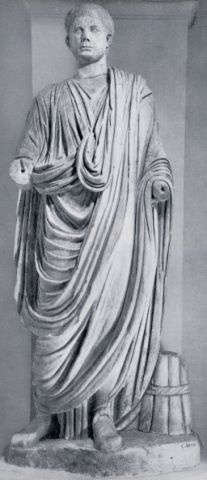
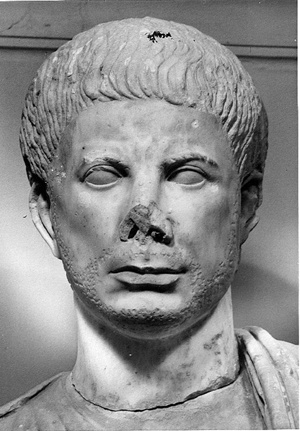
Togate portrait statue of governor (proconsul) of Africa, found with base (LSA-1184). From Bulla Regia (Africa proconsularis). Earlier to mid- fourth century.
Record details
Photographs
Bibliography
- Blanck, H., Wiederverwendung alter Statuen als Ehrendenkmäler bei Griechen und Römern, Rome 1969, 56, no. A 34, pl. 24
- Goette, H.R., Studien zu römischen Togadarstellungen, Mainz 1990, 49. 51. 130 no. B b 7 pl. 14, 3
Discussion
DESCRIPTION (Object)
The statue is preserved with portrait head and plinth, all worked from one block of marble. Both forearms are missing; they were both attached by round dowels. The head is broken at the base of the neck, but the break line shows that it is belonging with the statue. The surface is in an excellent state of preservation.
The heavy material of the toga veils the body; however, the folds follow the body’s movement. The folds have strong plastic values; in some parts of the garment deep long drill lines create strong contrasts of dark and light. The display of the garment and its relation to the underlying body puts the statue in line with works of the earlier to mid-2nd century, e. g. a statue in the theatre of Syracuse (Goette 1990 Bb 57 pl. 19, 5), the toga statues from the nymphaeum of Herodes Atticus in Olympia (Goette 1990, B b 106-8pl. 22, 4-6), or a toga statue from Apollonia in Tirana (Goette l. c. Bb 103 pl. 22, 3). The latter pieces of comparison show the umbo in the same characteristic elongated form as our statue does (on this feature see Goette l. c. 51 who characterizes it as a fashion of the mid-2nd century).
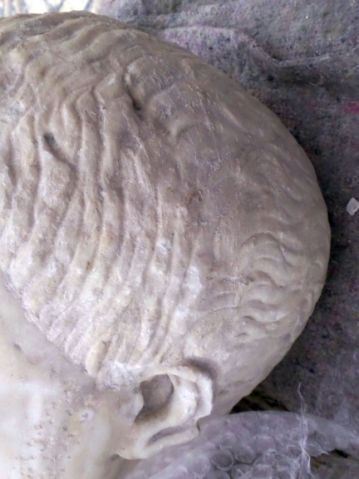
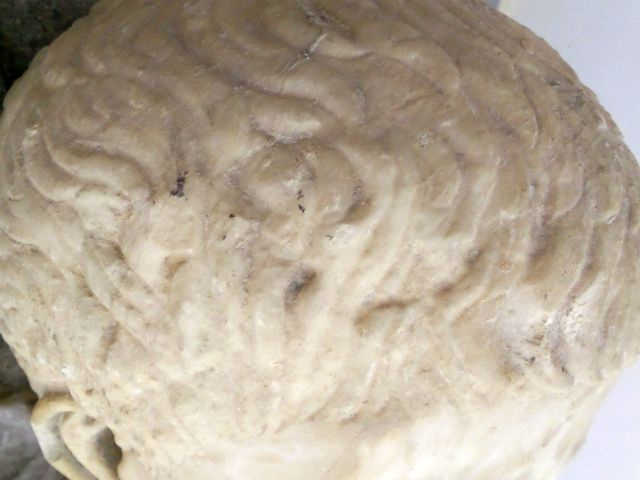
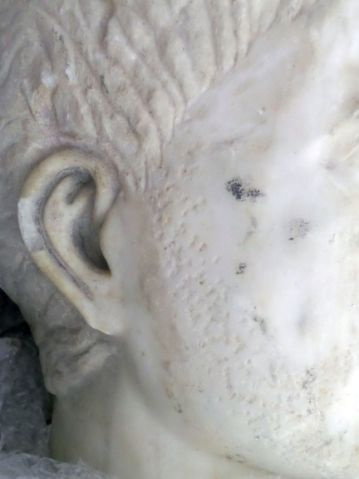
The head belongs to the original statue but was reworked in late antiquity (see also below, ‘Date’). A stubble beard was picked directly into the smooth flesh of the original portrait. The original hairstyle was changed into a 4th-century hairstyle as is evidenced by some drill lines on the skull which are not motivated by the present hairstyle. However, this rework must have been executed by a skilled sculptor. The eyes are without drillings and were left untouched by the rework. This suggests a date of the original portrait in the earlier 2nd century.
PROVENANCE AND CURRENT LOCATION
The statue was found in 1907, in the courtyard of the Temple of Apollo at Bulla Regia. It was fallen from a base in the West portico, in front of third column from north (LSA-1184). The head was detached and was lying some metres apart from the statue (Merlin 1908).
Head and statue are today in Tunis, Bardo museum, inv. no. C 1019.
DESCRIPTION (Subject)
The portrayed is wearing a toga in the old-fashioned, early imperial style with umbo. At his left foot there is a bundle of scrolls which are held by a broad rope. The shoes are clad in strapped boots (calcei) indicating the senatorial rank of the portrayed.
He is standing over his left leg; both arms are angled and were held forward. The head is only slightly turned to the right.
The man wears a short, forward brushed hairstyle; the hair is arranged into short, wavy strands. He has a picked stubble beard which signals the restless toils of the office-holder. The inscribed base on which the statue once stood informs us that he was a senatorial governor (proconsul) of the province of Africa.
DATE
The picked beard was in fashion for office holders from the late 3rd through the 4th century. The hairstyle with the forward brushed short wavy strands resembles the portrait of Constantine on his arch in Rome (312/15); such hairstyles can still be found in the mid-4th century.
The wreath-hairstyle fashionable among office holders of the time of Theodosius I (379-95) provides a rough terminus ante quem for our portrait head. This is supported by the old fashioned toga which was in use in the earlier and mid-4th century but was replaced by the new type toga in the Theodosian period (Gehn 2012, 128-32; 137-9; 320; 389-98 cat. no. O 22.)
Discussion references
- Gehn, U., Ehrenstatuen in der Spätantike. Chlamydati und Togati, Wiesbaden 2012
- Merlin, A., Le temple d'Apollon à Bulla Regia, Paris 1908
Cite: Last Statues of Antiquity, LSA-1130 (Ulrich Gehn).