
LSA-1132
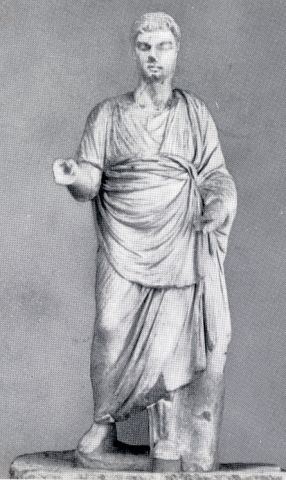
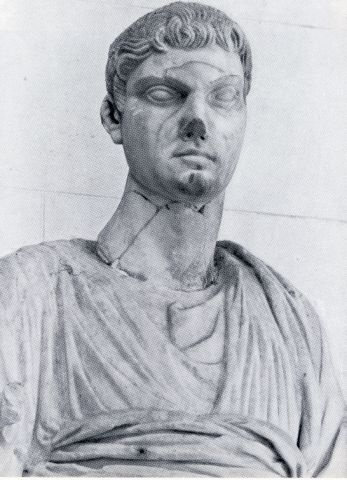
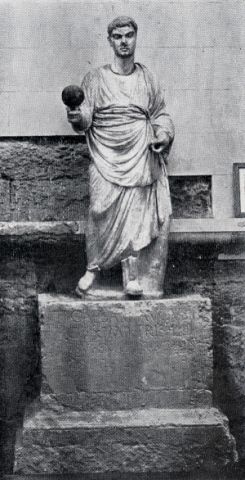
Portrait statue of man in toga re-cut from female statue. From Cyrene (Claudiopolis). Fourth or fifth century.
Record details
Photographs
Bibliography
- Catani, E. 'Statue marmoree rilavorate da Cirene', Scritti di antichità in memoria di Sandro Stucchi (Studi Miscellanei 29), 37-50, Rome 1996, 41-2, no. II, fig. 2
- Stucchi, S. 'La statua dello Strategheion di Cirene', Archeologia Classica 12, Rome 1960, 71-90, pls. 23-34
Discussion
DESCRIPTION (Object)
Over life-size statue. H: 203; D: 36 cm. White marble of two types (head and forearms, and body) and bronze (the orb).
The statue is composed of four separately worked pieces of marble: (1) the body from plinth to neck, (2) the right arm from below the biceps; (3) the left forearm and hand; and (4) the neck and head. A bronze globe with a protruding dowel was probably held in the left hand and a bronze sceptre or staff in the right arm.
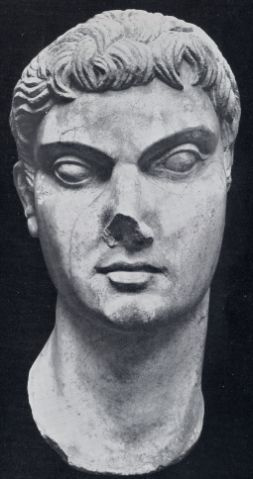
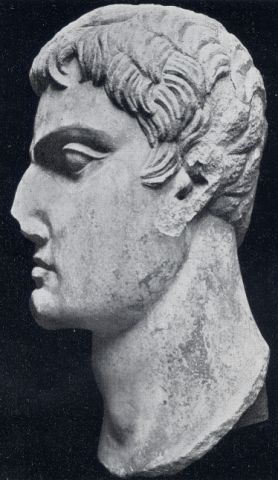
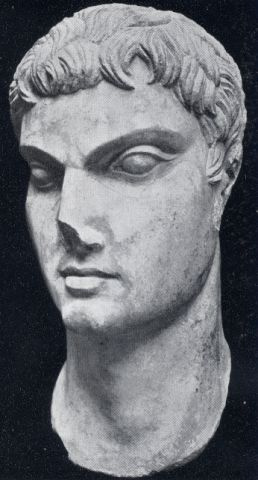
The statue body (1) is well-preserved but has been made from a pre-existing female statue. The arms (2 and 3) have lost most of the fingers in a fall after their discovery in 1929. The statue was mounted on the base, and the base collapsed. The head (4) is missing the tip of the nose and the shell of the left ear. The bronze sceptre is lost
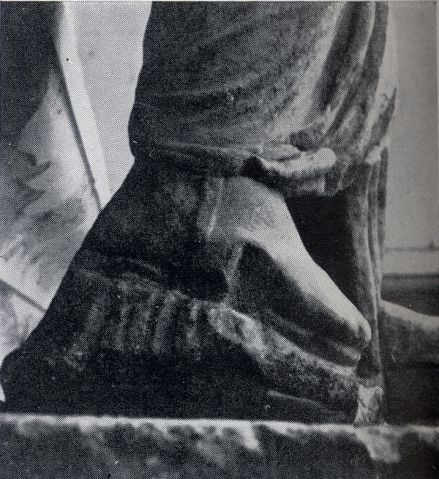
The statue body has signs of re-cutting over the chest area and around the feet which were once engulfed in a chiton. The closed shoe of the left foot has been entirely made from the chiton: this is visible both on the outside and at the back of the foot. The formerly filled area between the right foot and the left leg has been removed. The folds of a chiton over the left leg have been transformed into brachae (Stucchi) or simply a misplaced lacinia (see for example the similarly transformed statue of Marcus Aurelius from Cyrene, LSA-1133). The folds of the chiton outside of the left leg have been transformed into a statue support. The original folds of the chiton are visible behind this support. The back of the statue is flatly worked and was never intended to be seen. Stucchi (1960, p. 74) believes that several centimetres of depth have been removed from the back of the statue in the re-working.
Both arms have been purposefully cut down to fit into this statue. The drapery in both of these areas has been adjusted to accomodate the new arms. The head for insertion has also signs of re-carving. The back of the head is only roughly carved and lacks depth. This contrasts with the hair on the top of the head where locks have been sketched but without internal definition and with the hair at the brow which is carefully and fully worked. It is difficult from photographs to assess what can be ascribed to the original portrait and what is the result of secondary working. According to Stucchi (1960, p. 80), the back of the head and nape are part of the secondary reduction. The eyebrows have been enlarged by removing areas beneath them and by adjusting the upper eyelid. The area below the eye seems to have been cut back which creates a prominent eyebal. The lower face seems also to have been narrowed.
PROVENANCE:
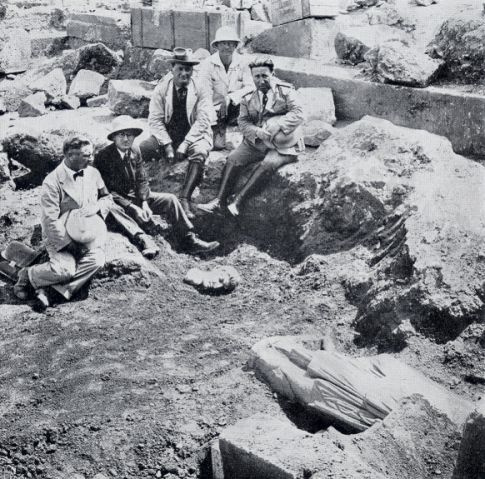
The headless statue and the head were found in front of a base for Tiberius (dedicated by Sufenas Proculus and dated between 4 and 14 AD) in the sacellum of the strategoi (rededicated by Sufenas Proculus between 4 and 14 AD) in the Sanctuary of Apollo at Cyrene in 1929. The only other object found in the sacellum was a bronze globe with a dowel. The sacellum seems to have been destroyed in the fourth century, probably in the earthquake of 362.
DESCRIPTION (Subject)
The statue is a composite that was carefully worked to represent a clean-shaven man in a toga and tunic and the strapped shoes of a senator. He furthermore held a bronze orb which acccording to Polacco was in the right hand with the dowel facing downward between the fingers or more probably, according to Stucchi, rested in the left hand with the dowel facing upwards for a winged victory. In the other hand, the statue probably held a staff or sceptre.
The figure has an unusual aspect because the body was adapted from a female statue, and the head re-cut from a Julio-Claudian portrait. Thus, the late antique toga does not conform to standard definition, and the footwear is also odd. No straps are visible at the front of the feet but on the outside of each foot falls the end of the tie of a strap--the corrigiae of the 'senatorial' footwear. There is however no doubt about the intent of the representation.
The head is disproportionate both to the body (it is too large) and in terms of its own physiognomy. The eyes are unusually large, the back of the head small, and the lower face receding. The locks over the brow seem to be dictated by the portrait which was adapted to create this one, possibly a portrait of Tiberius or even Augustus. The separately worked arms are also slightly too large for the body and were clearly taken from another statue.
HONORAND:
The statue was found in the Strategeum and probably stood on a base originally inscribed for Tiberius. The base however featured stucco rendering on its proper left side and was probably entirely covered with stucco; this would have obscured any reference to Tiberius. Moreover, its size and its position against the back wall, which would would have prevented a rear view of the statue, make it highly likely to have been the base used for the composite statue (contra Rosenbaum who suggests a smaller element in the centre of the room). The only other elements in the room were the arms and the bronze orb held in one hand.
The re-cutting of head and body indicates a second use which can be probably dated by the context to after the middle of the fourth century AD. The orb demonstates that this was a portrait of an Emperor. The head lacks a diadem but this would have to have been made separately since the head is re-used from a Julio-Claudian portrait.
Discussion references
- Blanck, H., Wiederverwendung alter Statuen als Ehrendenkmäler bei Griechen und Römern, Rome 1969, 37-41, pl. 10
- Polacco, L., Il volto di Tiberio. Saggio di critica iconografica, Rome 1955, 49-56, pls. 4-6
- Rosenbaum, E., A Catalogue of Cyrenaican Portrait Sculpture, London 1960, 43-4 no. 17, pl. 15.3-4 (not Tiberius)
- Stucchi, S., Cirene 1957-1966 : un decennio di attività della missione archeologica italiana a Cirene , Tripoli 1967, 139-42, figs. 144-6 (re-use of Tiberius, Honorius?)
Cite: Last Statues of Antiquity, LSA-1132 (J. Lenaghan).