
LSA-1133
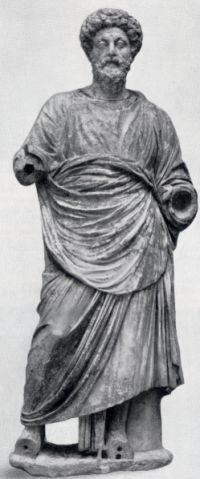
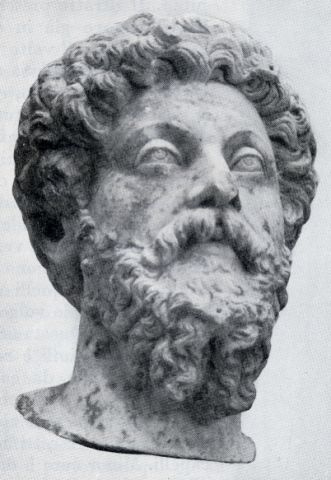
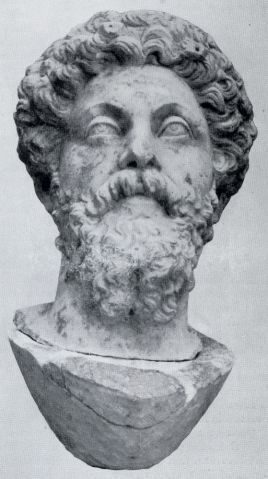
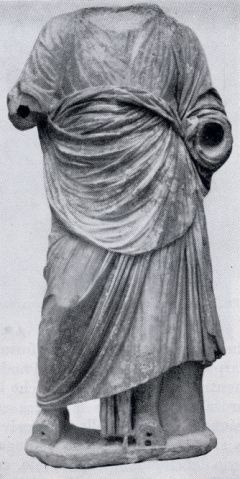
Portrait statue made from re-cut female statue and head of Marcus Aurelius. From Cyrene. Later fourth century.
Record details
Photographs
Bibliography
- Catani, E. 'Statue marmoree rilavorate da Cirene', Scritti di antichità in memoria di Sandro Stucchi (Studi Miscellanei 29), 37-50, Rome 1996, 42-3, no. III, fig. 3
- Stucchi, S., Cirene 1957-1966 : un decennio di attività della missione archeologica italiana a Cirene , Tripoli 1967, 130-138, figs.123-141
- Stucchi, S., L'Agorà di Cirene (Monografie di archeologia libica, 7), Rome 1965, 316, pl. 56 figs. 3-4
Discussion
DESCRIPTION (Object)
Over life-size statue made of three separate pieces: (1) head, (2) plug for neck, and (3) body.
Head
The head is well-preserved with its neck and an edge of drapery on the right side of the neck. Only the tip of the nose is missing. There is a dowel hole in the under surface of the neck.
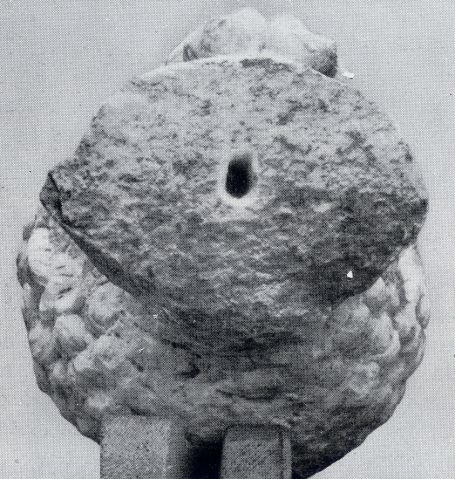
The top of the head is worked flat. This is invisible to a viewer in front of the statue and may have been part of the original working of the statue. Stucchi (1967, p. 135), however, suggests that breaklines in the area may show that it was a damaged section which was removed for the second use. The back and sides of the head have not been as carefully worked as the front. There are two holes in the hair over the brow (above each eye) and one hole in the beard at the chin which seem to be measuring points.
Socket
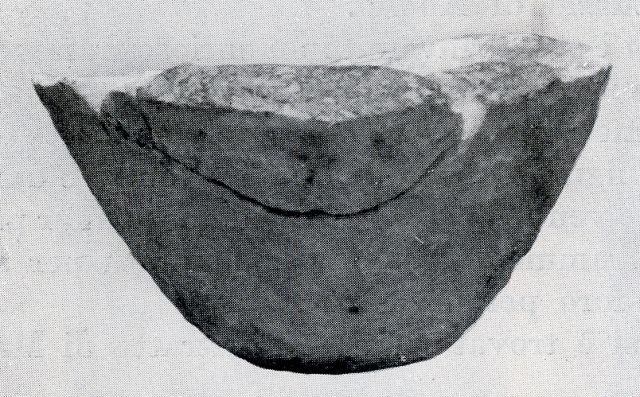
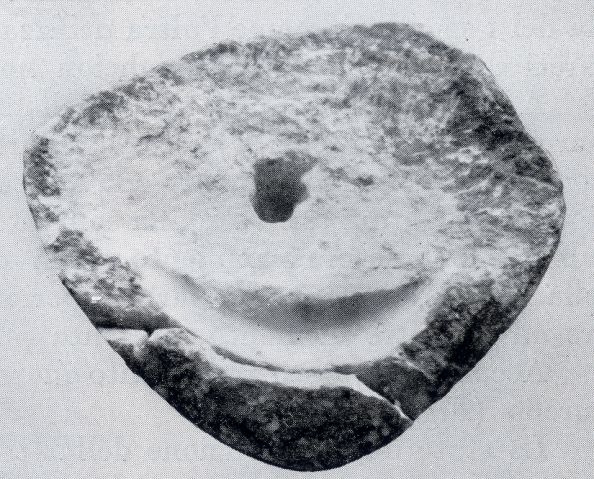
A small fragment has chipped at the upper front edge of the plug (2). The fragment is however preserved and has been reattached. The lower area is worked as a tenon for insertion. The upper surface has a rim at the front. The edge of the rim and the area at its base are worked smoothly. Behind this however the surface is evenly but roughly finished. In the centre of this roughly finished area is a dowel hole.
Body
The statue body is well preserved. It lacks the separately worked forearms and forepart of both feet
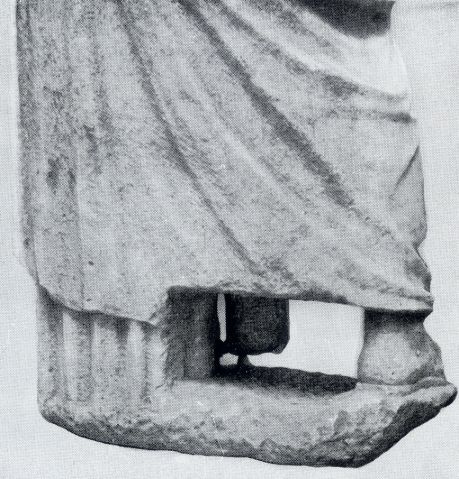
A large socket has been cut into body around the neckline of the inner garment (once a chiton, now a tunic). The chest area has been cut down. The area between the bottom edge of the toga and the feet, from the inside of the right foot to the lacinia on the inside of the left foot, has been cut away at a second moment. The bottom edge of the lacinia has been separated from the plinth also by secondary drilling. The area outside the left foot, once an area of vertical folds of the chiton, has been worked back into a smooth statue support. The chiton folds around the left shin have also been taken back into the form of the leg.
PROVENANCE
Found in 1963 inside a building which was originally constructed in the late second or early first century BC as a monumental covering for the well. In the imperial period it was turned into a cult room for the Emperors, and in late antiquity it served as an Audience Hall for magistrates. It lay on the western corner of the north side of the Agora. The body (3) was found first, face down in an open ditch, in the northwest sector of the building. The ditch had been made at the beginning of the fifth century when the area was occupied by a private dwelling. The socket (2) was found near the shoulders of the statue, and then next to it was found the head (3). After the earthquake of 365 the hall was made into a magisterial audience hall, and by the beginning of the fifth century it had become a private house.
DESCRIPTION (Subject)
The togate statue has been made of three separate elements: a portrait of Marcus Aurelius probably from a bust, a female statue probably from a portrait statue of the first century AD, and a plug element to connect the head and body. The find context places this statue in the second half of the fourth century. Since the head of Marcus has not been adjusted, one assumes that it was intended to maintain its original identity.
The head is a type 4 portrait of Marcus Aurelius created when he became sole ruler in AD 169. It preserves an edge of drapery around the right side which is probably the remains of a paludamentum. Marcus was most commonly depicted wearing military dress, a cuirass and paludamentum, in both statue and bust form. The head seems only to have been altered so as to fit it into the plug element. A dowel has been drilled through the base of the neck so that a dowel can be used to connect it to the plug which was then fit into the socket in the statue.
The statue body has undergone considerable alterations to transform it from a female statue into an acceptable male togate statue. These consist of the creation of a deep socket at the neck, a flattening of the chest area, and most importantly a reworking of the feet and chiton area. The original chiton, which touched the plinth and surrounded the feet, has been drilled away from the right foot to the inside of the left foot. A portion of the chiton has been left near the left foot, though its bottom edge has been cut away from the plinth; it has become a lacinia. The chiton over the left shin has been taken back and shaped into a leg, and the folds outside the left have been taken back and made into a smooth cylindrical shape, almost a capsa statue support. The back of the statue support retains the original folds of the chiton. The original feet probably wore closed shoes which would have been inappropriate for the togate emperor. The front parts of the feet have therefore been added separately, and straps (the corrigae of the calcei) have been engraved over the feet.
The plug has also been carefully worked to fit the head of Marcus and the statue body. It was worked down to receive the head and was dowelled to it; the two together were fitted into the body. It was probably not made ex novo but created from an existing element that belonged neither with the head nor the body.
HONORAND
The honorand seems to be Marcus Aurelius. The statue should represent a restoration of an extant statue for that Emperor.
Cite: Last Statues of Antiquity, LSA-1133 (J. Lenaghan).