
LSA-1135
Lost base for statue of Constantius II, emperor. Celeia (Noricum Mediterraneum). 324-337
Record details
Photographs
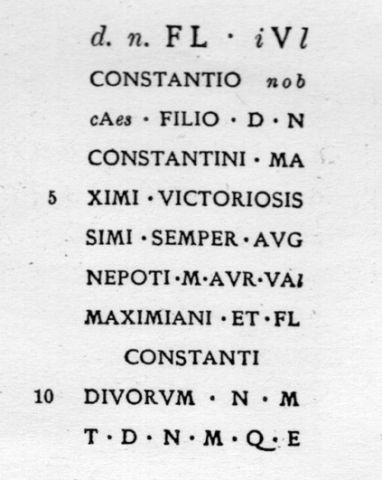
Inscription
D(omino) n(ostro) Fl(avio) Iul(io) / Constantio nob(ilissimo) / Caes(ari), filio d(omini) n(ostri) / (4) Constantini, ma/ximi victoriosis/simi semper Aug(usti), / nepoti M(arci) Aur(eli) Val(eri) / Maximiani et Fl(avi) / Constanti / (10) divorum. N(orici) M(edi)/t(erranei), d(evoti) n(umini) m(aiestati)q(ue) e(orum).
Inscription translation
To our Lord Flavius Iulius Constantius the most noble Caesar, son of our Lord Constantinus the most powerful and most victorious eternal Augustus, grandson of the deified Marcus Aurelius Valerius Maximianus and Flavius Constantius. The inhabitants of Noricum Mediterraneum (set this up), devoted to their divine spirit and majesty
Bibliography
- Corpus Inscriptionum Latinarum; , III, 2, 5208
Discussion
INSCRIPTION
In eleven lines:
D(omino) n(ostro) Fl(avio) Iul(io) / Constantio nob(ilissimo) / Caes(ari), filio d(omini) n(ostri) / (4) Constantini, ma/ximi victoriosis/simi semper Aug(usti), / nepoti M(arci) Aur(eli) Val(eri) / Maximiani et Fl(avi) / Constanti / (10) divorum. N(orici) M(edi)/t(erranei), d(evoti) n(umini) m(aiestati)q(ue) e(orum).
'To our lord Flavius Iulius Constantius the most noble Caesar, son of our lord Constantinus, the greatest and most victorious, forever Augustus, grandson of the deified Marcus Aurelius Valerius Maximianus and Flavius Constantius. The inhabitants of Noricum Mediterraneum, devoted to their divine spirit and majesty, [set this up].'
Letter height not recorded.
DESCRIPTION
No description and no measurements are given by CIL. No published image.
PROVENANCE AND LOCATION
The base was found in 1840 in Celje, ancient Celeia, close to the post-office; shortly afterwards it was taken to a stonecutter and destroyed ('paulo post ad lapicidam delata periit').
HONORAND AND DATE
The honorand, Flavius Iulius Constantius (Constantius II), one of Constantine's sons, was Caesar 324-37 (subsequently Augustus, 337-61).
The statue was set up by the Norici Mediterranei, the inhabitants of the province of Noricum Mediterraneum; it was presumably ordered by the provincial council.
The date of our inscription is provided by Constantius' title of Caesar, 324-37.
FURTHER DISCUSSION
Another base is known from Celeia with an almost identical dedication, but for Constantine II (LSA-1127). The presence in the city of two very similar bases, to two of the sons of Constantine I as Caesars, strongly suggests that a group of four bases was set up here by the Norici - to all three Caesars, and to the Augustus himself, Constantine I.
Cite: Last Statues of Antiquity, LSA-1135 (Ulrich Gehn).