
LSA-114
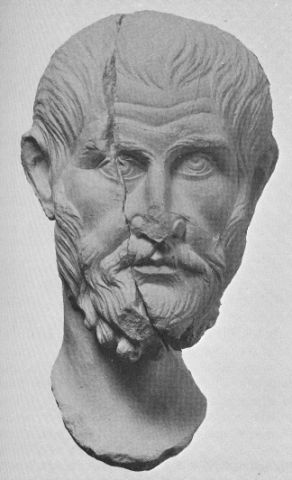
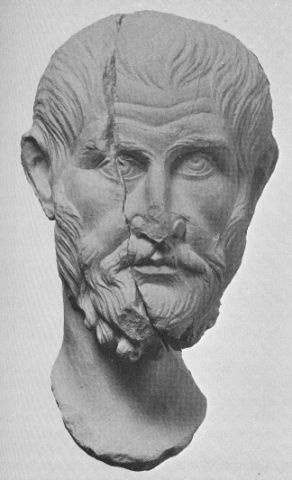
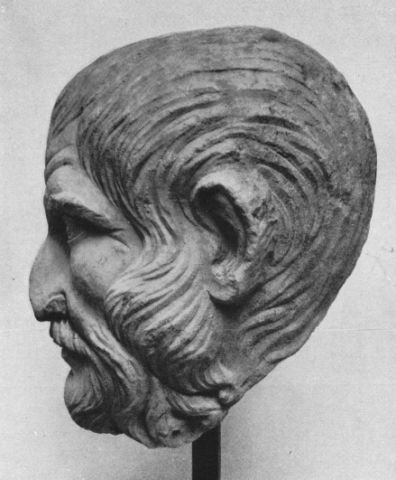
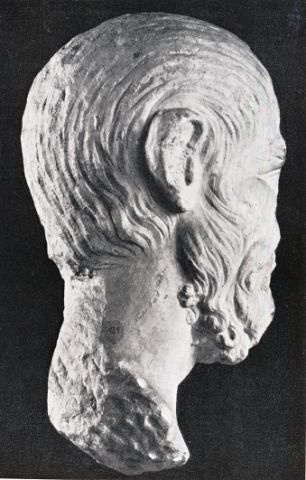
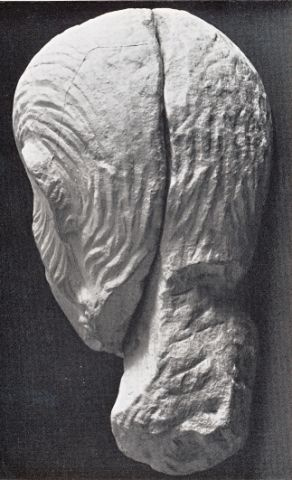
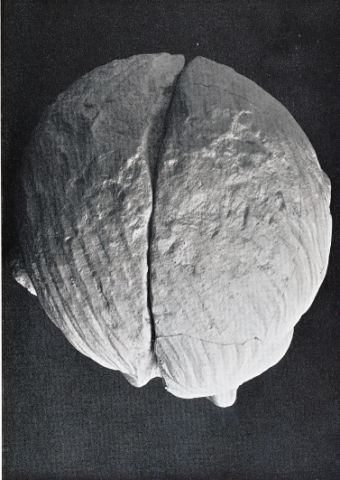
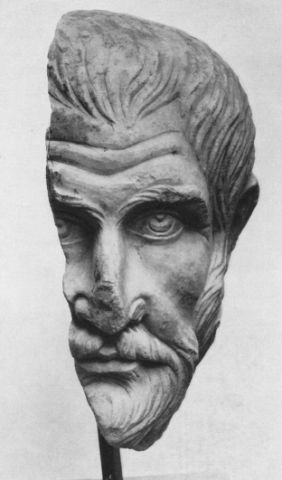
Portrait head (in two, separate pieces), of bearded man in 'Iamblichus-type. Athens. Later third century.
Record details
Photographs
Bibliography
- L'Orange, H. P., Studien zur Geschichte des spätantiken Porträts, Oslo 1933, pp. 41-3, 125-6 no. 64
- L'Orange, H. P., Some remarks on late Greek portraiture, especially regarding the Jamblichos type, Acta ad archaeologiam et artium historiam pertinentia, 6, 1975, 59-63, pp. 62-3 pl. VIII c, IX
- Voutiras, E., Ein wiedergewonnenes attisches Porträt der Spätantike, Mitteilungen des Deutschen Archäologischen Instituts, Athenische Abteilung, 96 (1981)
Discussion
DESCRIPTON (Object)
Marble portrait head (pentelic according to Rodenwaldt 1919, followed by L'Orange 1933, L'Orange 1975, Voutiras 1981), worked for insertion; H 41, W (right side fragment) 18.5, D (right side fragment) 24 cm. The head is broken into two pieces by a crack separating the right third of the head together with the largest part of the neck from the centre and left side of the face. The two pieces are being kept in two museums and were brought together by Voutiras 1981 (see below, 'Provenance and Current Location'). The crack has caused a deep jag on the forehead and right eyebrow. The tips of nose and chin are chipped, minor chips on the edge of the neck, the shells of the ears, and on the left eyebrow. The part of the neck below the left jaw-bone is missing. The back-side of the neck has been worked back with a point, certainly for a secondary use. The extant surface is in a remarkably good state of preservation.
The lank hair is indicated by long chisel-lines. These lines run parallel from forehead to neck and they are concentrically arranged around the ears; there is no apex. At the temples, the hair merges seamlessly into the beard. The long beard is given in the same technique on cheeks and chin. Under the chin, spiral locks are separated from each other with a drill; the end of each lock is marked by a round drill hole.
The hairy eyebrows are marked by chisel lines, similar to the beard. They overarch the eyes in regular flat vaults. The upper lid is separated from the orbital by a thin drill-line. The iris is circumscribed by a semi-circular incised line. The pupil is standing proud against the upper lid and is marked out against the iris by a broad, shallow drill-line.
The structure of the face is made up by a taut system of parallel lines which divide the face into well-defined geometrical areas. Hairline and eyebrows circumscribe the forehead almost as a parallelogram; the parallelism is amplified by the two furs on the forehead which follow the line of the brows. The inflated nostrils are accompanied by deep semi-circular folds.
The cheeks and the area around the mouth are vigorously modelled.
PROVENANCE AND CURRENT LOCATION
The (proper) left part of the head was found in the 1870s (probably during the campaign of the Archaeological Hetairia 1876/7) at the southern slope of the Acropolis in the area of the so-called Serpentzé-wall, a byzantine fortification wall of the 11th century (Voutiras 1981, 202 n. 7). It is today in the store rooms of the National Museum in Athens, inv. no. 581.
The right portion of the head with the neck is recorded in the 1967 catalogue of antiquities from the Musée Rodin (Rodin Collecteur, Paris 1967 no. 186). It is today in the Musée Rodin in Paris, inv. no. 121.
DESCRIPTION (Subject)
The head represents an elderly man with lank hair and long beard. His hair is brushed forward into the brow concealing that it recedes at the temples. Above the centre of the brow the strands gather into a triangular shape. His long beard is growing forward on the cheeks, and falls down vertically from mouth and chin. Under the chin it tapers out into spiral locks.
A similar fashion beard is displayed by other heads from the region (our head, LSA-111, LSA-112, LSA-113, LSA-115, LSA-116, LSA-123; see also LSA-894); apparently it follows a fashion that was widespread and is observable also in Italy (on evidence from Italy see LSA-111). Our head is similar in the arrangement of the beard on the cheeks notably to LSA-115 and LSA-112; it is possible that these three heads represent the same man.
L'Orange 1933, 43 argued that our head was the portrait of a neo-platonic philosopher. L’Orange 1957 assigned our head to the philosopher Iamblichus of Apamea (PLRE I, 450-1 Iamblichus 1). The author affirmed this hypothesis in L’Orange 1975; our head is L'Orange 1975 ‘replica III’ (for the other replicas see LSA-112, LSA-113, LSA-115, LSA-894).
Voutiras 1981 who united the two portions of the head (see above, ‘Description (Object)’) dedicated a detailed study to it. According to the date proposed by him (see below, ‘Date’), he suggested that the portrayed was possibly the Athenian historian Publius Herennius Dexippus (PLRE I, 250-1 P. Herennius Dexippus 2); a honorific base inscription for Dexippus is preserved in Athens (IG II/III 3669 = IG II/III(2) XXXX) (see also below, 'Further Discussion').
In my view, the portrayed is most probably a local notable (for more detailed account see LSA; LSA-116).
DATE
L’Orange 1975, 63 dated our head to the early 4th century (see also below, ‘Further Discussion’).
Voutiras 1981 conceded that our head displayed stylistic features that were traditionally associated with the Constantinian period of ca. 320/5, according to the framework by L’Orange 1933; most notably the ornamental way in which hair and beard are sketched out (Voutiras 1981, 205-6). However, taking up an argument advanced by v. Sydow 1969, Voutiras argued that such stylistic properties were observable in Greece as early as in the late Gallienic period (late 260s) (Voutiras l. c. 206).
Coin portraits of the emperor Tacitus (275-6) show the same fashion beard and provide the best dating evidence for our head, in the 3rd quarter of the 3rd century (Delbrueck 1940 pl. 25, 1-12). A similar fashion beard is displayed by the male portrait on the so-called Annona-sarcophagus in Rome that is unanimously dated to the 3rd quarter of the 3rd century (Wrede 2001, 70-3 pl. 17,1; Koch & Sichtermann 1982, 102-3 fig. 101). As Voutiras 1981, 207 points out, a later 3rd century head in the Athens National Museum (inv. No. 344) is comparable to our head in the way hair and beard is designed ornamentally; the head in question has been related to the emperor Claudius II Gothicus (268-70) by Balty & Balty 1976 and by Bergmann 1977.
On balance, a date in the 3rd quarter of the 3rd century appears most probable for our head.
FURTHER DISCUSSION
For the different proposals on the dating of the so-called ‘Iamblichus-type’ (see above, ‘Description (Subject)’) see LSA-111. For a more detailed discussion of the identifications proposed (see above, 'Description (Subject)', see LSA--.
Identification of the portrait type with Publius Herennius Dexippus was already, if cautiously, proposed by Harrison 1953, 104-5. However, Harrison maintained that Dexippus was possibly portrayed by five heads of the group which she considered to be replicas (LSA-79>k>, LSA-112, LSA-113, LSA-115, LSA-894); our head was not assigned to that person by her. On the other hand, Voutiras 1981 suggested that only two heads of the group were replicas and hence representend the same man, the Corinthian head LSA-79>k>, and the Athenian head LSA-112; in consequence, according to Voutiras both these heads can not represent Dexippus.
Discussion references
- Inscriptiones Graecae, II/III(2)
- Balty, J. & J. Ch. Balty, Notes d'iconographie romaine, II, Römische Mitteilungen 83, 1976, 175-93, 180-2 pl. 50.1, 51.2, 54.1
- Bergmann, M., Studien zum römischen Porträt des 3. Jahrhunderts n. Chr., Bonn 1977, 158 with n. 639 pl. 47.3-4
- Delbrueck, R., Die Münzbildnisse von Maximinus bis Carinus (Das römische Herrscherbild III. Abteilung Band 2), Berlin 1940
- Jones, A. H. M. et al., The Prosopography of the Later Roman Empire. Vol. I 260-395, Cambridge et al. 1971 (1975)
- Koch, G. & H. Sichtermann, Römische Sarkophage (Handbuch der Archäologie), München 1982, 102-3 fig. 101
- Von Sydow, W., Zur Kunstgeschichte des spätantike Porträts im 4. Jahrhundert. n. Chr, Bonn 1969, 106
- Wrede, H., Senatorische Sarkophage Roms: der Beitrag des Senatorenstandes zur römischen Kunst der hohen und späten Kaiserzeit, Mainz 2001, 70-3 pl. 17,1
Cite: Last Statues of Antiquity, LSA-114 (Ulrich Gehn).