
LSA-1143
Dedication to Constans, emperor, probably for statue. Probably from Salona (Dalmatia). 337-350
Record details
Photographs

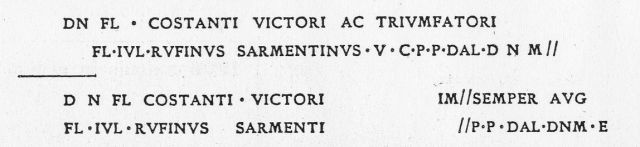
Inscription
D(omino) n(ostro) Constanti, victori ac triumfatori, semper Augusto. / Fl(avius) Iul(ius) Rufinus Sarmentius, v(ir) c(larissimus), p(raeses) p(rovinciae) Dal(matiae), d(evotus) n(umini) m(aiestatique) e(ius).
Inscription translation
To our lord Constans, victor and triumphant, forever Augustus. Flavius Iulius Rufinus Sarmentius, of clarissimus rank, governor (praeses) of the province of Dalmatia, devoted to his divine spirit and majesty, [set this up].
Bibliography
- Corpus Inscriptionum Latinarum; , III 1982
- Bulic, F., Inscriptiones quae in C. R. Museo Archaeologico Salonitano Spalati asservantur, Split 1886, 39 no. 92
- Gauthier, N., Marin, E., and F. Prévot (eds.), Salona IV. Inscriptions de Salone chrétienne IVe-VIIe siècles, Rome-Split 2010, 148-51 no. 6
Discussion
INSCRIPTION
In two lines:
D(omino) n(ostro) Constanti, victori ac triumfatori, semper Augusto, / Fl(avius) Iul(ius) Rufinus Sarmentius, v(ir) c(larissimus), p(raeses) p(rovinciae) Dal(matiae), d(evotus) n(umini) m(aiestatique) e(ius).
'To our lord Constans, victor and triumphant, forever Augustus. Flavius Iulius Rufinus Sarmentius, of clarissimus rank, governor (praeses) of the province of Dalmatia, devoted to his divine spirit and majesty, [set this up].'
Letter height 6 cm.
DESCRIPTION (from CIL III, Bulic 1886, and Gauthier et al. 2010)
Limestone block broken into three pieces; H 44, W 140, D 27.5 cm. On the top face there are two holes and a cast channel (possibly dowel holes), and two clamp holes; on the bottom face there is another hole. The epigraphic field is confined at the bottom by two slightly projecting flat bands. On the right side a wreath is carved, on the left side a bucranium.
The wording of the inscription - with the honorand in the dative, the awarder in the nominative, and a standard closing formula - displays all the features of Latin statue-base inscriptions. However, the block on which it is carved is short in height and long in width, not the normal shape for a statue base. It is, however, likely that a statue did stand above it, perhaps within an architectural setting like an arch. All three imperial dedications that Sarmentius set up in Salona (see below 'Honorand, Awarder, and Date') are seemingly of the same type.
PROVENANCE AND LOCATION
Part I of the inscription (the left end) was seen in a private house in Split by Mommsen before 1873 (in aedibus Parac n. 114, for CIL III) and is recorded in the Split Museum by Bulic in 1886, inv. no. 92. Part III (the right end), together with part I, were seen in the same house by Antonius Steinbuechel, one of the sources for CIL III, in the earlier 19th century. Another source for CIL III, Iohannes Iosephus Paulovich-Lucich, recorded the inscription in the late-18th/early-19th century in a more complete version, and, probably erroneously, ascribed it to the Garagnin collection in Trogir (cf. CIL III 1982). Whether it was originally set up within Diocletian's palace at Split (where it was found), or in nearby Salona (from which much building material later travelled to Split) cannot be ascertained. A location in public, and hence in the town of Salona (not within the palace at Split), is more probable.
It is now in the Split Archaeological Museum, inv. no. 92.
HONORAND, AWARDER, AND DATE
The honorand, Constans, the youngest son of Constantine I, was Augustus 337-50. He was granted Italy, Illyricum and Africa when, on Constantine's death, the empire was divided among his three surviving sons.
The awarder, Flavius Iulius Rufinus Sarmentius, governor (praeses) of the province of Dalmatia, is also known from four other inscriptions in Dalmatia (PLRE I, 804 Sarmentius). In Salona (or Split), he set up further dedications, of very similar form to ours, both to Constantius II (LSA-1136, LSA-1144). The formula of one of these is identical to that used for our inscription to Constans (LSA-1144); the other is only slightly different (LSA-1136) . He also set up a dedication to Constans at Riditae, up the coast from Salona (LSA-1481), and features on a mutilated stone, without imperial name, from Senia (CIL III 14333).
This dedication, to Constans as Augustus (337-50), provides the closest available dating for the governorship of Sarmentius, and therefore for all his inscriptions.
Discussion references
- Jones, A. H. M. et al., The Prosopography of the Later Roman Empire. Vol. I 260-395, Cambridge et al. 1971 (1975), 804
Cite: Last Statues of Antiquity, LSA-1143 (Ulrich Gehn).