
LSA-1145
Base for statue of Constans, emperor. Salona (Dalmatia). 333-337
Record details
Photographs
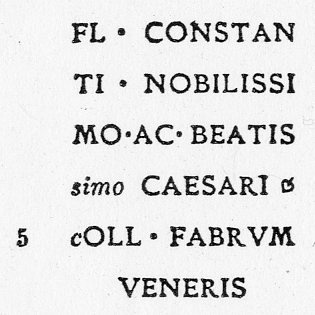
Inscription
Fl(avio) Constan/ti, nobilissi/mo ac beatis/simo Caesari, / coll(egium) fabrum / Veneris.
Inscription translation
To Flavius Constans, the most noble and blessed Caesar. The college of the carpenters [and] of Venus [set this up].
Bibliography
- Corpus Inscriptionum Latinarum; , III 1981
- Gauthier, N., Marin, E., and F. Prévot (eds.), Salona IV. Inscriptions de Salone chrétienne IVe-VIIe siècles, Rome-Split 2010, 145-6 no. 4
Discussion
INSCRIPTION
In six lines:
Fl(avio) Constan/ti, nobilissi/mo ac beatis/simo Caesari, / coll(egium) fabrum / Veneris.
'To Flavius Constans, the most noble and blessed Caesar. The college of the carpenters [and] of Venus [set this up].'
Letter height not recorded.
DESCRIPTION
No description or measurements of the block are given by CIL. However the apparent shape of the block and the formula of the inscription together strongly suggest that this was a statue base. There is no published photo.
PROVENANCE AND LOCATION
CIL refers to one source which saw the block in Split, and another one that recorded it in Trogir (ancient Tragurium). It is most likely to have been originally set up in Salona, very close to Split (to which much building material from Salona migrated during the Middle Ages). Salona, as the capital of Dalmatia, is the most plausible site for a college of carpenters in the 4th century.
There is no published record of its present location.
HONORAND, AWARDER, AND DATE
The honorand, Flavius Constans, the youngest son of Constantine I, was Caesar 333-7.
The awarder was a professional college, probably of the city of Salona. Dedications by such bodies are known from Rome, where they are made to high-ranking officials with responsibility for the economy of the city, like the urban prefect. The dedication of an honorific monument to an emperor by such a body, furthermore in a provincial city, is highly unusual.
Cite: Last Statues of Antiquity, LSA-1145 (Ulrich Gehn).