
LSA-1146
Base for statue of Aurelius Sabinianus, probably rationalis Aegypti. Alexandria (Aegyptus). Mid to late third century
Record details
Photographs
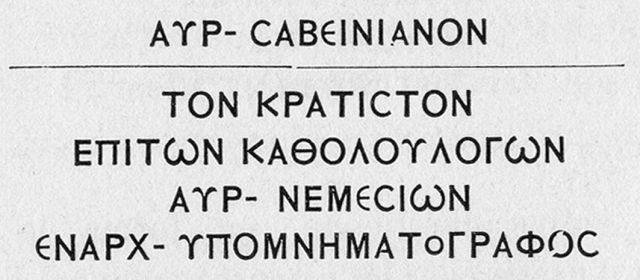
Inscription
Αὐρ(ήλιον) Σαβεινιανὸν, / τὸν κράτιστον, / ἐπὶ τῶν καθ’ ὅλου λόγων, / Αὐρ(ήλιος) Νεμεσίων, / ἔναρχος ὑπομνηματογράφος.
Inscription translation
Aurelius Nemesius, hypomnematograph in charge, [set this up to] Aurelius Sabinianus, man of egregius (or perfectissimus) rank, procurator of all finances [in Egypt].
Bibliography
- Kayser, F., Recueil des Inscriptions grecques et latines (non funéraires) d’Alexandrie impériale, Cairo 1994, 86-8 no. 23
Discussion
INSCRIPTION
In five lines:
Αὐρ(ήλιον) Σαβεινιανὸν, / τὸν κράτιστον, / ἐπὶ τῶν καθ’ ὅλου λόγων, / Αὐρ(ήλιος) Νεμεσίων, / ἔναρχος ὑπομνηματογράφος.
'Aurelius Nemesius, hypomnematograph in charge, [set this up to] Aurelius Sabinianus, man of egregius (or perfectissimus) rank, procurator of all finances [in Egypt].'
Letter height not recorded.
DESCRIPTION (from Kayser 1994)
Tall base of white marble: H 154, W 48, D 48 cm. No published photo.
PROVENANCE AND CURRENT LOCATION
The inscription was found in 1880 during the excavation of the foundations of the Greek hospital in Alexandria, in front of the convent of St. Saba, between the synagogue and the theatre Ziziana. Today in the Greek-Roman Museum of Alexandria, without a published inv. no.
HONORAND, AWARDER, AND DATE
About the honorand Aurelius Sabinianus and his title and rank some uncertainties remain (PLRE I, 790, Aur. Sabinianus 7). Stein translated the office as given in our inscription (line 3: ἐπὶ τῶν καθ’ ὅλου λόγων) with rationalis, arguing that it referred to the highest financial officer in Egypt (the rationalis Aegypti) (Stein, PIR I(2) p. 325 no. 1599; see also LSA-870). Pflaum 1960 and Lallemand 1964, however, argued that he must have been a subordinate of the rationalis Aegypti, because his rank attribute of κράτιστος (Latin egregius) was lower than that of the rationalis, who should have been styled διασημότατος (Latin perfectissimus). But, according to PLRE, the rank attribute of κράτιστος can in this period also be used for higher ranking perfectissimi, and therefore does not exclude Sabinianus from having held the higher office of rationalis Aegypti.
The office of the rationalis Augusti seems to have been established only under Diocletian, which would date our inscription to the late 3rd century, although a degree of uncertainty remains (Kayser 1994, 88 with n. 6). This is the only real evidence for dating this base to the end of the third century, rather than slightly earlier.
Aurelius Sabinianus reappears in an inscription in Salona, in Dalmatia, that was set up for his son Publius Balsamius Sabinianus (LSA-1142). This other monument must predate our inscription because the office of rationalis Aegypti is higher than the offices listed there.
The awarder Aurelius Nemesius was hypomnematograph, a prestigious civic office in Alexandria concerned with the control of the people in the city (Whitehorne 1987).
Discussion references
- Prosopographia imperii romani saec. I. II. III, Berlin & Leipzig 1933-
- Jones, A. H. M. et al., The Prosopography of the Later Roman Empire. Vol. I 260-395, Cambridge et al. 1971 (1975)
- Lallemand, J., L'administration civile de l'Égypte de l'avènement de Dioclétien à la creátion du diocèse (284-382, Bruxelles 1964, pp. 82-3
- Pflaum, H. G., Les carrières procuratoriennes équestres sous le Haut-Empire romain. Vol. I, II, III, Paris 1960, Vol. II pp. 934-5
- Whitehorne, J. E. G., 'The hypomnematographus in the Roman period', Aegyptus, 1987, 101-25
Cite: Last Statues of Antiquity, LSA-1146 (Ulrich Gehn).