
LSA-1148
Base for statue of unnamed governor of Syria Palaestina. Bostra (Arabia). 311-358
Record details
Photographs
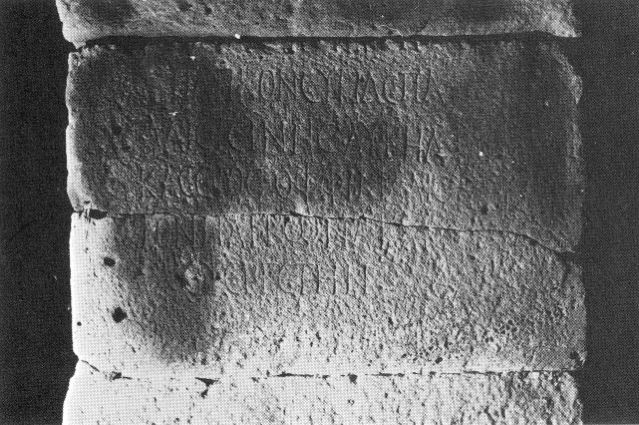
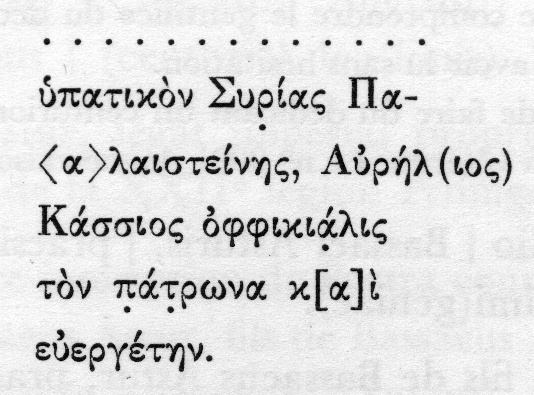
Inscription
... / ὑπατικὸν Συρ̣ίας Πα/λαιστείνης Αὐρηλ(ιος) / (3) Κάσσιος οφφικιά̣λις / τὸν π̣ατ̣ρώνα κ[α]ὶ / εὐεργέτην
Inscription translation
Aurelius Cassius the officialis (= member of the governor’s office) (set this up to) ..., the governor (consularis) of Syria Palaestina, the patron and benefactor
Bibliography
- Sartre, M., Bostra: nos 9001 à 9472 (Inscriptions grecques et latines de la Syrie, vol. 13, fasc. 1), Paris 1982, pp. 157-8 no. 9083 pl. XIV
Discussion
INSCRIPTION
In five preserved lines:
... / ὑπατικὸν Συρ̣ίας Πα/λαιστείνης Αὐρηλ(ιος) / (3) Κάσσιος οφφικιά̣λις / τὸν π̣ατ̣ρώνα κ[α]ὶ / εὐεργέτην
'Aurelius Cassius the officialis (= member of the governor’s office) (set this up to) ..., the governor (consularis) of Syria Palaestina, the patron and benefactor'
The extant inscription is in five lines, with at least one line missing at top.
Letter height 4.5 - 5.5 cm.
DESCRIPTION (from Sartre 1982 and the published photo)
Rectangular block of local stone (basalt), H 77 cm, W 50 cm, D 30 cm. There are no mouldings, the epigraphic field is not framed. A horizontal crack is runs over the front side between lines 3 and 4 of the inscription. It is not clear from the photo and the description given by Sartre 1982 whether the block is broken into two pieces, or whether this crack is only superficial. There are minor chips at the rims of the block, especially at the corners. There is at least one line missing at the top of the extant inscription, which must have given the honorand's name. Sartre 1982 argues that the missing part of the inscription was carved on an additional block.
PROVENANCE/ LOCATION
The block is situated in a private house ('la maison de Muhammad al-Samara', Sartre 1982) in the eastern quarter of the town. It is applied as a key-stone in the arcade at the back of the courtyard. There is no published information about where the block was originally found. The inscription refers to a governor (consularis) of Syria Palaestina (see below, 'Honorand, Awarder and Date'), whereas Bostra was the capital of the province of Arabia. Just possibly the base was brought to Bostra from elsewhere for re-use, but this is very unlikely, given the presence of abundant stone in the area.
HONORAND, AWARDER, AND DATE
The anonymous honorand of our inscription is identified as governor (consularis) of the province of Syria Palaestina (line 1). Unless this base has been brought to Bostra from another location, he would unusually have received his honour outside the province he administered.
The province of Syria Palaestina was set up in 135 after the second Jewish war, as a renaming of the province of Iudaea. It was administered by a legatus Augusti pro praetore. This governor was a former consul, but the title of consularis would be very strange in an inscription of the 2nd and early 3rd centuries, and clearly points to the late 3rd century or later.
In the wake of the tetrarchic reforms the southern parts of the province of Arabia were incorporated into Syria Palaestina, which in the sources of the late 3rd and the 4th century is usually simply called 'Palaestina'. (Syria-) Palaestina was administered by governors of equestrian rank (praesides) in the early fourth century. The last known governor of this rank provides the terminus post quem for our inscription (Valentinianus in 310-11, PLRE I, 932 Valentinianus 1). The governorship was probably later elevated to be held by a praeses of senatorial rank (clarissimus praeses) for an unknown time. In a second step, it was upgraded to the rank of consularis some time before the middle of the 4th century. No specific date for this development is known, and therefore no closer terminus post quem for our inscription. The province was divided into the three Palestines in 357-8, which provides the terminus ante quem for our inscription (for the develpment of the provinces in the region see the excellent account of Brünnow & Domaszewski 1909, 249-360).
The awarder of the inscription was an officialis, a member of the governor's staff.
Discussion references
- Brünnow, R. E. & A. v. Domaszewski, Die Provincia Arabia, auf Grund zweier in den Jahren 1897 und 1898 unternommenen Reisen und der Berichte früherer Reisender beschrieben von Rudolf Ernst Brünnow und Alfred v. Domaszewski. Bd. III, Straßburg 1909, 249-360
- Jones, A. H. M. et al., The Prosopography of the Later Roman Empire. Vol. I 260-395, Cambridge et al. 1971 (1975)
Cite: Last Statues of Antiquity, LSA-1148 (Ulrich Gehn).