
LSA-1149
Base for statue, possibly of Constantius Gallus, emperor. Bostra (Arabia). 293-360
Record details
Photographs
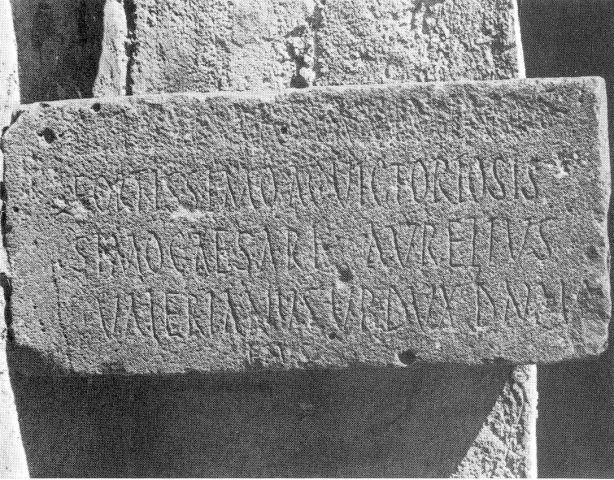
Inscription
[[D(omino) n(ostro) Fl(avio) Claudio Constantio]] / fortissimo ac victoriosis- / (3) simo Caesari Aurelius / Valerianus v(ir) p(erfectissimus) dux d(evotus) n(umini) m(aiestati)q̣(ue eius)
Inscription translation
Aurelius Valerianus, of perfectissimus rank, dux, (set this up to) our Lord Flavius Claudius Constantius the most powerful and victorious Caesar, devoted to his divine spirit and majesty
Bibliography
- Sartre, M., Bostra: nos 9001 à 9472 (Inscriptions grecques et latines de la Syrie, vol. 13, fasc. 1), Paris 1982, pp. 132-4 no. 9062 pl. XII
Discussion
INSCRIPTION
In four lines:
[[D(omino) n(ostro) Fl(avio) Claudio Constantio]] / fortissimo ac victoriosis- / (3) simo Caesari Aurelius / Valerianus v(ir) p(erfectissimus) dux d(evotus) n(umini) m(aiestati)q̣(ue eius)
'Aurelius Valerianus, of perfectissimus rank, dux, (set this up to) our Lord Flavius Claudius Constantius the most powerful and victorious Caesar, devoted to his divine spirit and majesty'
The first line with the imperial name has been erased. We reproduce it with the completions proposed by Sartre 1982. With the honorand in the dative and the name of the awarder it displays the usual formula for Latin statue base inscriptions.
Letter height 6-6.5 cm.
DESCRIPTION (from Sartre 1982 and the published photo)
Rectangular block of local stone (basalt). H 40 cm, W 87 cm, D 30 cm. No mouldings, the epigraphic field is not framed. Minor breaks at upper and lower left corners do not affect the inscription; only a chip at the bottom right corner renders the last letter of line 4 almost illegible. The surface is weathered. There are three shallow round holes, close to the upper left corner, between lines 3 and 4, and at the lower rim.
The inscription is complete, apart from the erased first line, so the block could be in its original form. However, if a statue base, it is very exceptionally squat, and it may have been cut down for later re-use of the block.
PROVENANCE/ LOCATION
The exact provenance of the block is unknown. Today it is preserved in the citadel of Bostra.
HONORAND, AWARDER, AND DATE
The name of the honorand is erased, and he was therefore a Caesar who fell from grace. Sartre dated the inscription to the 4th century on the basis of its letter forms, and argued that of the Caesars of that time only the name of Gallus (Caesar 351-4) was consistently erased. Indeed, during his sojourn in the Orient, Gallus suppressed the Jewish revolt of 352, an event which may be referred to by the epithet victoriosissimus in lines 2-3. We are less confident of Sartre's dating (see below), and would prefer to leave the exact identity of the Caesar involved more open.
The awarder Aurelius Valerianus was the military commander (dux) of the border troops in the province of Arabia; he is only known from this inscription (and has no entry in PLRE). He was of equestrian (perfectissimus) rank, which dates our inscription to before 373, since his office was updated to senatorial (clarissimus) rank by 365/73, as shown by an inscription to the dux Arabiae Maximinus (PLRE I, 577 Maximinus 6). The terminus ante quem for our inscription is further lowered to 360 by the Caesar-title, since Julian, the last Caesar of the 4th century, was elevated to the rank of Augustus in that year.
Our inscription is therefore certainly earlier than 360, and certainly later than the creation of the first Caesars under the Tetrarchy (in 293). As we have seen, Sartre believed he could date the inscription on the basis of its letter forms to the fourth century, but we are doubtful of the validity of this argument and of his identification of the honorand specifically as the Caesar Gallus (351-4). We prefer to leave the dating more open, to between 293 and 360, and the identification of the honorand uncertain, since several Caesars in this period fell from grace and had their names removed from inscriptions.
FURTHER DISCUSSION
The dux Arabiae is one of the few high-ranking imperial office-holders who after the reforms of Diocletian maintained both military and civic competences. In the Notitia Dignitatum he appears as dux Arabiae et praeses, i. e. 'military commander and provincial governor of Arabia' (Sartre 1982, 133 with references).
Discussion references
- Jones, A. H. M. et al., The Prosopography of the Later Roman Empire. Vol. I 260-395, Cambridge et al. 1971 (1975)
Cite: Last Statues of Antiquity, LSA-1149 (Ulrich Gehn).