
LSA-115
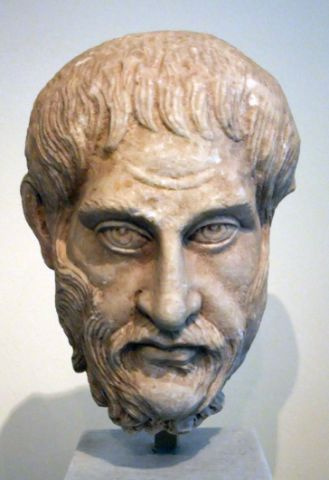
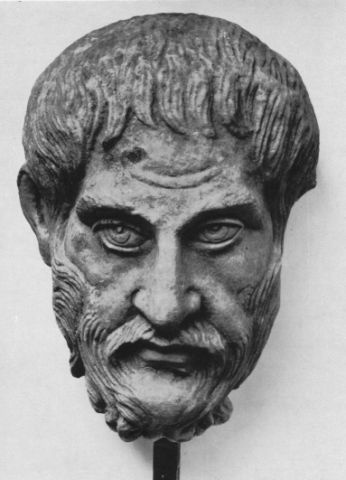
Portrait head of bearded man in 'Iamblichus-type'. From Epidaurus (Achaea). Late third to early fourth century.
Record details
Photographs
Bibliography
- Kaltsas, N., Sculpture in the National Archaeological Museum, Athens, Athens 2002, 371 nr. 792
- L'Orange, H. P., Studien zur Geschichte des spätantiken Porträts, Oslo 1933, 41-43, 126 nr. 65 fig. 114
- L'Orange, H. P., Some remarks on late Greek portraiture, especially regarding the Jamblichos type, Acta ad archaeologiam et artium historiam pertinentia, 6, 1975, 59-63, 62 pl. VII, VIII a, b
- Rodenwaldt, G., Griechische Porträts aus dem Ausgang der Antike: 76. Programm zum Winckelmannsfeste der archäologischen Gesellschaft zu Berlin, Berlin 1919, 3-4 nr. 1pl. I, II
Discussion
DESCRIPTION (Object)
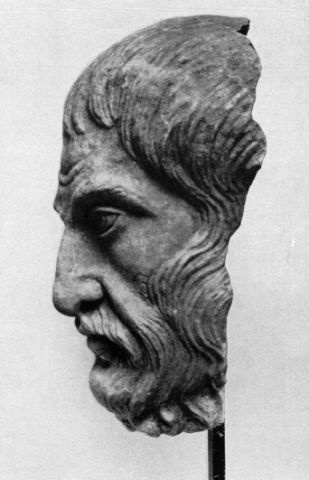
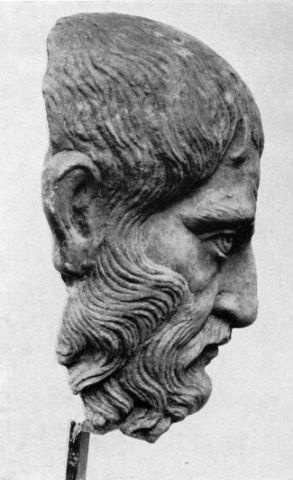
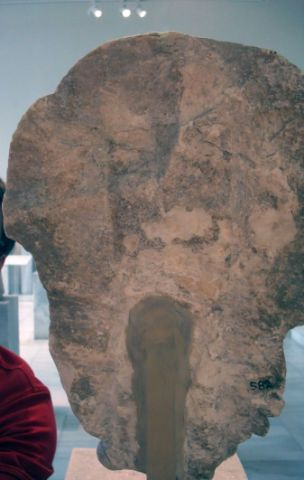
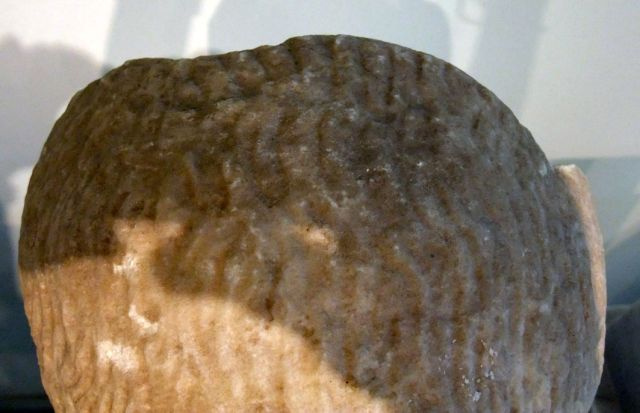
Marble portrait head broken beneath the chin, H. The back of the head is broken off behind the right ear; the left ear is lost.
The hair and beard are marked by long parallel chisel lines. At the temples, the hair merges into the beard in a long s-shaped line. Under the chin the long beard tapers out into spiral locks which curl in at their ends. The locks are separated by drill work and the curling up ends are marked by round drill holes.
The brow is furrowed by two concave horizontal lines.
The eyes are almond shaped, the eyebrows marked by short chisel strokes. The iris is circumscribed by an incised line, the pupil is a point standing proud at the upper lid and is circumscribed by a broad and shallow drill line. The right eybrow forms a flat arch, while the left one has a marked upheaval at the temple.
The cheeks and the area around the mouth are vigorously modeled.
PROVENANCE AND CURRENT LOCATION
The head was found in the sanctuary of Asclepius at Epidaurus in the late 19th century. It is today in the National Museum at Athens, inv. no. 582.
DESCRIPTION (Subject)
The portrayed is an older man with a long beard; his hair is still full but receding over the brow. It is brushed towards the face in long strands; four lunular locks fall into the brow, three turning to the left, the fourth, at the right temple, to the right. The ears are free. His cheeks are meager; the left eye is smaller than the right. His wide open eyes and the billowing nostrils lend an expression of alertness and energy to the face.
The head is one of a set of similar heads that were first discussed by Rodenwaldt 1919, then by L’Orange 1933, Harrison 1953, L’Orange 1975, and by Voutiras 1981 (see LSA-114; see also below, ‘Honorand and Date’; on the group see below, ‘Further Discussion’). Our head is similar to LSA-112 and LSA-114 notably in the way the voluminous beard is growing on the cheeks; it is possible that these three heads represent the same honorand. Rodenwaldt associated the heads with the late-4th century neo-platonic philosophers in Athens, while L’Orange suggested our head was a portrait of the neo-platonic philosopher Iamblichus of Apamea, active in the late 3rd/ early 4th century, the first ‘holy man’ in the ‘golden chain’ of the neo-platonic school (L’Orange 1933, 40-4; L’Orange 1975; PLRE I, 450-1 Iamblichus 1). Harrison 1953 cautiously suggested the portrayed was possibly the late-3rd century Athenian historian Publius Herennius Dexippus.
The head displays no priestly attributes; however, its presence in the sanctuary of Asclepius at Epidaurus indicates that the portrayed was probably a local notable who was possibly concerned with the sanctuary.
HONORAND AND DATE
The head together with its counter pieces (see below, ‘Further Discussion’) was dated to the end of the 4th century by Rodenwaldt 1919.
L’Orange 1933 accepted the grouping of heads proposed by Rodenwaldt but suggested that the heads were produced over a period of some decades in the late-3rd to early-4th century. Our head, according to L’Orange, represented the style of the Constantinian period of around 320/5 (‘konstantinischer Hofstil’).
Harrison 1953 dated the group to the pre-tetrarchic late 3rd century (see LSA-, ‘Date’).
Harrisons early date appears to be have been accepted by a majority of recent scholars. It was supported and confirmed with new arguments by v. Sydow 1969, and by Voutiras 1981 (see LSA-114); it was accepted by Kaltsas 2001.
Our head represents stylistic features that have been labeled ‘symmetrical-ornamental solidification of form’ by L’Orange 1933 (‘symmetrisch-ornamentale Befestigung der Form’). This refers, if I interpret L’Orange correctly, to phenomena like the ornamentally swinging lines of hair and beard, the regularly arching brows which are paralleled by the lines of the upper lids, the parallel wrinkles on the brow, the balancing of asymmetries which characterize e.g. LSA-116 and its contemporary head from the Athenian Agora (Harrison 1953 no. 49; not in our database), but also the reducing of the modelings of the face to large areas that are clearly defined against each other. In all properties our head is different from the heads considered the earliest representatives of the type, cf. LSA-116. While such stylistic differences have to be acknowledged, the question is whether they justify dates that differ half a century from each other. V. Sydow 1969, 206-7 pointed out that the close typological relation between the heads of the group asked for a close date; while he accepted the stylistic differences pointed out by L’Orange 1933, he claimed that the ‘solidification’ was active in Greece already around 270. Voutiras 1981, 206-7 confirmed this and suggested that different workshop traditions could explain these differences.
The most reliable dating criterion appears to be the fashion of the portrayed. A similar beard is displayed by other heads from the region ( LSA-111, LSA-112, LSA-113, LSA-114, LSA-116, LSA-123; see also LSA-894). Coin portraits of the emperor Tacitus (275-6) show the same fashion beard and provide the best dating evidence for our head, in the 3rd quarter of the 3rd century (Delbrueck 1940 pl. 25, 1-12). A similar fashion beard is displayed by the male portrait on the so-called Annona-sarcophagus in Rome that is unanimously dated to the 3rd quarter of the 3rd century (Wrede 2001, 70-3 pl. 17,1; Koch & Sichtermann 1982, 102-3 fig. 101).
Discussion references
- Delbrueck, R., Die Münzbildnisse von Maximinus bis Carinus (Das römische Herrscherbild III. Abteilung Band 2), Berlin 1940
- Harrison, E. B., Portrait Sculpture: The Athenian Agora I, Princeton, N. J. 1953, 101-105
- Jones, A. H. M. et al., The Prosopography of the Later Roman Empire. Vol. I 260-395, Cambridge et al. 1971 (1975)
- Kaltsas, N., Sculpture in the National Archaeological Museum, Athens, Athens 2002, 371 no. 792
- Koch, G. & H. Sichtermann, Römische Sarkophage (Handbuch der Archäologie), München 1982
- Rodenwaldt, G. , Griechische Porträts aus dem Ausgang der Antike. Programm zum Winckelmannsfeste der archaeologischen Gesellschaft zu Berlin ; 76, Berlin 1919, 3-4 no. 1 pl. I-II
- Sydow, W. von, Zur Kunstgeschichte des spätantike Porträts im 4. Jahrhundert. n. Chr, Bonn 1969
- Voutiras, E., Ein wiedergewonnenes attisches Porträt der Spätantike, Mitteilungen des Deutschen Archäologischen Instituts, Athenische Abteilung, 96, 1981
- Wrede, H., Senatorische Sarkophage Roms: der Beitrag des Senatorenstandes zur römischen Kunst der hohen und späten Kaiserzeit, Mainz 2001
- Καββαδίας, Π., Γλυπτά του Εθνικού Μουσείου, Περιγραφικός Κατάλογος, Athens 1890-1892, 297 nr. 582
Cite: Last Statues of Antiquity, LSA-115 (Ulrich Gehn).