
LSA-1151
Lower part of base for statue of Sabinianus, governor of Arabia. Bostra (Arabia). Fourth to fifth century
Record details
Photographs
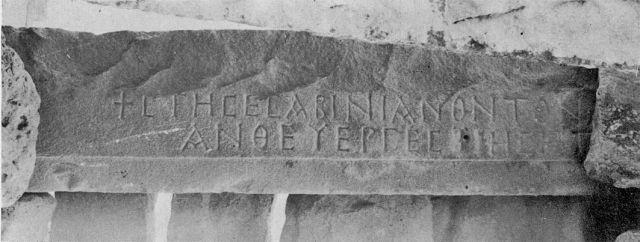

Inscription
Στῆσε Σαβινιανὸν τὸν ἀο[ιδιμον ἡγεμονῆα] / ἀνθ’ εὐερεργεσ<τ>ίης ἡ πό[λις ἡ σφετέρη]
Inscription translation
His city set up (the statue of) Sabinianus the famous governor, in exchange for his benefactions
Bibliography
- Sartre, M., Bostra: nos 9001 à 9472 (Inscriptions grecques et latines de la Syrie, vol. 13, fasc. 1), Paris 1982, p. 166-7 no. 9091
Discussion
INSCRIPTION
In two lines:
(Cross) Στῆσε Σαβινιανὸν τὸν ἀο[ιδιμον ἡγεμονῆα] / ἀνθ’ εὐερεργεσ<τ>ίης ἡ πό[λις ἡ σφετέρη]
'His city set up (the statue of) Sabinianus the famous governor, in exchange for his benefactions'
We reproduce the inscription with the completions proposed by Sartre 1982. These are based on the edition by Littmann 1921 who saw the inscription in a more complete state. Littmann's version is as follows:
Στῆσε Σαβινιανὸν τὸν ἀοιδιμον ἡγεμον(ῆ)α / ἀνθ’ εὐερεργεσ<τ>ίης ἡ πόλις ἡ σφετέρη
The inscription praises in an elegiac distich the benefactions of Sabinianus, in return for which he received this award. The phraseology indicates clearly that this was a statue dedication, although the dimensions of the block are unusual for statue bases (see below, 'Description').
Letter height 5-6 cm.
DESCRIPTION (from Littmann et al. 1921, Sartre 1982, and the published photo)
Oblong block, broken on top and on the right side. H 37 cm, W 148 cm (Littmann, who saw the inscription complete, recorded 293 cm), D 18 cm. The inscription is carved on a band on the face of the block. A drill hole has destroyed part of εὐερεργεσ<τ>ίης in line 2. The area above the inscription has apparently been roughly cut back.
PROVENANCE/ LOCATION
The block was recorded in the private house called 'awlad Mansur' ('children of Mansur') in central Bosra by Littmann et al. 1921 and again by Sartre 1982. It is used there as the lintel over a doorway. Provenance unknown.
HONORAND, AWARDER, AND DATE
The honorand Sabinianus was a native of Bostra (line 2) ( PLRE I, 790 Sabinianus 6). As to his identity and office, there has been some debate. Sartre 1982 rejected earlier assumptions that he was a provincial governor (praeses) of Arabia, with the argument that ἡγεμονεύς (accusative ἡγεμονῆα) referred to the highest ranking generals (magister militum), not to provincial governors or army commanders on the provincial level (dux). He therefore proposed to identify the honorand with the magister equitum Sabinianus who commanded the army sent against the Persians in 359 (Ammianus Marcellinus XVIII 5, 4). Against Sartre's assumptions, exactly the same formula as given here in line 1, 'τὸν ἀοίδιμον ἡγεμο/νῆα' (ἡγεμονῆα being the accusative of the poetic ἡγεμονεύς, as against the more technical ἡγεμών, acc. ἡγεμόνα) appears in the honorific inscription for Oecumenius, governor (praeses) of Caria (LSA-151). We therefore assume that Sabinianus was a provincial governor (praeses) of Arabia, otherwise unknown.
The denomination praeses (or its Greek equivalent 'ἡγεμών') for the provincial appears in inscriptions in Arabia already under Gallienus (261-8); the term is used in the generic meaning 'governor' at that time (Brünnow & Domaszewski 1909, p. 294 Iunius Olympus, Statilius Ammianus, and Virius Lupus). Only from the tetrarchic period onwards the term becomes an official title to denote a governorship of a specific rank. The governors of Arabia remain praesides from the tetrarchic period through the 4th and 5th centuries into the 6th (Brünnow & Domaszewski 1909, pp. 294-7 § 31).
Verse inscriptions on statue bases were set up in the Greek East throughout the 4th and the 5th century. Given the rarity of base inscriptions datable to the 5th century in the Near East, a date in the 4th century is the most likely for our inscription; the cross which accompanies our inscription suggests a date not before the middle of the 4th century.
Discussion references
- Brünnow, R. E. & A. v. Domaszewski, Die Provincia Arabia, auf Grund zweier in den Jahren 1897 und 1898 unternommenen Reisen und der Berichte früherer Reisender beschrieben von Rudolf Ernst Brünnow und Alfred v. Domaszewski. Bd. III, Straßburg 1909
- Jones, A. H. M. et al., The Prosopography of the Later Roman Empire. Vol. I 260-395, Cambridge et al. 1971 (1975)
- Littmann, E., Magie, D. jr. & D. Reed Stuart, Syria. Greek and Latin Inscriptions (Publications of the Princeton University Archaeological Expeditions to Syria in 1904-5 and 1909, Division III, Section A), Leyden 1921, pp. 247-8 no. 559
Cite: Last Statues of Antiquity, LSA-1151 (Ulrich Gehn).