
LSA-1152
Probable base for statue of Galerius, emperor. Scythopolis (Palaestina II). 310-311
Record details
Photographs
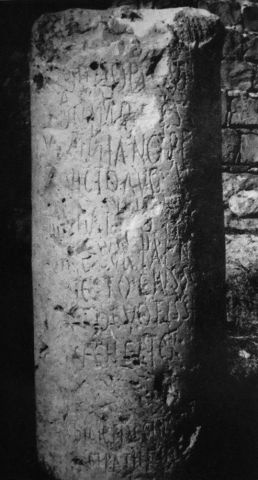
Inscription
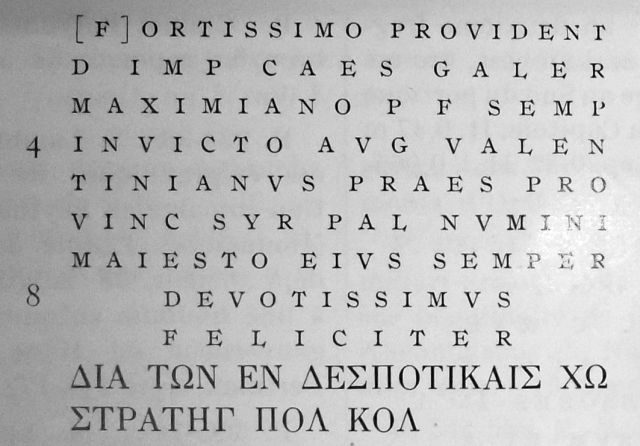
[F]ortissimo pr[o]vident(issmo) / D(omino nostro) imp(eratori) [Ca]es(ari) Gal(erio) Val(erio) / Maximiano p(io) f(elici) semper / invicto Aug(usto). Val(erius) Fẹr- / (5) mi[l]ị̣anus praes(es) pro- / vinc(iae) Sur(iae) Pal(aestinae) numini / maiest(ati)q(ue) eius semper / devotissimus / feliciter. / διὰ τῶν περὶ Λεόντιον καὶ Εὐ̣γ̣[έν]ιον / (10) στρατηγ(ῶν) πόλ(εως) κολ(ονίας).
Inscription translation
To our most powerful and provident lord the emperor Caesar Galerius Maximianus the pious, fortunate and always invincible Augustus. Valerius Firmilianus, governor (praeses) of the province of Syria Palaestina (set this up), always most devoted to his divine spirit and majesty, with good fortune. Leontius and Eugenius, duumviri of the city, the colony, took charge.
Bibliography
- Supplementum Epigraphicum Graecum, , 43, 1993, no. 1073
- L'Année épigraphique, , 1964, p. 78 no. 198
- Laniado, A., Last, R. and B. Porath, A Dedication to Galerius from Scythopolis. A Revised Reading*, Zeitschrift für Papyrologie und Epigraphik 98, 229-37, Bonn 1993
Discussion
INSCRIPTION
In ten lines:
[F]ortissimo pr[o]vident(issmo) / D(omino nostro) imp(eratori) [Ca]es(ari) Gal(erio) Val(erio) / Maximiano p(io) f(elici) semper / invicto Aug(usto). Val(erius) Fẹr- / (5) mi[l]ị̣anus praes(es) pro- / vinc(iae) Sur(iae) Pal(aestinae) numini / maiest(ati)q(ue) eius semper / devotissimus / feliciter. / διὰ τῶν περὶ Λεόντιον καὶ Εὐ̣γ̣[έν]ιον / (10) στρατηγ(ῶν) πόλ(εως) κολ(ονίας)
'To our most powerful and provident lord the emperor Caesar Galerius Maximianus the pious, fortunate and always invincible Augustus. Valerius Firmilianus, governor (praeses) of the province of Syria Palaestina (set this up), always most devoted to his divine spirit and majesty, with good fortune. Leontius and Eugenius, duumviri of the city, the colony, took charge'.
Letter height 5-8 cm (Latin), 2-6 cm (Greek).
We reproduce the inscription as given by the Supplementum Epigraphicum Graecum 43, 1993.
DESCRIPTION (from Lifshitz 1962 and the published photos)
Limestone column without mouldings, chipped at the upper margin; H 118 cm, diameter 57 cm. The surface is chipped; the inscription is carved directly into the surface in irregular letters.
PROVENANCE AND CURRENT LOCATION
The inscription was first recorded in 1962 in Bet She'an, and is now in the Bet She'an Museum, without published inv. no.
HONORAND, AWARDER AND DATE
Galerius, the honorand, was Augustus 305-11.
Valerius Firmilianus (the cognomen mispelled Fermilianus in our inscription), the awarder, was governor (praeses) of the province of Syria Palaestina in 308/9 – 310/11 (PLRE) (see below, ‘Further Discussion’). He is known from Eusebius' liber de martyribus Palaestinae where he is mentioned several times as a cruel persecutor of Christians.
The inscription was set up under the auspices of two local men, Leontius and Eugenius, holding the local office of strategos (the Greek equivalent of the Latin duumvir) (see below, ‘Further Discussion‘).
FURTHER DISCUSSION
The formula of the inscription would suit milestones as well as statue bases. However the obviously intact inscription gives no mileage, and it refers to Galerius alone (without mentioning his imperial colleagues). This, in our view, speaks in favour of a statue base. There are indeed seven late antique columnar statue bases in Caesarea in the nearby province of Palestina I (LSA-11, LSA-12, LSA-1090, LSA-1100, LSA-1105, LSA-1106, LSA-1107).
Lifshitz 1962, the first editor of the inscription read the name of the awarder in lines 4-5 Valentinianus.This name has since entered the fasti of the governors of Syria Palaestina as successor of Valerius Firmilianus (PLRE I, 932 Valentinianus 1, and ibid. 1108, Fasti, Palaestina). However, we follow the revised reading of Laniado, Last and Porath 1993. Since Valentinianus had only been testified to by our inscription, he must be cancelled from the fasti; instead Valerius Firmilianus‘ time of office must be extended to the period earlier thought to have been covered by Valentinianus ( Laniado, Last and Porath 1993, 229-34).
The title of strategos held by the men in charge of the inscription’s erection makes sure that Scythopolis had received the status of a colony at this time. This must have occured after the mid-3rd century, perhaps in the reign of Galerius (Laniado, Last and Porath 1993, 236-7).
Discussion references
- Jones, A. H. M. et al., The Prosopography of the Later Roman Empire. Vol. I 260-395, Cambridge et al. 1971 (1975)
- Lifshitz, B., Un dédicace à Galère trouvée à Beisan (Skythopolis), Hommages à Albert Grenier (Collection Latomus LVIII) vol. 2, pp. 1063-4, Bruxelles-Berchem 1962
Cite: Last Statues of Antiquity, LSA-1152 (Ulrich Gehn).