
LSA-1153
Fragment of probable base for statue, perhaps of jurist Patricius. Berytus (Phoenice). Possibly fifth to early sixth century
Record details
Photographs
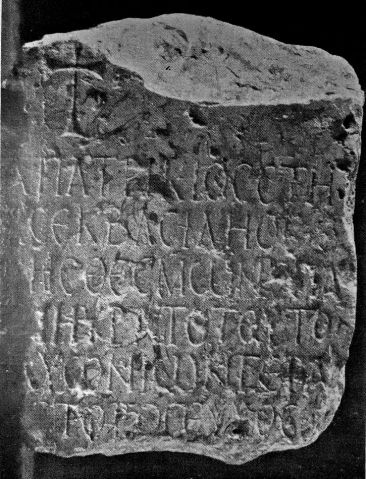
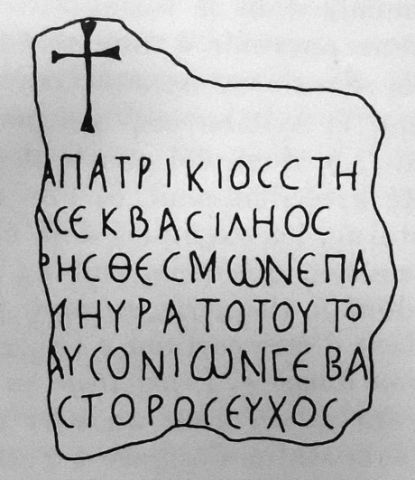
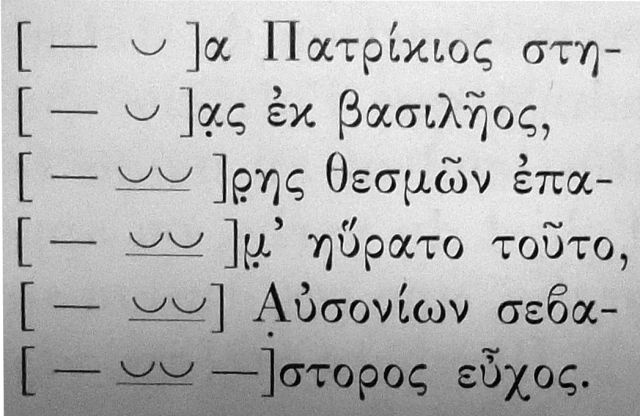
Inscription
[--]α Πατρίκιος στῆ- / [--]α̣ς ἐκ βασιλῆος / (3) [--]ρης θεσμῶν ἐπα- / [--]μ̣’ ηὕρατο τοῦτο / [--] Αὐσονίων σεβα - / (6) [---]στορος εὖχος
Inscription translation
... Patricius ... set up ... from the emperor ... of the laws ... he found this ...(emperor(s) ?) of the Romans ... honour of ...
Bibliography
- Merkelbach, R. and J. Stauber (eds.), Steinepigramme aus dem griechischen Osten. Bd. 4. Die Südküste Kleinasiens, Syrien und Palaestina, Munich 2002, no. 20/ 11/ 04
Discussion
INSCRIPTION
In six lines, only partly preserved:
[--]α Πατρίκιος στῆ- / [--]α̣ς ἐκ βασιλῆος / (3) [--]ρης θεσμῶν ἐπα- / [--]μ̣’ ηὕρατο τοῦτο / [--] Αὐσονίων σεβα - / (6) [---]στορος εὖχος.
'... Patricius ... set up ... from the emperor ... of the laws ... he found this ...(emperor(s) ?) of the Ausonians (= Romans) ... honour of ...'
Above the inscription there is a cross in the upper left corner.
Feissel 1984 pp. 553-5 in a careful analysis of the text proposed the following completions, which were adopted by Merkelbach & Stauber 2002:
[εἰκόν]α Πατρίκιος στῆ- / [σεν γέρ]α̣ς ἐκ βασιλῆος / (3) [...]ρ̣ης θεσμῶν ἐπα- / [.. μνῆ]μ̣’ ηὕρατο τοῦτο / [...] Αὐσονίων σεβα[..] / (6) [...] κυαί]στορος εὖχος.
'Patricius set up this statue, a reward from the emperor, ... of the laws ... he found this memory ... of the Ausonians (= Romans) ... the honour of a quaestor'
As Feissel points out, the inscription probably consisted of three hexameters laid out in six lines. The allusion to the laws and the reference to the emperor (the fount of all Roman law) in our inscription have led scholars to the assumption that it was in honour of the famous jurist Patricius of the 5th century (PLRE II, 839 Patricius 10; Berger 1949; Collinet 1925, 132-8. See below, 'Honorand, Awarder, and Date'). Earlier studies considered our inscription an epitaph, and Feissel 1984 was the first to connect the formula used with other inscriptions alluding to statues as reward (Gr. γέρας, line 2) by the emperors. This view was adopted by Merkelbach & Stauber 2002.
DESCRIPTION (From Feissel 1984 and the published images)
Limestone block broken at top, bottom, and left side; H 45, W 35 cm. The right margin is chipped, but without cutting into the inscription. The surface is smoothly finished.
PROVENANCE/ LOCATION
The inscription was found in the environs of the Greek Orthodox Cathedral of St. George; this is probably the area where in the 5th century the cathedral of Eustathius, and, associated with it, the famous ancient school of law were located (Mouterde & Lauffrey 1952, pp. 14, 21; see also map there p. 23, fig. 12; Collinet 1925, 61-75). The location would fit both an epitaph and a honorific monument.
HONORAND AND DATE
This may be a dedication to (or by) Patricius, the eminent jurist of the 5th century, one of the so-called 'heroes', whose comments and interpretations on legislation were of outstanding importance for the 6th-century commentators of the Codex Iustinianus (Berger 1949, 2244-7). His precise dates are hard to determine; whereas Berger argued that he probably worked in the 2nd half of the 5th century (Berger 1949, 2247-8), Collinet believed he was already active in the 420s (Collinet 1925, 135). He was certainly dead by 533.
If the Patricius mentioned in the inscription was not the famous jurist, there is no clear evidence of date, besides the fact that it is certainly late antique (from the verse form and the presence of a prominent cross).
FURTHER DISCUSSION
Whereas the completions proposed by Feissel are plausible, it remains puzzling that the honorand Patricius, who appears in the nominative, should be the agent of the erection of his own statue.
Discussion references
- Berger, A., Patrikios 2, Paulys Real-Encyclopädie der Classischen Altertumswisenschaft XVIII, 4, pp. 2244-9, Stuttgart 1949
- Collinet, P., Histoire de l'École de Droit de Beyrouth, Paris 1925
- Feissel, D. 'Notes d' Épigraphie chrétienne', Bulletin de Correspondance Hellénique 108, 545-579, Paris 1984, 552-6
- Mango, C., Epigrammes honorifiques, statues et portraits a Byzance, Αφιέρωμα στον Νίκο Σβορώνο, 23-35, Rethymno 1986
- Martindale, J. R., The Prosopography of the Later Roman Empire. Vol. II A.D. 395-527, Cambridge 1980
- Mouterde, P. R. & J. Lauffray, Beyrouth ville romaine: histoire et monuments, Beyrouth 1952
Cite: Last Statues of Antiquity, LSA-1153 (Ulrich Gehn).