
LSA-1158
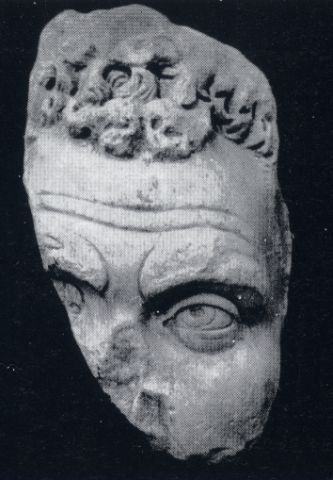
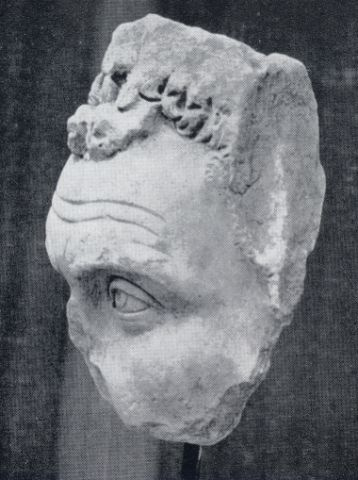
Brow fragment of over life-size portrait of man with curly 'wreath' hairstyle. From Cyrene. Severan or mid fourth to fifth century.
Record details
Photographs
Bibliography
- Rosenbaum, E., A Catalogue of Cyrenaican Portrait Sculpture, London 1960, 74, no. 96, pl.60.1-2
Discussion
DESCRIPTION (Object)
Brow and eye of over life-size portrait head. H: 22.9, W: 12.7 cm. Fine-grained white marble.
The fragment is broken diagonally from the upper right corner of brow to above the left corner of mouth. It is also broken along the left side in front of the ear and vertically behind the brow hair. The nose is chipped.
The thick hair is rendered with extensive use of the drill. The pupils of the eyes are made by two drill holes that form a large central circle. The semi-circular perimeter line of the iris, a line under the lower lid, two C-shaped folds rising from the root of the nose, and two furrows across the brow are made with a flat chisel. The surface of the face has been finely polished.
PROVENANCE
The fragment is from Cyrene but the exact provenance is unrecorded.
DESCRIPTION (Subject)
The head shows a man with thick curly hair that recedes at the corners of the brow and comes forward at in two curls at the centre. The brow is heavily marked by both horizontal furrows and vertical creases that stem from the base of the nose. The break at the left side of the face may follow the line of a beard (so Rosenbaum). Below the lower eyelid, the bulge of the eye has been reiterated by another line of the flat chisel. The treatment of the brow and eyes give the face an emphatic intensity.
The hair is thick and full. Deep drilling gives it volume and movement. The tall broken form of the hair behind the brow hair may represent either a crown or a late antique wreath hairstyle.
DATE
Whereas the drilling of the hair and eyes resembles that of Severan portriature, the distinctively expressive quality of the face and fine polish of the surface suggest a high-quality late antique portrait. Rosenbaum suggested that it belonged in the Tetrarchic period which explains neither the expressivity nor the fine drilling.
Cite: Last Statues of Antiquity, LSA-1158 (J. Lenaghan).