
LSA-116
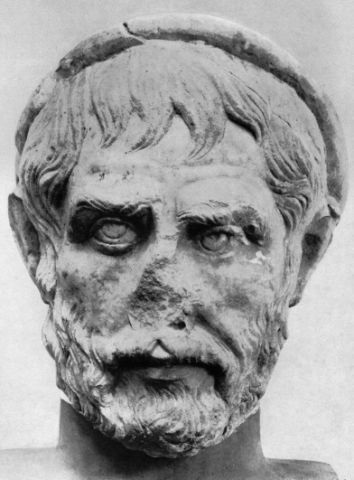
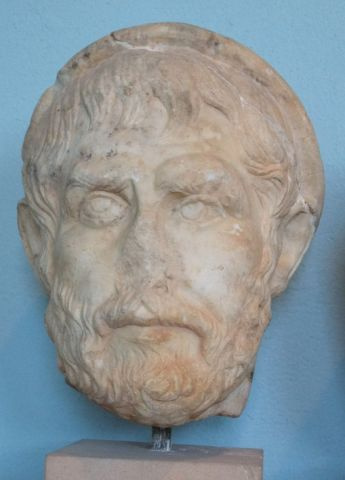
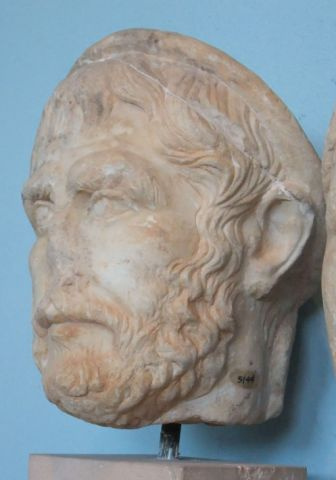
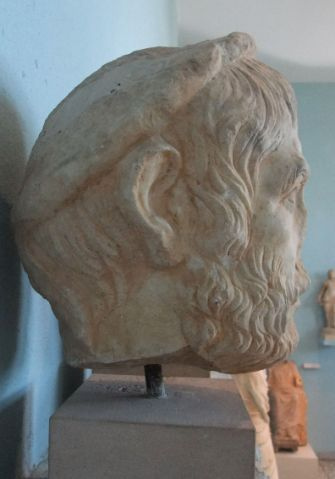
Portrait head of bearded man in 'Iamblichus-type', wearing wreath. Eleusis (Achaea). Mid to later third century.
Record details
Photographs
Bibliography
- L'Orange, H. P., Studien zur Geschichte des spätantiken Porträts, Oslo 1933, 40-42, 124 nr. 58
- L'Orange, H. P., Some remarks on late Greek portraiture, especially regarding the Jamblichos type, Acta ad archaeologiam et artium historiam pertinentia, 6, 1975, 59-63, 60-61 pl. III
Discussion
DESCRIPTION (Object)
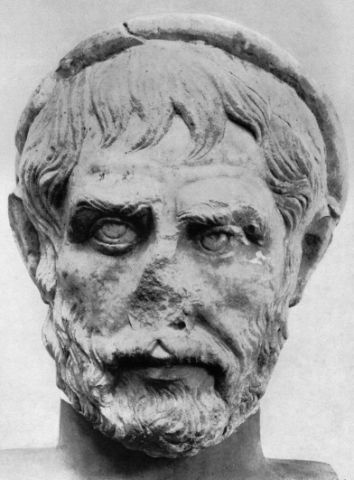
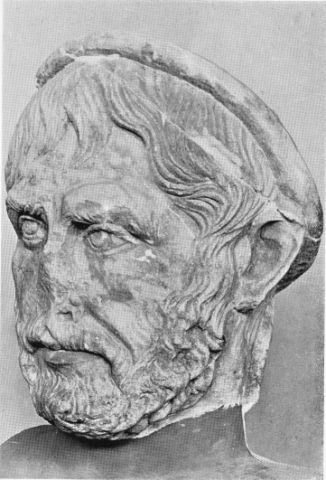
The marble head is broken at the neck below the chin; H 30 cm. A portion of the upper head is broken and fixed with plaster. The nose is broken and the left eyebrow is chipped; there are some chips on eyes, eyebrows, beard and cheeks.
The hair is plastically set off the flesh; strands are singled out by long, shallow parallel groves with the chisel; there is no drill work. The beard is also executed without only by chisel work. It is lank on the right side but forms knobby locks at the left and under the chin.
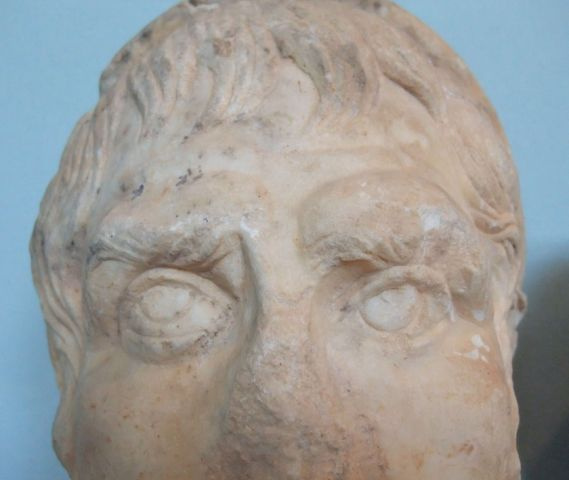
The eyes are markedly asymmetric. The right one is larger and has a bulgy lower lid. The pupil of the left eye is set against the upper lid; it is carved out by a broad, shallow circular drill channel. The iris is circumscribed by a deeply incised circular line. At the right eye, only the iris is marked, in the same way as on the left. The eyebrows are horizontal, with strong upheavals at the root of the nose and at the temples. They are marked with wavy chisel lines.
On the brow there is a horizontal fold; above the eyebrows protruding knobs are modelled. The cheeks are divided into small sections; from the left nostril a marked fold is running to the angle of the mouth, lending a further element of asymmetry to the face.
PROVENANCE AND CURRENT LOCATION
The head was found before 1940 in the sanctuary at Eleusis (Harrison 1953, 101 no. VII); it was lying close to a base to the priest Nicagoras, son of Mnesaeus (Hekler 1940, 135-6; see also above, ‘Description (Subject)’). It is today in the Elefsina Museum, inv. no. 5144.
DESCRIPTION (Subject)
The portrayed is a mature man as is indicated by the full beard, the heavily furrowed face, and the sunken cheeks. His hair is brushed forward and falls in four lunular locks into the brow; three of these are bent to the right, the fourth one to the left (see also below, ‘Date’). The hair is trimmed in the neck; the ears are free. At the temples it merges into the beard, while at the jawbones the beard grows into shorter locks; this distinctive design is probably an individualizing feature.
The eyebrows are heavily contracted causing two steep vertical folds rising from the root of the nose. The brow is heavily bulging over the eyes. The heavy contraction is combined with wide open eyes which gives an expression of alertness to the portrayed. The right eye is larger than the left one, again probably an individualizing feature.
The man is wearing a bulgy wreath, a στρόφιον. This is the headgear of a a priest in the Eleusinian mysteries (Clinton 1974, 33). The major Eleusinian priesthoods were a privilege of the established Athenian clans of the Kerykes (heralds) and Eumolpids (Clinton 1974, 8). The portrayed is certainly an Athenian aristocrat. Hekler 1940 points out that not far from the head a columnar base with an inscription to the Sacred Herald (kerux - κῆρυξ) Marcus Iunius Nicagoras, son of Mnesaeus, was found; he associates our head with that inscription (see above, ‘Provenance and Current Location’); this association was confirmed by Voutiras 1981, 208. Clinton 1974, 80-1 no. 11 suggested that the inscription was postumous.
DATE
The head was dated to the post-Gallienic 3rd century by L'Orange 1975.
The technique of the hair fits stylistic properties of the Gallienic era; such a date is confirmed by the knobby locks of the beard at the left jaw. A similar treatment of both, hair and beard is displayed by a Gallienic cosmete portrait head in Athens (Lattanzi 1968, no. 28 pl. 28).
However, the striking asymmetries in the face and the heavy muscular movement, particularly in the eye zone, indicate an even earlier date for our head. They take up the stylistic currents of the mid 3rd century (cf. Harrison 1953, 95-7). Similar features reoccur on a priestly head from the Athenian agora (Harrison 1953 no. 49 pl. 31). The Athenian head, like ours, wears a strophion. Beyond the clear stylistic similarities, it displays similar individualizing features, as the strands that fall into the brow (however, 4 to the right side in Athens, as compared to only 3 on our head) and the different eyes (however, the left lower lid bulgy in Athens, whereas the right one on our head). Harrison 1953, 63 therefore reasonably assessed the Athenian portrait as a replica of our head.
The stylistic analysis supports the possible association of our portrait with the mid-3rd century base of Nicagoras (see above, ‘Description (Subject)’ and ‘Provenance and Current Location’).
Discussion references
- Harrison, E. B., Portrait Sculpture: The Athenian Agora I, Princeton, N. J. 1953, 101-105
- Rodenwaldt, G., Griechische Porträts aus dem Ausgang der Antike: 76. Programm zum Winckelmannsfeste der archäologischen Gesellschaft zu Berlin, Berlin 1919, 7 nr. 7 fig. 2
Cite: Last Statues of Antiquity, LSA-116 (Ulrich Gehn).