
LSA-1160
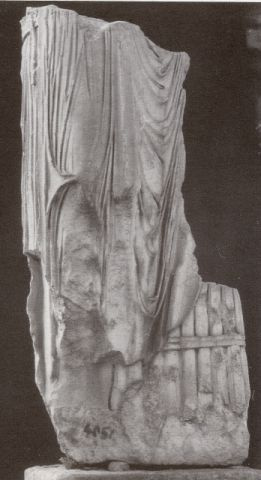
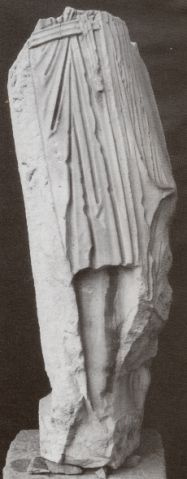
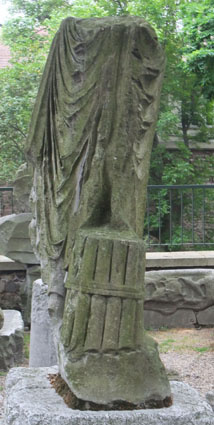
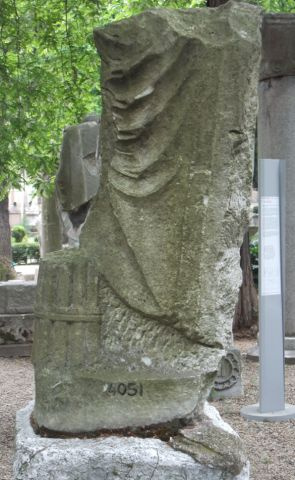
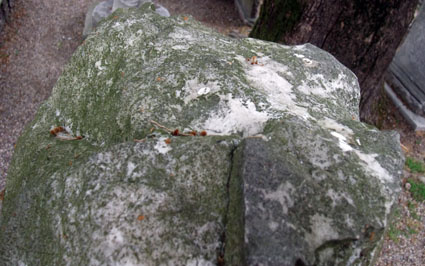
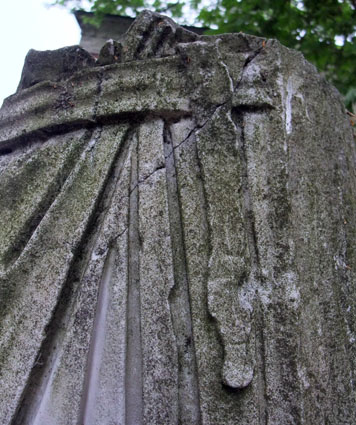
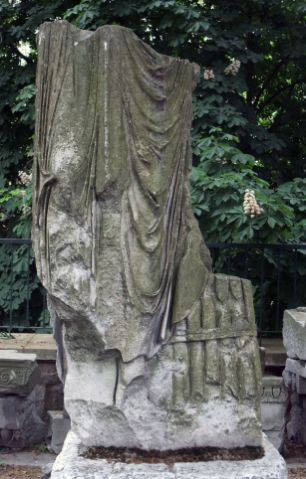
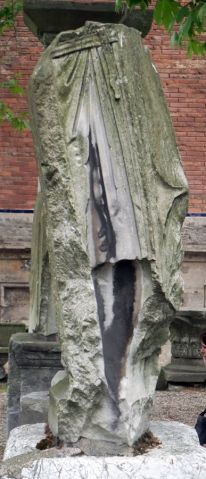
Lower half of portrait statue of man wearing chlamys. Constantinople. Late fourth to earlier fifth century.
Record details
Photographs
Bibliography
- Fıratlı, N., La sculpture byzantine figurée au Musée archéologique d'Istanbul, Paris 1990, 13, no. 16, pl. 8
- Gehn, U., Ehrenstatuen in der Spätantike. Chlamydati und Togati, Wiesbaden 2012, 352-3 cat. no. O 4
Discussion
DESCRIPTION (Object)
Marble, H 120, W 58, D 36 cm. The body is broken off above the waist. Both feet and a portion of the right shin are broken, together with the front and right side of the plinth. The edge of the cloak is broken at full length on the rear right side, and it is chipped at the left side. The surface of the front is damaged at the right shin and at the area between the shins.
The folds of the cloak and the details of the costume are realistically rendered; the underlying body determines the fall of the folds of the garment and the build-up of the statue (see below, ‘Description (Subject)’ and ‘Date’).
PROVENANCE AND CURRENT LOCATION
The torso was found in the Sirkeci quarter of Istanbul, in the area of the main post office; this is the area of the ancient Augusteum. It entered the Museum in 1925. It is now in the Istanbul Archaeological Museum, inv. no. 5051. In spring 2011 it was on display in the Museum garden.
DESCRIPTION (Subject)
The statue is standing over its left leg; the right knee is bent and stretches the heavy cloak. At the left foot a bundle of scrolls held by a double band is standing. The statue is clad in a chlamys which reaches down onto the shins. At the open right side of the cloak a knee-length tunic is visible. The tunic is girded by a belt with borders and a spine running in the centre. The end of the belt is hanging over the belt at the right side (cf. LSA-1010); it is mounted with a drop-shaped coating.
The chlamys costume identifies the portrayed as a high ranking imperial office holder. An emperor can be excluded, because the belt is without jewels (see also below, ‘Further Discussion’).
DATE
A terminus post quem for our statue is the late 4th century, when the chlamys entered the self-representation of the late-antique senatorial class in all media (Gehn 2012, 103-6. 113-32). The ‘realistic’ rendering of the garment and the impact of the underlying body suggest a date in the late 4th or earlier 5th century (Gehn 2012, 148-50).
FURTHER DISCUSSION
The statue was found in the area of the ancient Augusteum, one of the centres of political life in Constantinople. From literary sources it is known that this square was one of the outstanding locations of imperial statue representation in the capital. Our statue suggests that the square was also equipped with non-imperial honorific statues which were not recorded by our mid-byzantine literary sources (see also LSA-1167, LSA-1168).
Cite: Last Statues of Antiquity, LSA-1160 (Ulrich Gehn).