
LSA-1161
Fragmentary base for statue, probably of governor of Creta. Olous (Creta). Late third to fifth century
Record details
Photographs
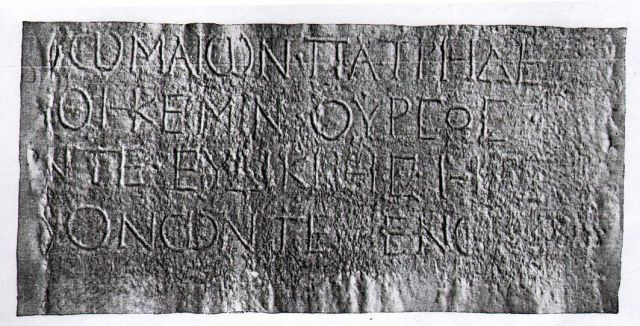
Inscription
Νίκῃ Ῥωμαίων πάτρῃ δὲ / ἀνέθηκέ μιν Οὖρσος / νηόν τε Εὐδικίης ἡγεμόνων τε [γ]ένος.
Inscription translation
Ursus set him up to Victory, the fatherland of the Romans, (him who is a) temple of justice, from a family of governors.
Bibliography
- Guarducci, M. , Inscriptiones Creticae. Vol. I. Tituli Cretae mediae praeter Gortynos, Rome 1935, p. 256 Olous no. 13 B
Discussion
INSCRIPTION
Verse epigram of one distich laid out in three lines:
Νίκῃ Ῥωμαίων πάτρῃ δὲ / ἀνέθηκέ μιν Οὖρσος / νηόν τε Εὐδικίης ἡγεμόνων τε [γ]ένος.
'Ursus set him up to Victory, the fatherland of the Romans, (him who is a) temple of justice, from a family of governors'.
Letter height: 2-3 cm.
The inscription remembers a certain Ursus who dedicated a statue to a high ranking person, probably to a governor of Crete. The name of the honorand is not preserved on the fragment.
DESCRIPTION (from Guarducci 1935)
Fragment of white marble.
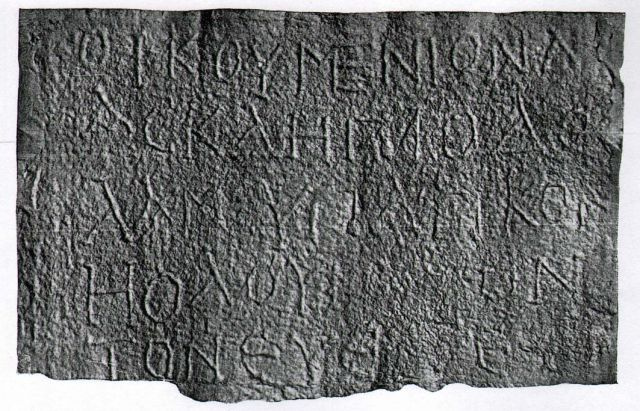
Guarducci 1935 put this fragment together with another fragment of the same material from the same findspot, bearing a prose inscription to the governor (consularis) of Crete Oecumenius Dositheus Asclepiodotus (LSA-792). According to Guarducci, the two inscriptions were put on the opposite broad sides of a single statue base. This would be unparalleled, as far as we see. Moreover, the lettering of the two inscriptions is so different, that we think they represent two distinct honours.
PROVENANCE AND CURRENT LOCATION
For the provenance of the inscription see LSA-792.
HONORAND, AWARDER, AND DATE
The name of the honorand is not preserved, but from the formula it is evident that he was a high ranking official, most probably a governor of Crete.
The awarder Ursus can not be identified with any of the men of that name known so far (PLRE I, 998-9; PLRE II, 1192-3). He possibly was a member of the provincial or municipal elite.
If the title ἡγεμών applied to the honorand is read in its specific meaning praeses, this would date the inscription into the period after the province of Creta was established in the wake of the tetrarchic reforms 295/7, and before its governorship was elevated to consular rank in the 4th century. This is not secure, though. ἡγεμών might be used in the broader sense of 'governor'.
Discussion references
- Jones, A. H. M. et al., The Prosopography of the Later Roman Empire. Vol. I 260-395, Cambridge et al. 1971 (1975)
- Martindale, J. R., The Prosopography of the Later Roman Empire. Vol. II A.D. 395-527, Cambridge 1980
Cite: Last Statues of Antiquity, LSA-1161 (Ulrich Gehn).