
LSA-1165
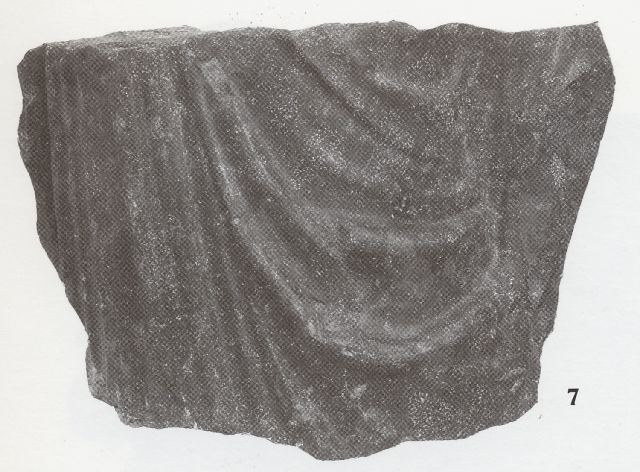
Fragment of porphyry togate or chlamys statue of Emperor. Constantinople. Fourth to fifth century.
Record details
Photographs
Bibliography
- Fıratlı, N., La sculpture byzantine figurée au Musée archéologique d'Istanbul, Paris 1990, 8, no. 7, pl. 4
- Gehn, U., Ehrenstatuen in der Spätantike. Chlamydati und Togati, Wiesbaden 2012, 347-8 cat. no. P 9
Discussion
DESCRIPTION (Object):
Fragment of statue. H: 23, W: 40, D: 27 cm. Porphyry.
The fragment is broken above and below. The extant folds are well-executed and finished.
PROVENANCE
Hagia Sophia, Istanbul. Entered the Istanbul Archaeological Museum in 1965.
DESCRIPTION (Subject)
The fragment comes probably from a life-size statue. From the single published photograph, it is difficult to determine which portion of the statue is preserved. The fold patterns correspond either to the right hip area of a togate statue (such as any high-imperial togate figure or even LSA-154 ) or the left hip area of a statue wearing a full-length chlamys (such as LSA-150).
If it were from the right hip of a togate statue, one would understand the U-shaped folds as the folds immediately below the balteus at the right hip: the thick straight folds on the viewer’s left would represent the folds falling beneath the right arm which reach below the right knee before turning upwards; the forward and diagonal material at the viewer’s right would be the material rising around the advanced left thigh. One would have to imagine that a portion of the statue was missing here; that is the proper left hip would have had to have been wider.
If the fragment came from the left thigh of a chlamys statue, the straight folds on the viewer’s left would correspond to large folds falling essentially from a fibula on the right shoulder; the U-shaped folds would be those around the proper left hip and thigh which are created in such statues by the bent left arm; the forward material on the viewer’s right would correspond to large folds falling from the forearm of a statue in such a pose.
HONORAND AND DATE
The use of porphyry makes it certain that this is from an imperial statue.
The predilection for porphyry for imperial statues from the Tetrarchic period onwards and the find location in Constantinople suggest that this is a fragment from a late-antique statue or at least from a statue re-used in the late-antique period. Pre-Constantinian Byzantium is unlikely to have housed porphyry statuary.
Cite: Last Statues of Antiquity, LSA-1165 (J. Lenaghan).