
LSA-117
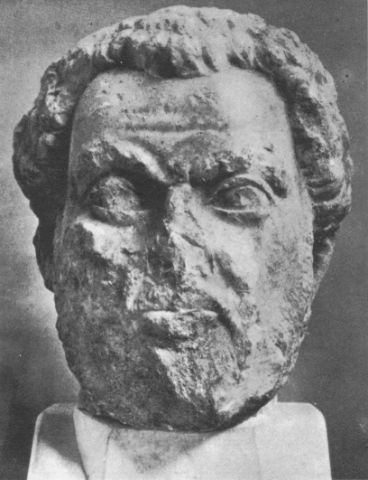
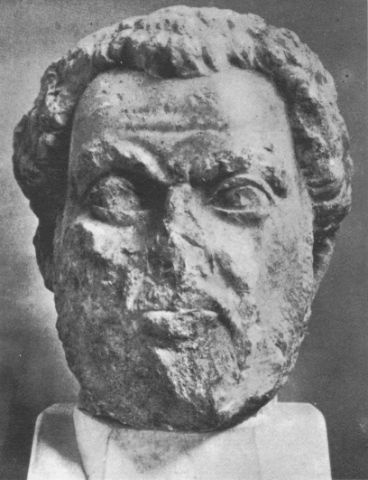
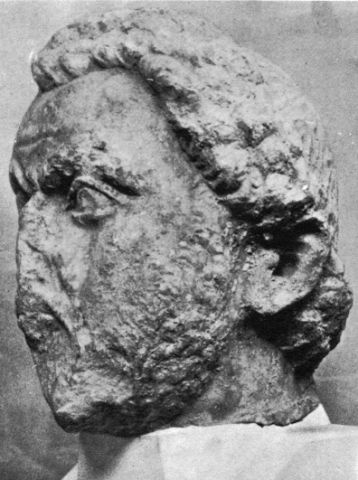
Portrait head of bearded man with 'wreath' hairstyle. Athens. Fifth century.
Record details
Photographs
Bibliography
- L'Orange, H. P., Studien zur Geschichte des spätantiken Porträts, Oslo 1933, 89-92,150 nr. 126
Discussion
DESCRIPTION (Object)
Marble head (Pentelic according to L'Orange 1933), horizontally broken below the chin. Nose, chin, and right cheek are chipped off; eyebrows, eyes and lips are chipped. There are no measurements published (L'Orange 1933, 150, only gives the distance mouth-hairline, 12.5 cm).
The hair is a compact mass articulated by chisel work on the surface only. The beard is plastically rendered, worked in the same technique as the hair.
The eyeballs are protruding, both lids sharply delineated; the upper lid is separated from the orbital by a deeply drilled line. Both eyeballs are damaged so that it is impossible to tell whether and in which way pupil and iris were sketched. The eyes are wide open, the right brow raised; this incongruity is mirrored in the wrinkles on the forehead.
The flesh is markedly if parsimoniously articulated by the deep naso-labial-folds and the wrinkles on the forehead. The lips are closed, separated from each other by a thin horizontal chiselled line.
PROVENANCE/ LOCATION
There is no published record of the head's provenance. L'Orange 1933, 150 suggests that it is of Pentelic marble which makes it probable that it was worked in Athens. Today in the Acropolis Museum, inv. no. 2358.
DESCRIPTION (Subject)
Portrait head of a mature man with trimmed beard. The hair is combed forward radially from the crown of the head to form a thick wreath of curls around the face and in the neck, thereby covering the upper part of the ears. The hair is slightly receding over the temples. The open eyes, the raised eyebrows, and the compressed lips create an impression of awareness and austerity.
The 'wreath-hairstyle' is a coiffure type which can be observed on magistrate's heads on the obelisk-base in Constantinople (where it is typologically distinguished from the lank imperial hair style and the long hair of the barbarian life-guards). It has been applied throughout the 5th century to magistrate's portraits as traceable primarily in portraits from Asia minor (for exmple the so-called 'Younger Magistrate' LSA-170, the praeses Cariae Oecumenius (LSA-150 (statue with head), LSA-151 (base)), or the consularis Cariae Flavius Palmatus (LSA-198), all from Aphrodisias). Given the typological division in late-antique portraiture, the portrayed most probably was a high imperial office holder.
DATE
For L'Orange 1933, the reduction of plastic articulation as shown by our head, was a criterium of stylistic development away from the 'theodosian classicism' towards a stereometric, linear 'byzantine' style. Though typologically still connected with the portraiture of the 1st half of the 5th century, he saw our head as 'advanced' towards that byzantine style and dated it, together with the head from Piraeus (LSA-101), to the 2nd half of that century (L'Orange 1933, 88-92).
In the absence of hard dating evidence, typological and stylistic considerations remain our sole criteria. Within the set of Athenian portrait heads, the head from Piraeus in the National Museum inv. no. 125 (LSA-101) and the head National Museum inv. no. 124 (LSA-119) offer the closest stylistic and typological parallels. National Museum 124 resembles our head in the thick wreath surrounding the face, combined with the trimmed beard. The latter head (NM 124), for the similarities in hair- and beard-style together with the generally 'ornamentalizing style' has been associated with the diptych of Boethius from 487 (Delbrueck 1929 N 7) by L'Orange 1933, 91.
In the wider ambit, portraits from Asia Minor that have traditionally (and often based on the frame worked out by L'Orange 1933) been dated to the advancing 5th century show comparable stylistic and typological features (so called 'Younger Magistrate' from Aphrodisias (LSA-170); so-called 'Elder Magistrate' from Aphrodisias (LSA-169), with different hairstyle, but similar stylistic values).
The thick, 'developed' hair-wreath of our head indicates, in our view, a date later than the Obelisk-base in Constantinopel (dated 390-2), where the 'magistratic hairstyle' is displayed in a moderate form. We accept a date in the mid/ later 5th century for our head.
Discussion references
- Delbrueck, R., Die Consulardiptychen und verwandte Denkmäler, Berlin & Leipzig 1929, pp. 103-6 N 7
Cite: Last Statues of Antiquity, LSA-117 (Ulrich Gehn).