
LSA-1170
Architrave (?) with inscription for statue of Constantius I, emperor. Thugga (Africa Proconsularis). 295.
Record details
Photographs
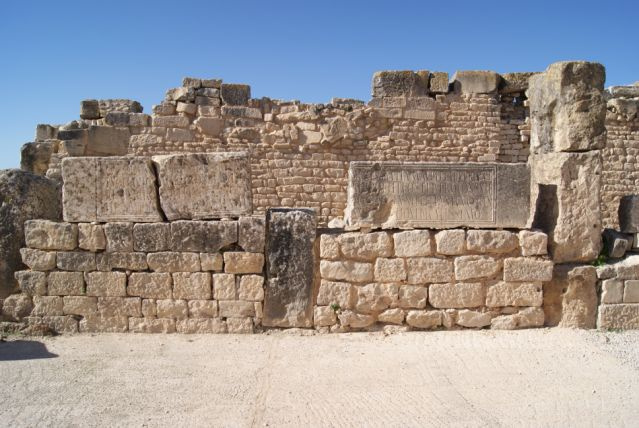
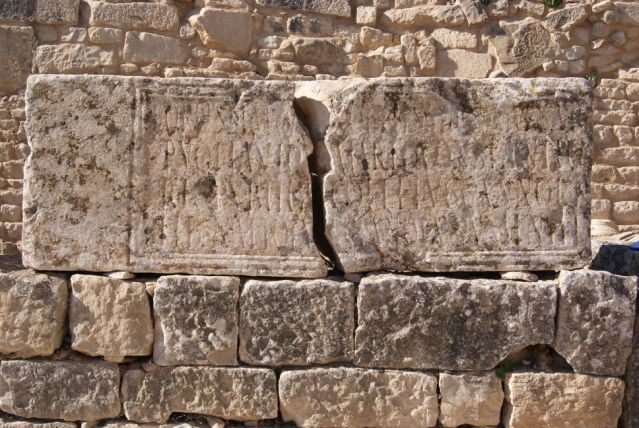
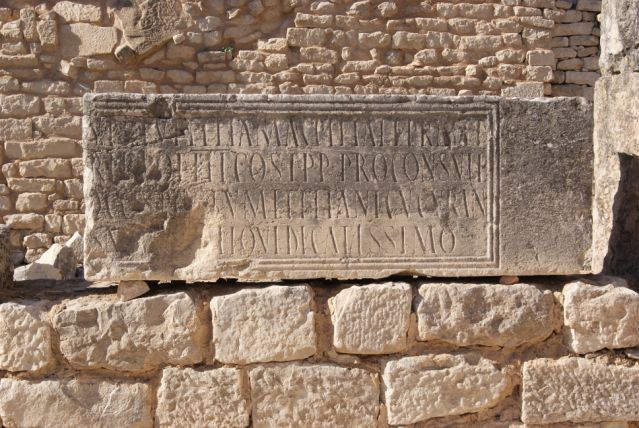
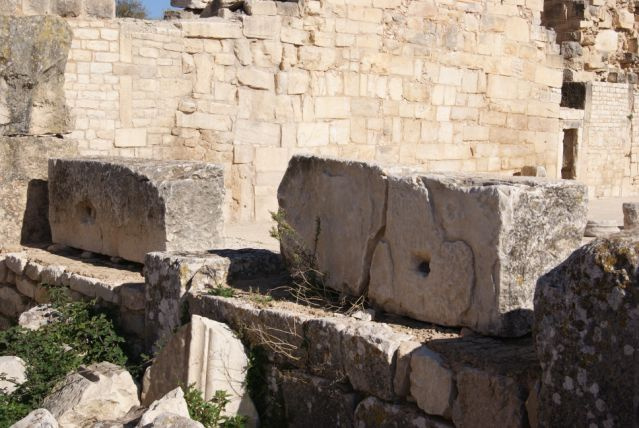
Inscription
Fortissimo ac nobilissimo Caesari, virtute etiam ac pietate praeci/puo, Flavio Valerio Constantio, trib(unicia) pot(estate) III, co(n)s(uli) I, p(atri) p(atriae), proconsuli, / res publica col(oniae) Thugg(ae), anno proco(n)s(ulatu) Postumi Titiani c(larissimi) v(iri), curan/te Egnatio Tucciano c(larissimo) v(iro), numini ei[u]s m[aiesta]tique dicatissimo. (2 ivy leaves, and 2 palm branches)
Inscription translation
To the most powerful and noble Caesar, outstanding in virtue and piety, Flavius Valerius Constantius, holding tribunician power for the third time, consul for the first time, father of the fatherland, proconsul. The community (res publica) of the colony of Thugga [set this up] in the year of the governorship of Postumus Titianus, of clarissimus rank; with Egnatius Tuccianus, [also] of clarissimus rank, taking charge, [and] most devoted to his divine spirit and majesty. (2 ivy leaves and 2 palm branches)
Bibliography
- Corpus Inscriptionum Latinarum; , VIII no. 26566
- Khanoussi, M. and L. Maurin (eds.), Dougga, fragments d'histoire : choix d'inscriptions latines éditées, traduites et commentées (1er-IVe siècles), Bordeaux 2000, p. 50-51, no. 21
- Lepelley, C., Les cités de l'Afrique romaine au Bas-Empire, t. 2, Notices d'histoire municipale, Paris 1981, p. 219, n. 7
Discussion
INSCRIPTION
In four lines:
Fortissimo ac nobilissimo Caesari, virtute etiam ac pietate praeci/puo, Flavio Valerio Constantio, trib(unicia) pot(estate) III, co(n)s(uli) I, p(atri) p(atriae), proconsuli, / res publica col(oniae) Thugg(ae), anno proco(n)s(ulatu) Postumi Titiani c(larissimi) v(iri), curan/te Egnatio Tucciano c(larissimo) v(iro), numini ei[u]s m[aiesta]tique dicatissimo. (2 ivy leaves, and 2 palm branches)
'To the most powerful and noble Caesar, outstanding in virtue and piety, Flavius Valerius Constantius, holding tribunician power for the third time, consul for the first time, father of the fatherland, proconsul. The community (res publica) of the colony of Thugga [set this up] in the year of the governorship of Postumus Titianus, of clarissimus rank; with Egnatius Tuccianus, [also] of clarissimus rank, taking charge, [and] most devoted to his divine spirit and majesty.' (2 ivy leaves and 2 palm branches)
The inscription is in large, regular, and well executed capitals, 10 cm high.
DESCRIPTION (from N. Demaison and L. Maurin, in Khanoussi and Maurin (eds.), 2000)
On two conjoining blocks that make up 'un linteau' (presumably an architrave): H 64, W 369, D 44 cm. The left block is broken into two conjoining pieces and badly worn; the right block is damaged at its left end, but otherwise well preserved. The epigraphic field is framed by a moulding.
PROVENANCE AND CURRENT LOCATION
L. Poinssot discovered this inscription amongst the debris directly to the west of the Capitolium. It is now displayed on the east side of the forum (inv. nos. F23 and F57).
HONORAND, AWARDER AND DATE
The honorand, Constantius I, was Caesar from 293 to 305. Constantius' third holding of tribunician power (tribunicia potestas) is dated between 10 December 294 and 9 December 295, while the governorship of Titus Flavius Postumius Titianus (PLRE I, 919-20 Titianus 9) began in July 295. Our base can therefore be dated between July and December 295.
Egnatius Tuccianus, who was responsible for setting up the dedication on behalf of the city of Thugga, was probably its curator (PLRE I, 924, Tuccianus).
FURTHER DISCUSSION
Our inscription, and another in Thugga dedicated to Galerius (LSA-1951), are of the same year and have the same formula. C. Poinssot and then C. Lepelley suggested they were part of a single monument located on the forum, southwest of the Capitolium, with four statues of the Tetrarchs above (See Poinssot, 1983, p. 39, and Lepelley, 1981, p. 219). Demaison and Maurin, however, argue that the measurements and layout of these two inscriptions are dissimilar, and favour a hypothesis that the two inscriptions derive from two differents monuments. As both inscriptions were found close to a large substructure to the southwest of the Capitolium, the hypothesis of Poinssot and Lepelley is the most attractive.
Cite: Last Statues of Antiquity, LSA-1170 (Gabriel de Bruyn).