
LSA-1171
Building inscription mentioning statues for three emperors (Augusti). Thugga (Africa Proconsularis). Probably 364-395
Record details
Photographs
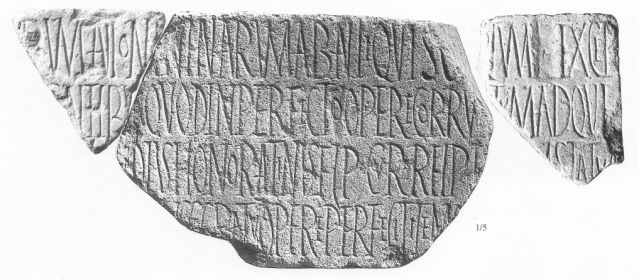

Inscription
Atrium thermarum Antoninianarum ab antiquis c[oe]ptum, excep/toriis in eodem loco su[b]stantibu[s], quod inperfecto opere corruptum adque / ruderibus foedatum, [---]dius Honorati(a)nus, fl(amen) p(erpetuus), cur(ator) rei p(ublicae) II, [cu]m statua / [s]ignoq(ue) felicissim[--- A]uggg(ustorum), ratu opere fecit itemq[ue dedica]vit.
Inscription translation
---dius Honoratianus, priest in perpetuity, curator of the city for the second time, carefully restored and dedicated the atrium of the Antonine baths, built by men of the past, with its underlying cisterns, which through shoddy work had decayed and fallen into ruin, with [also] a statue and image (cum statua signoque) of our most fortunate three Augusti.
Bibliography
- Ben Abdallah, Z. B., Catalogue des inscriptions latines païenne du Musée du Bardo, Rome 1986, no. 225
- Khanoussi, M. and L. Maurin (eds.), Dougga, fragments d'histoire : choix d'inscriptions latines éditées, traduites et commentées (1er-IVe siècles), Bordeaux 2000, no. 42
Discussion
INSCRIPTION
In four lines:
Atrium thermarum Antoninianarum ab antiquis c[oe]ptum, excep/toriis in eodem loco su[b]stantibu[s], quod inperfecto opere corruptum adque / ruderibus foedatum, [---]dius Honorati(a)nus, fl(amen) p(erpetuus), cur(ator) rei p(ublicae) II, [cu]m statua / [s]ignoq(ue) felicissim[--- A]uggg(ustorum), ratu opere fecit itemq[ue dedica]vit.
'...dius Honoratianus, priest in perpetuity, curator of the city for the second time, carefully restored and dedicated the atrium of the Antonine baths, built by men of the past, with its underlying cisterns, which through shoddy work had decayed and fallen into ruin, with [also] a statue and image (cum statua signoque) of our most fortunate three Augusti.'
Letter height: 6-7 cm.
The name of the Antonine Baths (thermae Antoninianae) derives from their construction at the time of Caracalla.
The use of the singular for 'statua' (in line 3) led early editors to restore the name of Gratian in line 4 (see Ben Abdallah, 1986). However, Z. Ben Abdallah and L. Maurin, who have reviewed the inscription, are certain we must read 'Auggg(ustorum)', in that line - a reference to three Augusti (Abdallah and Maurin, in Khanoussi and Maurin (eds.), 2000, 123), though why or how they were honoured with a single statue and image (statua signoque) is obscure.
DESCRIPTION (from Ben Abdallah and Maurin)
Four fragments of a limestone plaque, all 12 cm thick.
Fragment 1 preserves part of the original top and left edges: H 33, W 42 cm. Fragment 2 part of the upper edge: H 21, W 20 cm. Fragment 3 preserves both upper and lower edges: H 33, W 50 cm. While fragment 4 is complete only at the top: H 23, W 20cm. From these figures we can calculate that the plaque was rectangular, 33 cm high and at least 132 cm long.
PROVENANCE AND CURRENT LOCATION
Fragment 1 was found in 1902 re-used in a modern house next to the Capitolium; it is now lost. The precise find-spot of fragment 2 is unknown; it is now in the Dougga store rooms (Inv. no. D 3). Fragment 3 was found in 1919 in the street that runs about thirty metres east of the macellum, and Fragment 4 during the excavations of the so-called 'Licinian' baths (which are in fact the Antonine baths); they are now in the Bardo museum (inv. no. 1734 and 1735).
HONORAND, AWARDER AND DATE
The mention of three Augusti in the inscription led Ben Abdallah and Maurin to identify the honorands as Valens, Gratian and Valentinian II (375-8) or Gratian, Valentinian II and Theodosius I (379-83), and therefore to date our inscription between 375 and 383. However, other trios of emperors are also possible: Constantius II, Constantine II and Constans (337-40); Valens, Valentinian I and Gratian (367-75); and Theodosius I, Honorius and Arcadius (393-5). The reign of the three sons of Constantine (337-40) is unlikely, since this was a period when cities had much of their income confiscated, and when new building and repair were rare (Lepelley 1979, 90-98). By contrast, under the Valentinianic and Theodosian dynasties, the north African cities undertook many repairs to their buildings. We therefore suggest 367 to 395 as the probable date-range for our inscription.
The awarder, ...dius Honoratianus, priest in perpetuity and curator of Thugga, is known only from this inscription.
FURTHER DISCUSSION
Ben Abdallah and Maurin suggested that the names of the three emperors were inscribed on a plaque fixed above our inscription or on another support.
Discussion references
- Khanoussi, M. and L. Maurin (eds.), Dougga, fragments d'histoire : choix d'inscriptions latines éditées, traduites et commentées (1er-IVe siècles), Bordeaux 2000, p. 122-4, no. 42
Cite: Last Statues of Antiquity, LSA-1171 (Gabriel de Bruyn).