
LSA-1172
Base for statue of unknown emperor. Uchi Maius (Africa Proconsularis). 293-369
Record details
Photographs
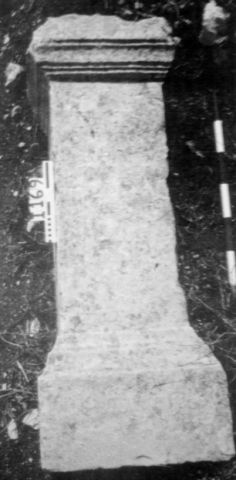
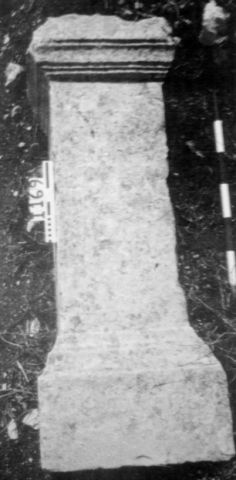
Inscription
Felicissimo / ac ịṇ[vic(?)]ṭissi/mo d(omino) n(ostro) Flavio A/R[---]/TI[---], / (5) proco(n)s(uli), / [---], / [r(es) p(ublica) col(oniae) Uchitanorum] Ma/iorum, devota / numini [maiesta]/[tique eius]
Inscription translation
To our lord, the most fortunate and most unconquered (?), Flavius AR[---]TI[---], proconsul ... The community (res publica) of the colony of Uchi Maius, devoted to his divine spirit and majesty, [set this up].
Bibliography
- Corpus Inscriptionum Latinarum; , VIII, no. 26269
- Ibba, A., Uchi Maius. 2, . Le iscrizioni, Sassari 2005, no. 58
Discussion
INSCRIPTION
In nine lines:
Felicissimo / ac ịṇ[vic(?)]ṭissi/mo d(omino) n(ostro) Flavio A/R[---]/TI[---], / (5) proco(n)s(uli), / [---], / [r(es) p(ublica) col(oniae) Uchitanorum] Ma/iorum, devota / numini [maiesta]/[tique eius]
'To our lord, the most fortunate and most unconquered (?), Flavius AR[---]TI[---], proconsul ... The community (res publica) of the colony of Uchi Maius, devoted to his divine spirit and majesty, [set this up].'
In line 2, C. Lepelley suggests '[pi]issimo'. However, the Italian team which has examined the stone prefers 'in[vic]tissimo', following P. Ruggeri's reading of a 'T'. The first letters of this word, here tentatively rendered as 'IN', are almost erased, and practically illegible. If the last two letters of line 3 should be read as 'AV' (as proposed by A. Ibba), the name could be 'Au/r[elio]'.
Letter height: 5.5 cm
DESCRIPTION (from A. Ibba)
Rectangular limestone base, with plinth and crown, and mouldings on three faces. The back is roughly worked. The epigraphic field is almost erased, leaving few letters readable. H 170, W 44, D 47 cm.
PROVENANCE AND CURRENT LOCATION
Found by Captain Gondouin 100 metres east of the zaouïa of Sidi Mohamed Salah, on the southwest side of the hill, where it remains. Inventoried by the Institut National du Patrimoine as inv. I 169.
HONORAND, AWARDER AND DATE
The honorand was an emperor of the fourth century. It is certain he was a 'Flavius', and therefore a member of the Constantinian, Valentinianic or Theodosian dynasties.
The awarder was the city, as is usual in Africa for imperial statues.
The inscription uses a traditional titulature, with mention of the emperor's proconsulship, which, according to A. Chastagnol (1988, 13), is last recorded in 369, for Gratian. Our base can therefore probably be dated between 293 and 369.
Discussion references
- Chastagnol, A. "Le formulaire de l'épigraphie latine officielle dans l'Antiquité Tardive", Donati, A. (ed.), La terza età dell'Epigrafia, Faenza 1988, p. 13
- Lepelley, C., Les cités de l'Afrique romaine au Bas-Empire, t. 2, Notices d'histoire municipale, Paris 1981, p. 235
- Ruggeri P., "La casa imperiale", Uchi Maius, 1, Scavi e ricerche epigrafiche in Tunisia, Sassari, 1997, p. 160
Cite: Last Statues of Antiquity, LSA-1172 (Gabriel de Bruyn).