
LSA-1174
Base for statue of Valens, emperor. Uchi Maius (Africa Proconsularis). 364-367.
Record details
Photographs
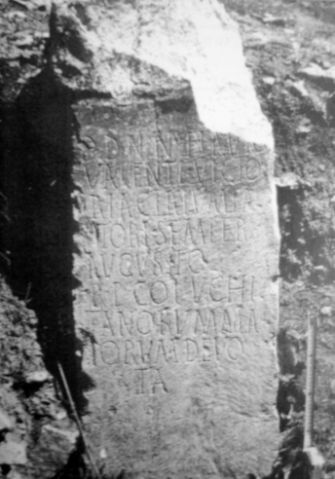
Inscription
Dd(ominis) nn(ostris) (sic) Flavio / Valenti, victo/ri ac triumfa/tori, semper / (5) Augusto, / r(es) p(ublica) col(oniae) Uchi/tanorum Ma/iorum devo/ta.
Inscription translation
To our [two] lords Flavius Valens, victorious and triumphant, forever Augustus. The community (res publica) of the devoted colony of the Uchitanians [set this up].
Bibliography
- Corpus Inscriptionum Latinarum; , VIII, 15452
- Ibba, A., Uchi Maius. 2, . Le iscrizioni, Sassari 2005, p. 173-5, no. 55
Discussion
INSCRIPTION
In eight lines:
Dd(ominis) nn(ostris) (sic) Flavio / Valenti, victo/ri ac triumfa/tori, semper / (5) Augusto, / r(es) p(ublica) col(oniae) Uchi/tanorum Ma/iorum devo/ta.
'To our [two] lords Flavius Valens, victorious and triumphant, forever Augustus. The community (res publica) of the devoted colony of the Uchitanians [set this up].'
Letter height : 5-6 cm
See below 'Honorand and Date' for an explanation of the inscription's seemingly contradictory opening words.
DESCRIPTION (from A. Ibba and the photo)
Rectangular base of grey limestone with plinth and crown, and mouldings on all sides: H 171, W 45, D 59 cm. Broken at the top.
PROVENANCE AND CURRENT LOCATION
Found northwest of an equestrian base dedicated to Septimius Severus (CIL VIII 26255). Merlin and Poinssot thought it was in its original location, but it had probably been re-used in Vandal-period buildings on the forum (See A. Ibba, 2005,173). The base is today standing where it was found; it was inventoried by the Institut National du Patrimoine as inv. I 152.
HONORAND AND DATE
The honorand, Valens, was Augustus from 364 to 378.
The awarder was the city, as usual in Africa for imperial statues.
The plural 'Dominis nostris' presumably indicates that our base was set up with another, dedicated to a co-emperor of Valens (Valentinian I or Gratian). Tissot thought the second base was dedicated to Gratian; but Lepelley and Ruggeri prefer Valentinian I. Indeed, since the double 'D' and double 'N' of our inscription are a reference to two emperors only, the two statues presumably represented Valens and his brother Valentinian I, and were erected before 24 August 367, when Gratian joined them as a third Augustus. Our base can therefore be dated between 364 and 367.
Discussion references
- Lepelley, C., Les cités de l'Afrique romaine au Bas-Empire, t. 2, Notices d'histoire municipale, Paris 1981, p. 235, no. 4
- Ruggeri P., "La casa imperiale", Uchi Maius, 1, Scavi e ricerche epigrafiche in Tunisia, Sassari, 1997, p. 161-2, no. 35
Cite: Last Statues of Antiquity, LSA-1174 (Gabriel de Bruyn).