
LSA-1175
Base for statue of unknown emperor (a Caesar). Uchi Maius (Africa Proconsularis). Late third to mid fourth century.
Record details
Photographs
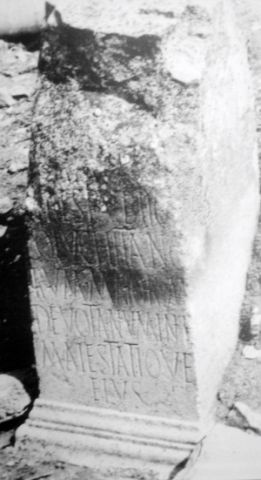
Inscription
---[nobi]/[lis]simo C[aesa]/ri, res publica / col(oniae) Uchitano/rum Maiorum, / devota numini / maiestatique / eius.
Inscription translation
To ..., the most noble Caesar. The community (res publica) of the colony of the Uchitani, devoted to his divine spirit and majesty, [set this up].
Bibliography
- Corpus Inscriptionum Latinarum; , VIII, no. 26268
- Ibba, A., Uchi Maius. 2, . Le iscrizioni, Sassari 2005, p. 171-3, no. 54
Discussion
INSCRIPTION
In seven surviving lines:
---[nobi]/[lis]simo C[aesa]/ri, res publica / col(oniae) Uchitano/rum Maiorum, / devota numini / maiestatique / eius.
'To ..., the most noble Caesar. The community (res publica) of the colony of the Uchitani, devoted to his divine spirit and majesty, [set this up].'
Letters height : 7-8 cm
DESCRIPTION (from A. Ibba)
Rectangular limestone base, badly damaged at the top, with surviving moulding at the bottom (on the front face only): H 125, W 42, D 49 cm.
PROVENANCE AND CURRENT LOCATION
Found (and still standing) on the forum of Uchi Maius, adjacent to the equestrian base of Septimius Severus. We cannot say whether the base was found in its original location, or re-used in Vandal-period buildings. It was inventoried by the Institut National du Patrimoine as inv. I 156.
HONORAND, AWARDER AND DATE
The formula uses the epithet nobilissimus for its imperial honorand, which is attested from Geta to Valentinian III, but is very common in the tetrarchic and Constantinian periods, and used for Caesars, not Augusti. After Julian, all 4th-century emperors were Augusti ; the terminus ante quem is therefore Julian's elevation to the rank of Augustus in 361.
The dedication by the 'colony' of Uchi Maius provides an absolute terminus post quem of 230, when the colony was founded by Severus Alexander, but the most probable terminus post quem is the year 293, when Caesars were adopted into the imperial college of the tetrarchy.
Cite: Last Statues of Antiquity, LSA-1175 (Gabriel de Bruyn).