
LSA-1178
Base for re-erected statue (subject unstated). Gortyna (Creta). Fourth to early fifth century
Record details
Photographs
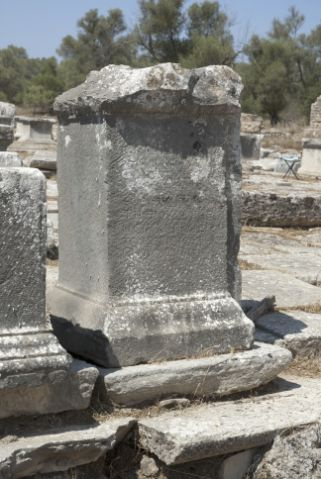
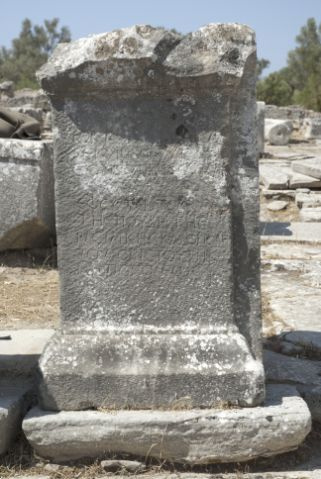
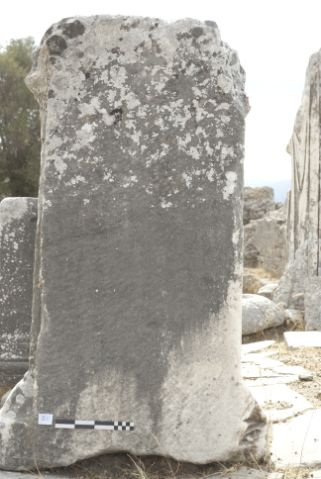
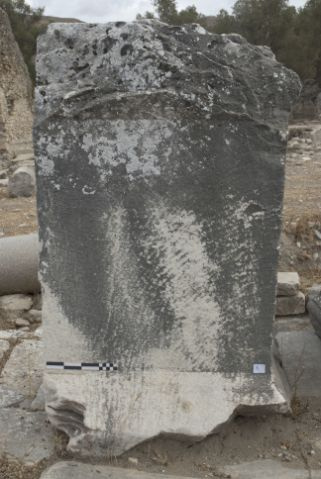
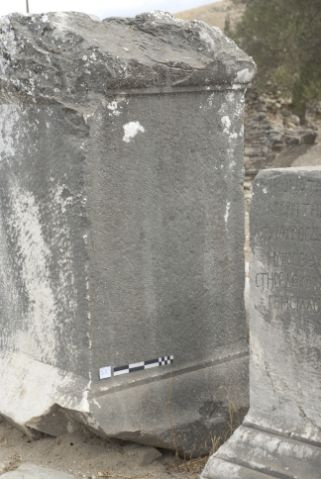
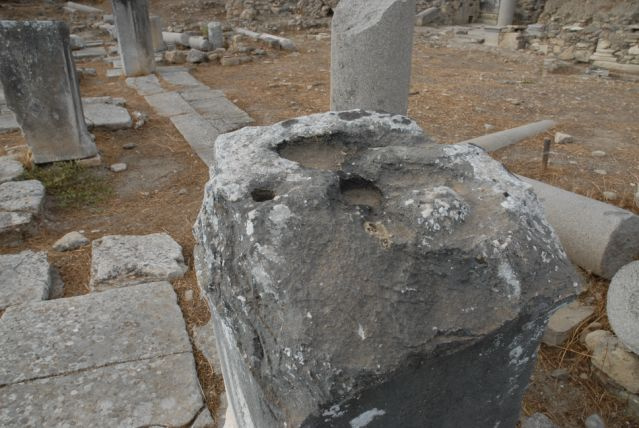
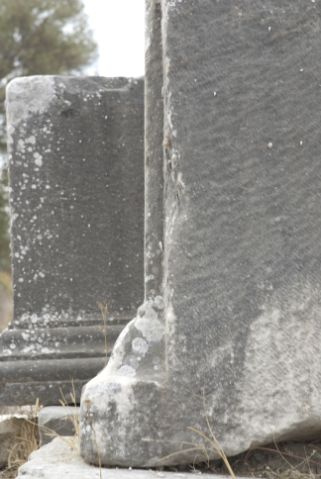
Inscription
Fortunatianus / Servilius / v(ir) c(larissimus) / consularis cur[avit]. ἐφεστῶτος τῇ / σπουδῇ τῆς / βασιλικῆς Καλοπόδη / τοῦ λογιστοῦ τῆς μητροπόλεως
Inscription translation
Fortunatianus Servilius, man of clarissimus rank, governor (consularis) took charge. Responsible for the regards of the Basilica ( = praetorium) was Calopodes the curator of the metropolis.
Bibliography
- Guarducci, M., Inscriptiones Creticae. Vol 4. Tituli Gortynii, Roma 1950, no. 336 b
Discussion
INSCRIPTION
In five lines:
Fortunatianus / Servilius / v(ir) c(larissimus) / consularis curavit / (vacat) / ἐφεστῶτος / τῇ σπουδῇ τῆς / βασιλικῆς Καλοπόδη / τοῦ λογιστοῦ τῆς / μητροπόλεως
'Fortunatianus Servilius, of clarissimus rank, governor (consularis) took charge. Responsible for the regards of the Basilica ( = praetorium) was Calopodes the curator of the metropolis'
Letter height 3.5 - 4 cm.
DESCRIPTION (from Guarducci 1950)
Marble base with mouldings at top and bottom, intact on all sides. H 114 cm, W 55 cm, D 55 cm. At the right side the moulding does not surround the base, the side is levelled to fit against a wall.
In the praetorium of Gortyn a similar base with the same inscription has been found (LSA-1177). This second base is levelled on the left side. The two bases obviously were set up on two opposite walls responding to each other.
PROVENANCE/ LOCATION
The base was found in the praetorium of Gortyn many years after the corresponding base LSA-1177 (Guarducci 1950, p. 357 no. 336: '...multos post annos ...'). There is no published record of its present location. No published photo.
HONORAND, AWARDER, AND DATE
No honorand is given in our inscription. His (or her) name was possibly on a plinth or another crowning element, now lost. It is also possible that the statue carried by our base was ideal. The fromula, with the governor in the nominative and the verb curavit, together with a subordinate to take charge, resembles a set of inscriptions, mostly known from Rome and Italy, which remember the transposition and re-elevation of collapsed statues from abandoned areas to the central places of late antique cities.
The governor of our inscription, Fortunatianus Servilius, was identified by PLRE with the man of exactly the same name who dedicated the funerary inscription to his mother in Santa Saba in Rome (CIL VI 37125; PLRE I, 827 Fortunatianus Servilius). This man was a christian.
Seeck, on the other hand, identified the cretan governor with the comes rerum privatarum (CRP) of 369 and comes sacrarum largitionum (CSL) of 371 ( Seeck, RE VII (1912) 44 Fortunatianus 5 = governor of Crete and ibid., Fortunatianus 4 = the CRP and CSL). This Fortunatianus was a correspondent of Libanius and a pagan (PLRE I, 369 Fortunatianus 1).
Provided the identity of the Roman Fortunatianus Servilius with the cretan governor, the identity proposed by Seeck remains highly doubtful (cf. Guarducci 1950, p. 358 no. 336 a: 'valde incertum est'), although the change in religious confession could possibly be explained by a late conversion (De Tommaso 2000, 342).
The province of Crete, cut from the proconsular province of Crete and Cyrene in the wake of the tetrarchic reforms, was administered by a consularis probably from the constantinian period (cf.LSA-63,LSA-89), dedications to tetrarchs by a governor in the lower rank of praeses, cf. also Guarducci 1950, p. 322 no. 282). The formula of the inscritpion, which seems to indicate transposition and/ or repair after a desaster, points to the earthquakes of the mid 4th century. The reconstruction of the praetorium in Gortyn, testified to by several inscriptions of the governor Oecumenius Dositheus Asclepiodotus of 382/3 (LSA-472, LSA-770, LSA-774, LSA-950), are generally believed to have been executed after the earthquake of 365 (De Tommaso 2000, pp. 337-348). The transposition or re-elevation of a statue was possibly part of the restoration work. However, this seems too hypothetical to base a precise date on it. We therefore chose as a broader date range the 4th and early 5th centuries.
Discussion references
- Corpus Inscriptionum Latinarum; , VI
- De Tommaso, G., Il Settore B: La Basilica del Pretorio. Fase B6 = Fase costruttiva IX (ultimo venticinquennio del IV sec. d.C.), Gortina V.1. Lo Scavo del Pretorio (1989-1995) - Vol. V. 1* - , 337-48, Padova 2000
- Jones, A. H. M. et al., The Prosopography of the Later Roman Empire. Vol. I 260-395, Cambridge et al. 1971 (1975)
Cite: Last Statues of Antiquity, LSA-1178 (Francesca Bigi - Ignazio Tantillo - Ulrich Gehn).