
LSA-1179
Base for statue of Constantine I, emperor. Alexandria (Aegyptus), but probably from Thebae (Thebais). 310-324
Record details
Photographs
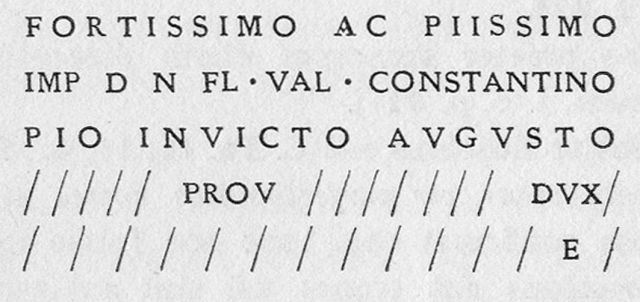
Inscription
Fortissimo ac piissimo / imp(eratori), d(omino) n(ostro), Fl(avio) Val(erio) Constantino, / pio, invicto Augusto, / [---] prov [---] dux [-] /[ -----------]e[---
Inscription translation
To the most powerful and most pious emperor, our lord Flavius Valerius Constantinus, pious, unconquered Augustus (...), commander (dux) ... of the provinces (?)....[set this up].
Bibliography
- Corpus Inscriptionum Latinarum; , III suppl. 2, 12050
- Lacau, P., Inscriptions latines du temple de Louxor, Annales du Service des Antiquités de l’Égypte 34, 1934, 17-46, 40-42 no. IV B
Discussion
INSCRIPTION
Partly preserved in five lines:
Fortissimo ac piissimo / imp(eratori), d(omino) n(ostro) Fl(avio) Val(erio) Constantino, / p(io), f(elici), invicto Augusto, / [V]al(erius) Rometalca [v](ir) p(erfectissimus) dux /(5) [ --utraru]mque / [---]
'To the most powerful and most pious emperor, our lord Flavius Valerius Constantinus, pious, fortunate, unconquered Augustus. Valerius Rometalca, of perfectissimus rank, military commander (dux) … of both … .'
Letter height not recorded.
We reproduce the inscription in the reading proposed by Lacau 1934. An earlier reading, reproduced in Corpus Inscriptionum Latinarum III, is different notably in line 4, where Lacau recognizes the name of the awarder:
Fortissimo ac piissimo / imp(eratori), d(omino) n(ostro), Fl(avio) Val(erio) Constantino, / pio, invicto Augusto, / [---] prov [---] dux [-] /(5)[ -----------]e[---
'To the most powerful and most pious emperor, our lord Flavius Valerius Constantinus, pious, unconquered Augustus, ... commander (dux) ... of the provinces (?) [set this up].'
Botti 1900 offered yet another reading of lines 4-5: ---edux / ---e /.
The reading convincingly offered by Lacau 1934 puts our inscription in line with two dedications to Constantine in Thebae set up by the same awarder (LSA-1180, LSA-2660<, see below, ‘Description’ and ‘Honorand, Awarder and Date’).
DESCRIPTION (Lacau 1934, Botti 1900, and the published images)
Upper portion of a columnar shaft of sandstone, H 29, diameter 53 cm. On the top face, there is a dowel hole and a cast channel by which a crowning element was attached. The material, ‘nubian sandstone’ according to Lacau 1934, 42, is identical to that of two dedications to Constantine in Thebae (Luxor) (LSA-1180, LSA-2660).
PROVENANCE AND CURRENT LOCATION
Research in in the archives of the Alexandria Museum in the early 1930s has brought forth no information about the provenance of the inscription (Lacau 1934, 42); the information by Breccia 1911 that it is from Alexandria is possibly mistaken (Breccia 1911 no. 91); the earlier catalogue by Botti 1900 gives no provenance (Botti 1900, 255 no. 13). As Lacau 1934, 42 points out, the material and the epigraphic formula which are similar to the Constantinian dedications in Thebae (LSA-1180, LSA-2660) suggest that our inscription is likewise from Thebae.
HONORAND, AWARDER AND DATE
The honorand, Constantine I, was Augustus 306-337, but fully recognized in the East only from 310 (Kienast 1996). After the defeat of Licinius in 324, Constantine replaced the title invictus (as in our inscription) by victor).
The name of the awarder is damaged; Lacau 1934, however, convincingly read the name of Valerius Rometalca, dux Aegypti et Thebaidos utrarumque Libyarum in line 4, thereby correcting earlier readings of the inscription. Valerius Rometalca is known as awarder of the two dedications to Constantine in Thebae mentioned above (LSA-1180, LSA-2660).
The rank of dux was held by commanders of frontier troops in the late Roman army. In the Constantinan period one such commander was responsible for all the provinces of Egypt and Lybia (the dux Aegypti et Thebaidos utrarumque Libyarum, LSA-1180; Mommsen 1889, p. 211 n. 2).
Discussion references
- Botti, G., Catalogue des monuments exposés au Musée Gréco-Romain d’Alexandrie, Alexandria 1900, p. 255 no. 13
- Breccia, E., Iscrizioni greche ed latine, Cairo 1911, no. 91
- Jones, A. H. M., The Later Roman Empire, 2 vols., Oxford 1964, Map IV
- Kienast, D., Römische Kaisertabelle. Grundzüge einer römischen Kaiserchronologie, Darmstadt (2)1996, p. 299
- Mommsen, T., Das römische Militärwesen seit Diocletian, Hermes 24, 195-279, Berlin 1889, p. 211 n. 2
Cite: Last Statues of Antiquity, LSA-1179 (Ulrich Gehn).