
LSA-1180
Base for statue of Constantine I, emperor. Thebae (Thebais). 310-324
Record details
Photographs
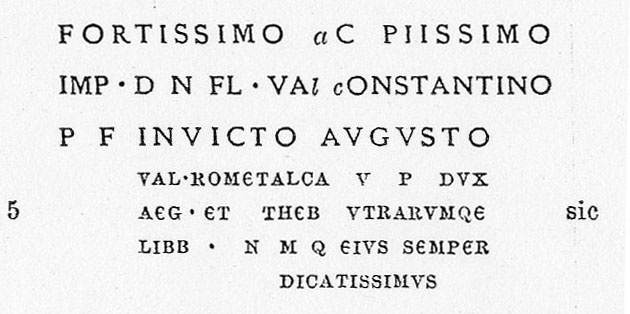
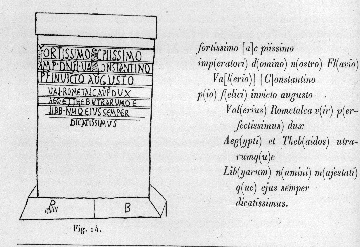
Inscription
Fortissimo ac piissimo / imp(eratori), d(omino) n(ostro), Fl(avio) Val(erio) Constantino), / p(io), f(elici), invicto Augusto, / Val(erius) Rometalca, v(ir) p(erfectissimus), dux / (5) Aeg(ypti) et Theb(aidos) utrarumq(u)e / Libb(yarum), n(umini) m(aiestati)q(ue) eius semper / dicatissimus.
Inscription translation
To the most powerful and most pious emperor, our lord Flavius Valerius Constantinus, pious, fortunate, unconquered Augustus. Valerius Rometalca, of perfectissimus rank, commander of the frontier army (dux) of Aegyptus and the Thebaid and both Libyas, most dedicated to his divine spirit and majesty,[set this up].
Bibliography
- Corpus Inscriptionum Latinarum; , III suppl. 2, 12073
- El Saghir, M. et al., Le camp romain de Louqsor (Mémoires Publiés par les Membres de l’Institut Français) 83, 1986, Cairo 1986
- Lacau, P., Inscriptions latines du temple de Louxor, Annales du Service des Antiquités de l’Égypte 34, 1934, 17-46, 35-8 no. IV A
Discussion
INSCRIPTION
In seven lines:
Fortissimo ac piissimo / imp(eratori), d(omino) n(ostro), Fl(avio) Val(erio) Constantino), / p(io), f(elici), invicto Augusto, / Val(erius) Rometalca, v(ir) p(erfectissimus), dux / (5) Aeg(ypti) et Theb(aidos) utrarumq(u)e / Libb(yarum), n(umini) m(aiestati)q(ue) eius semper / dicatissimus.
'To the most powerful and most pious emperor, our lord Flavius Valerius Constantinus, pious, fortunate, unconquered Augustus. Valerius Rometalca, of perfectissimus rank, commander of the frontier army (dux) of Aegyptus and the Thebaid and both Libyas, most dedicated to his divine spirit and majesty [set this up].'
Letter height 5-7 cm.
DESCRIPTION (from Lacau 1934)
Rectangular with mouldings at top and bottom, H 99, W 72, D 46 cm (the material of the stone is not reported by Lacau 1934; it is probably sandstone, like in the case of the similar base for Galerius LSA-2629). The base is made up of five blocks: the lower and upper mouldings are of one block each, the front face with the inscription of one block, and the rear half of the shaft of two blocks. On the top face there are holes for the insertion of a bronze statue.
PROVENANCE AND CURRENT LOCATION
The base was found in 1888 (date given by CIL) in the tetrarchic military camp built into the area of the temple of Ammon in Thebes. It was standing in the colonnaded hall in front of the room for the imperial cult, at the left side of the central aisle, close to the entrance of the room for the imperial cult (Deckers 1979, 605 fig. 1, 607-8). The base was recorded in situ by el-el-Saghir et al. 1986.
HONORAND, AWARDER, AND DATE
The honorand, Constantine I, was Augustus 306-337, but fully recognized in the East only from 310 (Kienast 1996). In 324, on the defeat of Licinius, he substituted his earlier title invictus (as in our inscription) with a new title victor.
The awarder, Valerius Rometalca, is known from this inscription and a similar, fragmented one likewise from Thebae (LSA-2630). A further, mutilated yet very similar inscription now in Alexandria might be attributable to him, LSA-1179 (PLRE I, 770, Val. Rometalca). He was the commander of the frontier troups in the provinces of Egypt and Libya (dux Aegypti et Thebaidos utrarumque Libyarum).
FURTHER DISCUSSION
The rank of dux was held by commanders of frontier troops in the late Roman army. In the Constantinan period one such commander was responsible for all the provinces of Egypt and Lybia (Mommsen 1889, p. 211 n. 2).
Discussion references
- Jones, A. H. M., The Later Roman Empire, 2 vols., Oxford 1964, Map IV
- Jones, A. H. M. et al., The Prosopography of the Later Roman Empire. Vol. I 260-395, Cambridge et al. 1971 (1975)
- Kienast, D., Römische Kaisertabelle. Grundzüge einer römischen Kaiserchronologie, Darmstadt (2)1996, p. 299
- Mommsen, T., Das römische Militärwesen seit Diocletian, Hermes 24, 195-279, Berlin 1889, p. 211 n. 2
Cite: Last Statues of Antiquity, LSA-1180 (Ulrich Gehn).