
LSA-1183
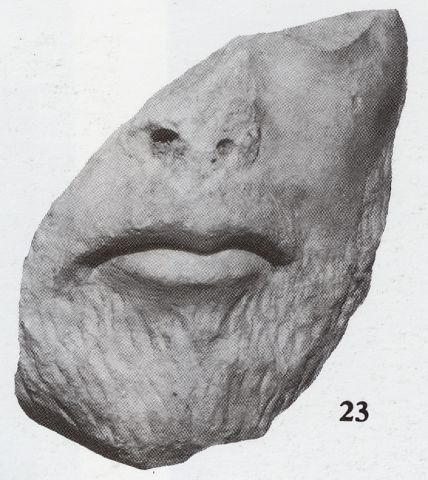
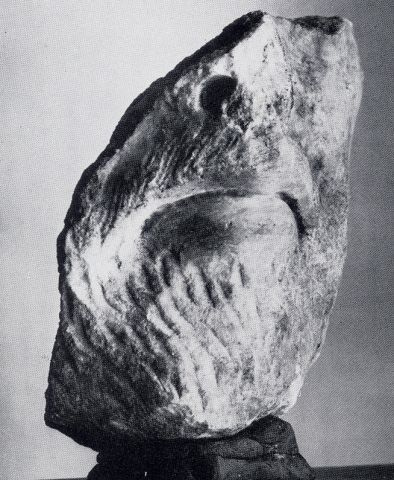
Lower face of portrait head of man with engraved beard. Constantinople. Fifth century.
Record details
Photographs
Bibliography
- Fıratlı, N., La sculpture byzantine figurée au Musée archéologique d'Istanbul, Paris 1990, 15, no. 23, pl. 11
- Inan, J. & E. Alföldi-Rosenbaum, Römische und frühbyzantinische Porträ̈tplastik aus der Türkei : neue Funde, Mainz 1979, 281-2,no. 273, pl. 204.5 (AD 235-250)
Discussion
DESCRIPTION (Object)
Fragment of a male marble portrait head, H 12 cm. The head is broken in a line from the right jawbone to the left eye. The nose is broken.
The beard is indicated with flat long lines of a broad chisel at the chin; the moustache is sketched with a fine chisel.
The left upper lid is set against the cheek with an incised line. The lips are subtly modeled.
PROVENANCE AND CURRENT LOCATION
The fragment was found at Laleli, at Mesih Paşa (Müller-Wiener 1977, 437-8), near the Bodrum Camii. It entered the Istanbul Archaeological Museum in 1944. In the same area, a 5th century toga statue (LSA-1040) and an inscription, probably a statue base to an emperor Theodosius (LSA-30) were found.
DESCRIPTION (Subject)
Portrait head of a male with trimmed beard.
The trimmed beard suggests that this was probably the portrait of a non-imperial person, possibly of a Constantinopolitan aristocrat.
DATE
The head was dated to the earlier 3rd century by Inan and Rosenbaum 1979. However, the indication of the beard is in a technique different from the short pickings used in the earlier 3rd century and the tetrarchic period. Fittschen 1984 (review IR II) convincingly compared the fragment to the so-called Elder Magistrate from Aphrodisias (LSA-169), traditionally dated to the earlier 5th century. This suggestion was adapted by Fıratlı 1990.
Further possible pieces of comparison are all from the Greek East, and have all been dated to the late 4th/ earlier 5th century: LSA-69, LSA-70 (both Corinth); LSA-182 (Aphrodisias; fine chisel technique of moustache); LSA-380 (probably from Asia Minor, now Bonn); LSA-448 (Polybotus); LSA-460 (from Asia Minor, now Malibu); LSA-679 (Ephesus).
Discussion references
- Fittschen, K., “Rezension zu: Roman and Early Byzantine Portrait Sculpture in Asia Minor” , GGA 225 (1973)
- Müller-Wiener, W., Bildlexikon zur Topographie Istanbuls, Tübingen 1977, 437-8
Cite: Last Statues of Antiquity, LSA-1183 (Ulrich Gehn).