
LSA-1184
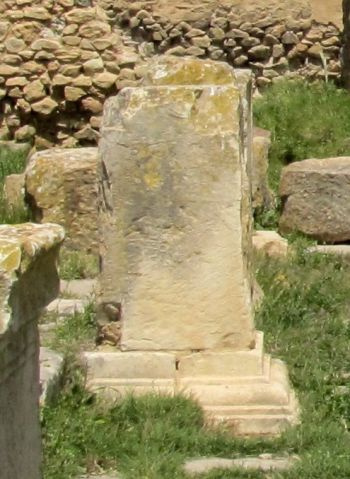
Base for statue of governor, possibly with togate statue LSA-1130. Bulla Regia (Africa Proconsularis). 312-400
Record details
Photographs
Inscription
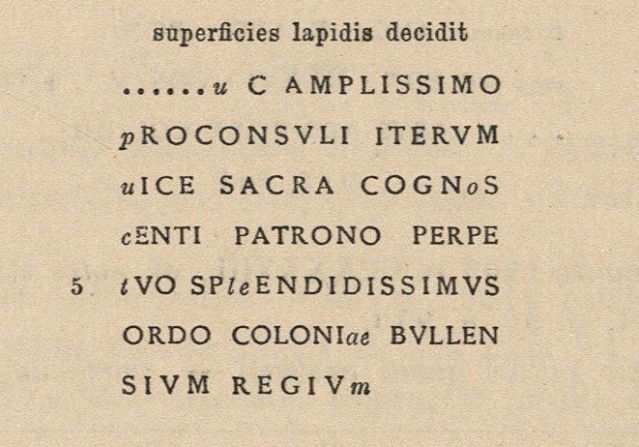
------/ [---v(iro)] c(larissimo), amplissimo / [p]roconsuli iterum, / [v]ice sacra cogn[o]s/[c]enti, patrono perpe/[t]uo, sp[le]ndidissmus / ordo coloni[ae] Bullen/sium Regiu[m].
Inscription translation
To (...), man of clarissimus rank, most magnificent governor (proconsul) for the second time, judge representing the emperor, perpetual patron. The most magnificent council (ordo) of the colony of Bulla Regia [set this up].
Bibliography
- Corpus Inscriptionum Latinarum; , VIII, 25528
Discussion
INSCRIPTION
------/ [---v(iro)] c(larissimo), amplissimo / [p]roconsuli iterum, / [v]ice sacra cogn[o]s/[c]enti, patrono perpe/[t]uo, sp[le]ndidissmus / ordo coloni[ae] Bullen/sium Regiu[m].
'To (...), man of clarissimus rank, most magnificent governor (proconsul) for the second time, judge representing the emperor, perpetual patron. The most magnificent council (ordo) of the colony of Bulla Regia [set this up].'
Letter height : 5 cm.
DESCRIPTION (from Merlin, 1908, 8)
Statue base of limestone with plinth, broken at the top: H 125, W 64 cm, depth unrecorded.
PROVENANCE AND CURRENT LOCATION
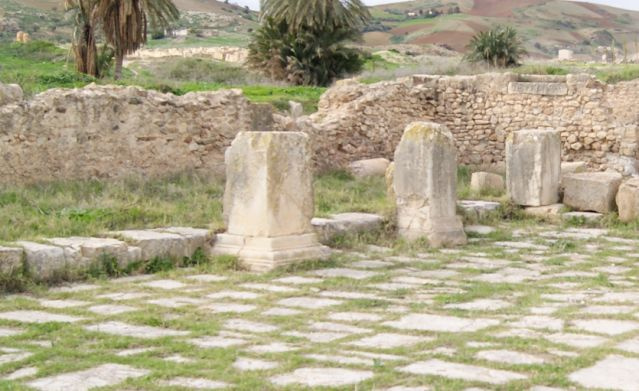
Our base was found in 1906-7 by Benet in the courtyard of the temple of Apollo, in front of the third column (from the north) of the west portico. It is still in situ.
HONORAND, AWARDER AND DATE
The upper part of the base, with the name of the honoured governor is lost (PLRE I, 1012 Anonymus 41).
The awarder was the council (ordo) of the city.
The wording of the inscription provides an approximate, but reliable, date in the 4th century.
FURTHER DISCUSSION
A togate statue was found in front of our base, lying face down on the pavement (LSA-1130). Merlin concluded it had fallen from our pedestal (Merlin, 1908, 8).
Y. Thébert and R. Hanoune suppose that the temple of Apollo became a storeroom for statuary in the second half of the fourth century (see Beschaouch, Thébert and Hanoune, 1977), while Lepelley argues that it became a sort of museum (see Lepelley, 1994). Some inscriptions discovered here clearly come from monuments elsewhere in the city, especially from the forum area. Our base may well have been set up first on the forum, and only later transferred with other statues into the temple. The assembling here of many statues was probably the consequence of imperial laws protecting statues and the classical heritage (see Codex Theodosianus XVI, 10, 8; 10,15; and 10,18).
Discussion references
- Beschaouch A., Hanoune R., Thébert Y., Les ruines de Bulla Regia, Rome, 1977
- Jones, A. H. M. et al., The Prosopography of the Later Roman Empire. Vol. I 260-395, Cambridge et al. 1971 (1975), 1012, Anonymus 41
- Lepelley, C., Les cités de l'Afrique romaine au Bas-Empire, t. 2, Notices d'histoire municipale, Paris 1981
- Lepelley, C., "Le musée des statues divines. La volonté de sauvegarder le patrimoine artistique paien à l'époque théodosienne", Révue Archéologique 42, 1994
- Merlin, A., Le temple d'Apollon à Bulla Regia, Paris 1908
Cite: Last Statues of Antiquity, LSA-1184 (Gabriel de Bruyn).