
LSA-1185
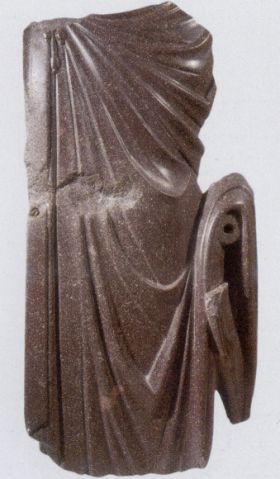
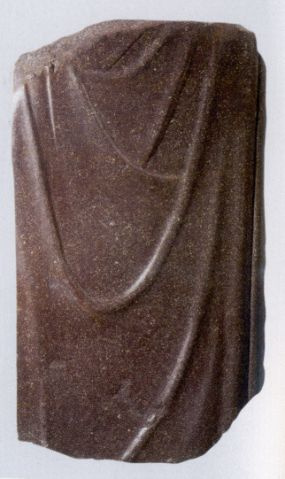
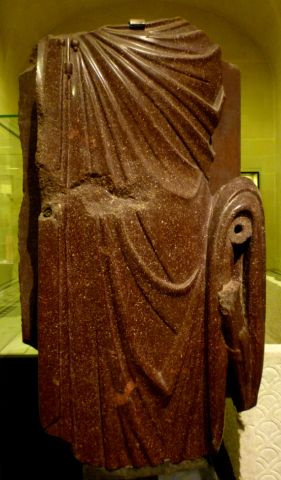
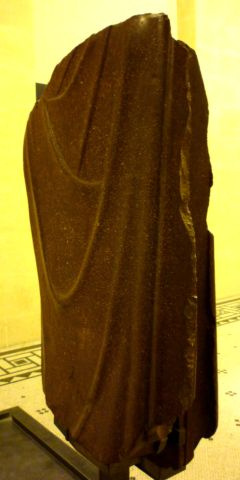
Two fragments of porphyry statue of emperor in chlamys with sword. Unknown provenance. Fourth to fifth century.
Record details
Photographs
Bibliography
- Gehn, U., Ehrenstatuen in der Spätantike. Chlamydati und Togati, Wiesbaden 2012, 348-9 cat. no. P 10
- Malgouyres, P. & C. Blanc-Riehl, Porphyre. La pierre pourpre des Ptolémées aux Bonaparte, Paris 2003, pp. 63-5 no. 14
- Martinez, J.-L., Les antiques du Musée Napoléon, Paris 2004, p. 224 no. 0407
Discussion
DESCRIPTION (object)
Front and back of life-size statue. H (of front): 90, H (of back): 81, W (of front): 45, „ (of back): 48, D (of back): 10, D (of front): 10 cm. Porphyry.
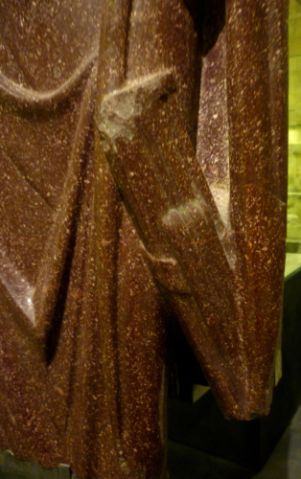
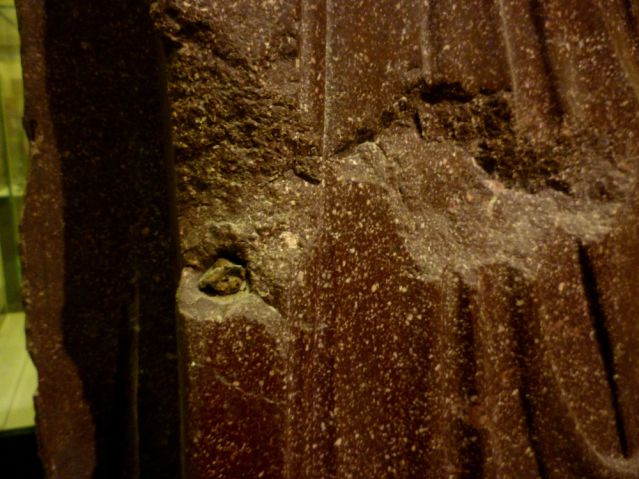
The statue has been sawn, vertically and parallel to the front, into three slabs. The middle one, which was the desired slab, is missing. Missing are also the head , the right arm, the upper part of the left arm, the left wrist and hand area which had been inserted, and the legs below the chlamys. In the middle of the front piece a horizontal zone has been hacked away; this removed the lower right removed. Just under this, a break in the big vertical fold was repaired with dowel. The preserved back is shorter than the front. The execution of the back is less detailed than the front, but it is still well executed and polished.
PROVENANCE
Unknown. Inventoried in the Louvre Museum in 1807.
DESCRIPTION (subject)
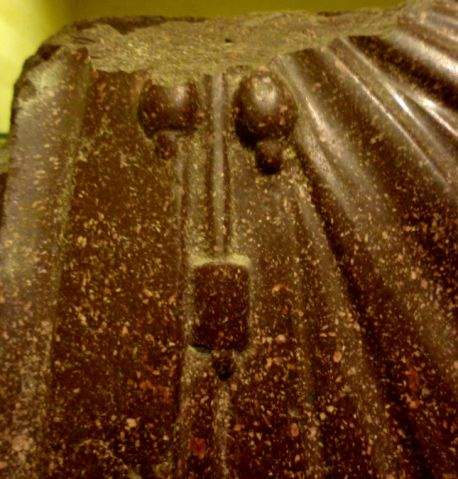
The statue wears a chlamys which is fastened by a pendile fibula at the right shoulder. The left arm was bent at the elbow; the now missing hand would have grasped the scabbard of the sword. The right forearm crossed the body; the right hand probably touched the hilt of the sword.
The length of the chlamys can approximately be determined from the vertical fold at its right side; it fell down to the shins but did not reach the ankles.
The statue follows the same scheme as that in Ravenna, LSA-1010. It repeats the motifs of the chlamys as well as the gesture and placement of the hands and sword. The ends of the pendilia, which hang down from the no longer extant fibula on the right shoulder, are slightly different. The outer ones are ovoid and the middle one is small and rectangular; all three terminate in a small knob. Also the style of the drapery is less angular and more soft than that of the statue in Ravenna, LSA-1010.
HONORAND AND DATE
The material of the statue and its iconography (pendile fibula and the sword) indicate that an emperor was intended.
Most scholars (here Bergmann, also in Donati & Gentili and Malgouyres) believe that the statue belongs to the late fourth or early fifth century. It seems closely related to LSA-1010, which, from the hinterland of Ravenna, should be dated to the period after Honorius moved the capital of his empire to Ravenna in 404. Such a date seems consistent with the strongly classisizing style of both statues. No longer are there traces of the Egyptian workmanship of the Tetrarchic period.
U. Gehn notes that the clothing might aid in the dating. The pendile fibula provides a terminus post quem for the statue; such fibulae enter the imperial chlamys costume only in the later tetrarchic period (gold aurei of Licinius and Licinius II, Smith 1997 pl. V). For him, the length of the relatively short chlamys is probably the most reliable indicator of date and it suggests the earlier or mid 4th century.
Discussion references
- Demandt, A. and J. Engemann, (eds.), Konstantin der Grosse, Mainz 2007
, no. I.4.4 (D. Roger) - Donati, A. and G. Gentili, Costantino il Grande. La civiltà antica al bivio tra Occidente e Oriente, Milan 2005, 283, no. 120 (D. Roger)
- Smith, R.R.R.,'The public image of Licinius I: Portrait sculpture and imperial ideology in the early fourth century', JRS 87, 1997, pl. V
Cite: Last Statues of Antiquity, LSA-1185 (Marianne Bergmann with Ulrich Gehn).