
LSA-1186
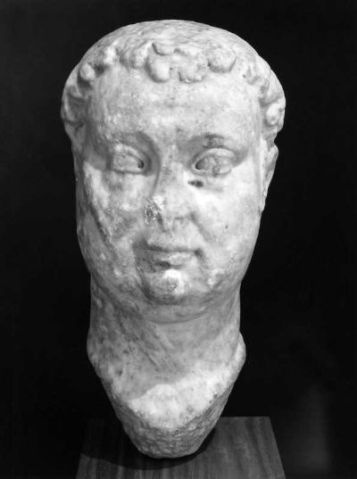
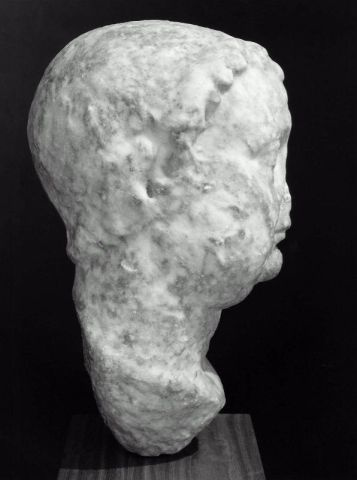
Portrait head for insertion of man with full-face and receding chin (re-cut). From Asia Minor? Late fourth to fifth century.
Record details
Photographs
Bibliography
- Vermeule, C.C. and M. Comstock, Sculpture in stone and bronze in the Museum of Fine Arts, Boston : additions to the collections of Greek, Etruscan, and Roman art, 1971-1988 , Boston 1988, 60, no. 52
Discussion
DESCRIPTION (Object)
Over life-size head worked separately for draped statue. H: 43 cm. Medium-grained grey-white marble.
The head is completely preserved with its socket. Only the nose is missing.The surface is badly worn and has brown striations, presumably burial contact with water and iron. The edge of the back of the socket rises sharply to almost the top of the nape of the neck. At the front of the socket a small V-shaped area of chest is preserved.
The hair grows in volume around the face and at the nape of the neck. The upper edge of the upper eyelid is accentuated by two parallel and deep lines of a flat chisel. The irises are defined by engraved half-circles. The pupils are marked by a fine line in a U-shape.
The head has been re-cut. On the right side, the hollow of inner ear is far too high on the head, and the missing outer shell of the ear seems to have been removed. Traces of a beard can be felt on the right cheek. On the left side a long sideburn reflects the original form of a beard. On the neck, along the proper right of front, are raised areas of marble, which appear to have been points of attachment of beard. At the centre of the neck are the ghosts of six diagonal drill channels; the drill was probably used to remove beard hair.
PROVENANCE
Gift received in 1977 said to be from a German collection. The marble and technique recall other portraits from Asia Minor: see below.
DESCRIPTION (Subject)
The badly worn head is large and was made to be inserted into a draped statue. The honorand wears a wreath hairstyle popular in the late fourth and fifth centuries and has a specific physiognomy.
He has a tall receding brow and a round chin which projects directly beneath the chin and above a broad band of sagging flesh. At the centre of the brow, the hair comes forward in short thick curls, and above the nose are two deep and inorganic vertical creases. The eyes have thick upper lids and deep rounded inner canthi. The nose was long and fine. The mouth is broad with upturned-corners. From the corners run deep folds that echo the heavy naso-labial folds and continue along either side of the chin. The neck is thick and has horizontal creases
DATE
The rendering of the eyes (lids, canthi, and markings) provides technical evidence for a date no earlier than the mid-fourth century. The wreath hairstyle is usually considered a trend of the fifth century but it is visible in an early stage on some individuals depicted on the base of the Obelisk of Theodosius, c. 390. Here, it is combined with a smooth clean-shaven face that lacks even a trace of stubbleò this suggests an earlier date. Two fragmentary heads (l>693">LSA-693 , LSA-706)from Ephesus show comparable portraits.
Cite: Last Statues of Antiquity, LSA-1186 (J. Lenaghan).