
LSA-119
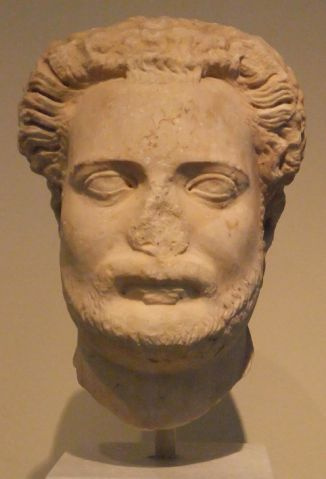
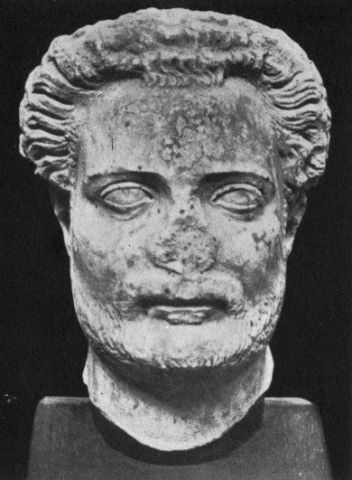
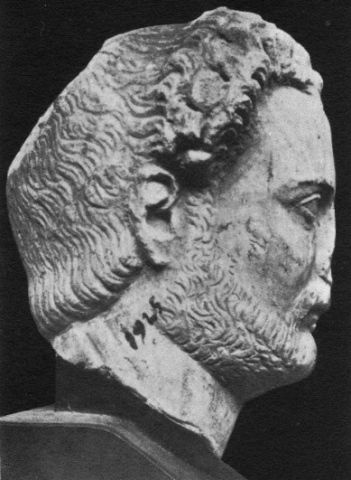
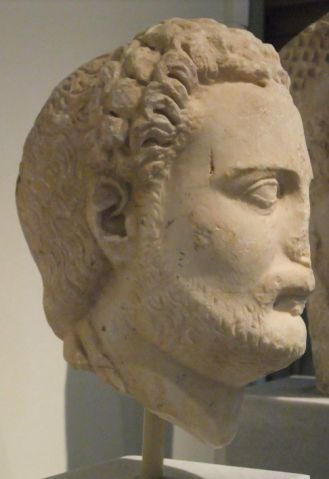
Re-worked portrait head of bearded man. Athens. Fifth century.
Record details
Photographs
Bibliography
- L'Orange, H. P., Studien zur Geschichte des spätantiken Porträts, Oslo 1933, pp. 88-92, pp. 149-150 no. 124 figs. 232, 233
- Romiopoulou, K., Ellenoromaika Glypta tou Ethnikou Archaiologikou Mouseiou, Athens 1997, p. 139 no. 153
Discussion
DESCRIPTION (Object)
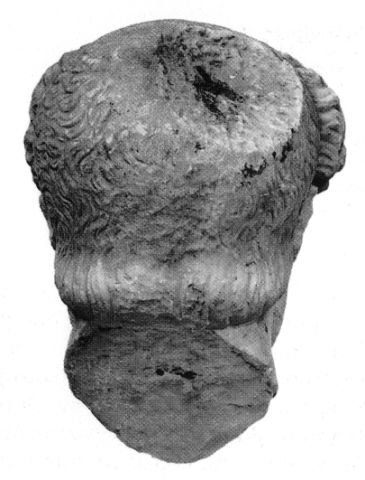
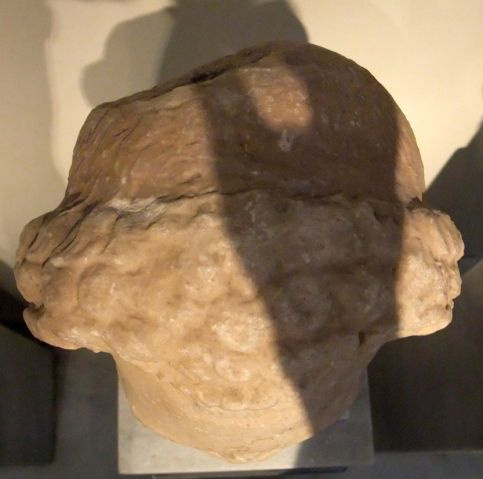
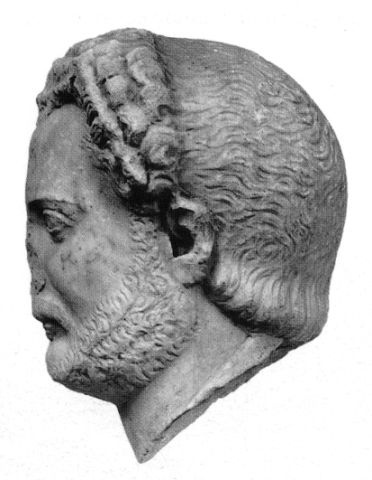
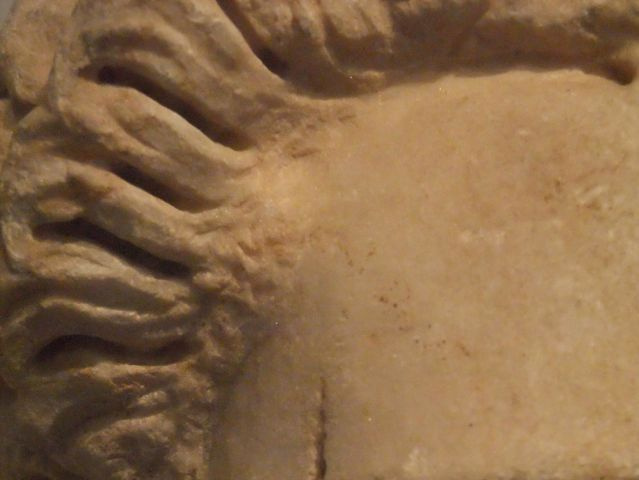
Portrait head of a bearded male, reworked from an earlier portrait; pentelic marble, H 28.5 cm. The traces of the late-antique re-work are visible particularly at the hairline of both temples. The nose is broken off; ears, moustache and lower lip, eyelids- and brows are chipped. On the backside, a piece of the calvary is missing. This was worked separately and fixed with a dowel. The shallow cave to which it was fitted is finished with a point; in its centre there are traces of metal. L'Orange 1933, 150 still saw an iron cone protruding from that cave (today removed). The neck is worked back in an inclined plain from the adam's apple to the hairline in the back; L'Orange 1933 thought it was made for insertion. Apart from the damages mentioned, the head is in an excellent state of preservation.
The hair is a compact mass piled into a thick 'wreath' over the forehead. On the calvary, it is indicated by short, wavy chisel strokes which are deep enough to lend plasticity to the single strands; the beard is indicated by the same technique. The streaks and curls of the 'wreath' are separated from each other by deeply intruding drill work.
The pupils are gently marked by a shallow, round hole. The caruncle, indicated by a drill point, is surrounded by the lids while at the outer ends the upper lids overlap. The almond-shaped eyes are embedded with remarkably subtle plasticity; the low-arching brows, indicated as a sharp ridge, make the impression of a 'natural eyecut'.
The flesh is highly polished, without any wrinkles; single forms softly merge without abrupt caesuras.
PROVENANCE/ LOCATION
The head is from the Old Agora, from the environs of the Hephaistaion (Romiopoulou 1997). Today in the National Archaeological Museum, inv. no. 2314.
DESCRIPTION (Subject)
The mature age of the portrayed is indicated by the meticulously trimmed beard alone, while no wrinkles disturb the 'classical' smoothness of the polished flesh. The hair is combed forward from the peak to all sides, piling into a thick wreath around the forehead, and into a moderate coil at the back; the ears are left free. Remarkably a bunch of hair is combed into the middle of the forehead; the whole appearance airs diligent care.
The 'wreath-hairstyle' appears with the magistrate's portraits on the obelisk-base in Constantinople (dates 390/2) where it is distinguished from the lank imperial hairstyle and the long hair of the german life-guards. It has been applied throughout the 5th century to magistrate's portraits as traceable primarily in portraits from Asia minor (for example, the praeses Cariae Oecumenius (LSA-150 (statue with head), LSA-151 (inscribed base), from Aphrodisias). The portrayed most probably was a high imperial official.
On both sides of the neck traces of the garment worn by the portrayed are extant; this could have been a chlamys, or a toga, or a himation.
DATE
L'Orange 1933, 90 assigned the head to the 2nd half of the 5th century, comparing it to the diptych of Boethius, consul in 487 (Delbrueck 1929 N 7). As stylistic features he named out 'smoothening of the surface and enhancement of the line', together with 'ornamentalization of single forms' ('Abglättung der Oberfläche und Steigerung der Linie, (...) damit Hand in Hand gehende Ornamentalisierung des Einzelnen', L'Orange 1933, 91). Romiopoulou 1997 dated towards the middle of the 5th century.
In the absence of hard dating evidence, typological and stylistic considerations remain our sole criteria. Typologically, in our view, the wreath hairstyle requires a date later than the obelisk-base. Whereas L'Orange's hint at the ornamental single form associated with his comparison with the Boethius-diptych is admittedly appealing, the stylistic features of the head, and notably the subtle plastic rendering of the carnate, on the other hand, associate this head rather with portraits of the 'theodosian renaissance' around 400. The low-arching brows, if inherited from the original early imperial portrait, resemble the 'natural eyecut' ('natürlicher Augenschnitt') of theodosian imperial heads (LSA-163); M. Bergmann has interpreted this 'natural eyecut' plausibly as a function of the classicistic bias of that time (Bergmann 2000, 240: 'ritorno a forme classiche'). The coiffure type with the more sumptuously dressed hair over the forehead, as against a modest 'coil' in the back, reappears, together with subtle modelling of the flesh, at the chlamydatus bust in Thessaloniki which was taken as prototype of the 'subtle style' in the first decade of the 5th century by L'Orange 1961.
The head from Piraeus in the National Museum inv. no. 125 (LSA-101), and the head in the Acropolis Museum, inv. no. 2358 (LSA-117) which were grouped together with our head by L'Orange 1933, 88-92 in fact share the 'magistrate'-hairstyle of our head, yet show distinctive stylistic features. In our view, its smooth, classicising appearance assigns our head rather to the early than to the later 5th century - a decisive assessment, however, remains beyond our capacity.
FURTHER DISCUSSION
The head is reported to be from the environs of the sanctuary of Hephaistos on the Greek Agora in Athens. There is no recorded evidence about the find circumstances, wether it was set up there or found in a secondary location. In the broader area, in late antiquity the so-called 'palace of the giants' occupied the central agora (Frantz 1988, 95-116). The exact purpose of this extraordinarily large and sumptuous late-antique house remains uncleared. H. A. Thompson (in Frantz 1988, 110-16) interpreted it as an official residence, 'intended for the occasional accomodation either of the emperor himself or of high-ranking Imperial officials when on tours of duty' (Frantz 1988, 111). According to Fowden 1990, it was the town house of the empress Eudocia, an Athenian by birth.
From the Agora, and possibly from the 'palace of the giants' comes the headless late togate statue (LSA-143). Wether our head and that statue can be associated, is beyond our evidence at present; our own stylistic argumentation would rather speak against such an association.
Discussion references
- Bergmann, M., Il ritratto imperiale e il ritratto privato. L'evoluzione delle forme, Ensoli, S. & E. La Rocca (eds.), Aurea Roma (2000), 237-43, Rome 2000
- Delbrueck, R., Die Consulardiptychen und verwandte Denkmäler, Berlin & Leipzig 1929, pp. 103-6 N 7
- Fowden, G., The Athenian Agora and the Progress of Christianity, Journal of Roman Archaeology 3, 1990, 494–501
- Frantz, A., Late Antiquity A. D. 267 - 700: The Athenian Agora XXIV, Princeton 1988
- L'Orange, H. P., 'Der subtile Stil. Eine Kunstströmung aus der Zeit um 400 n. Chr.', Antike Kunst , 4 (1961) 68-75
Cite: Last Statues of Antiquity, LSA-119 (Ulrich Gehn).