
LSA-1191
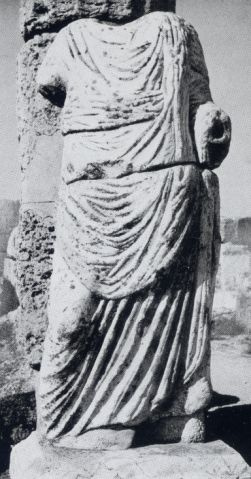
Headless portrait statue of man in toga. From Cyrene. Late second to early third, or fourth to fifth century.
Record details
Photographs
Bibliography
- Catani, E. 'Statue marmoree rilavorate da Cirene', Scritti di antichità in memoria di Sandro Stucchi (Studi Miscellanei 29), 37-50, Rome 1996, 43-4 no. IV fig. 4
- Rosenbaum, E., A Catalogue of Cyrenaican Portrait Sculpture, London 1960, 84, no. 133, pl. 68.4
- Stucchi, S., Cirene 1957-1966 : un decennio di attività della missione archeologica italiana a Cirene , Tripoli 1967, 138-9, fig. 142-3
Discussion
DESCRIPTION (Object)
Life-size statue in three fragments. H (shoulders to shins): 164, W (of body) 62 cm. Coarse-grained white marble.
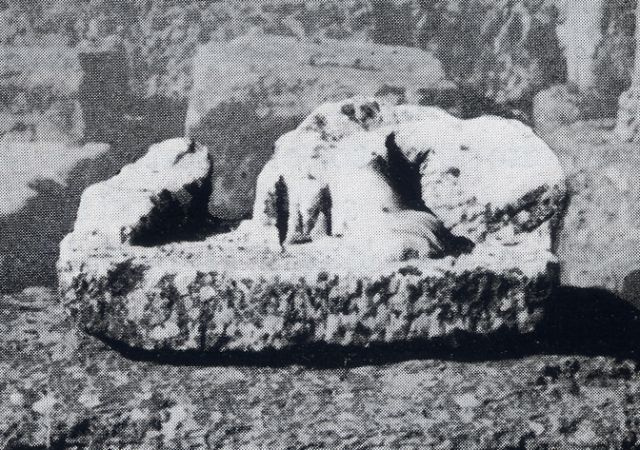
The statue was initially recorded in three fragments: 1) shoulders to waist, 2) waist to shins, and 3) feet and plinth. Fragments 1 and 2 join; fragment 3 seems not to join break to break. In 1960 Rosenbaum records only 1 and 2. Stucchi in 1967 shows a photograph also of fragment 3.
The statue is missing an area between the feet and shins. It lacks also the head; the right arm from the lower biceps down; and the left hand. These three areas were, however, all separately worked. There is a large dowel hole and smaller pin hole preserved at the left wrist; and at the right arm there is still a metal dowel preserved. Between the shoulders is a socket for the insertion of a head.
The front is schematically and flatly worked. The back is only summarily finished.
As Stucchi 1967 points out, this was originally a female draped statue which was later worked into a male statue (see below, ‘Description (Subject)’).
PROVENANCE
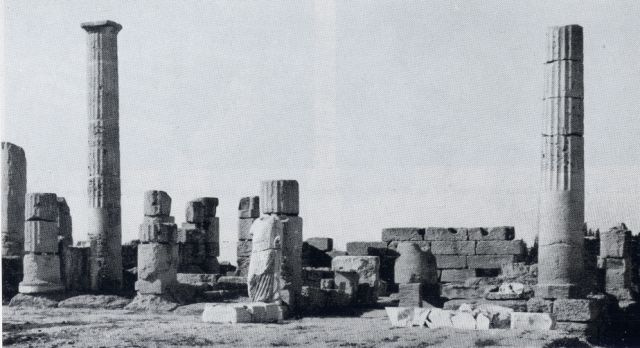
The statue was found in the Agora immediately after world war II. Photographs show it standing in front of the monumental structure to cover the Well/Augusteum/Audience Hall. This building is on the western corner of the north side of the Agora.
DESCRIPTION (Subject)
The statue represents a male standing over his left leg. The left arm is bent in the elbow, the left hand stretched forward. The dress of the man has three layers at the front: there is an ankle length undergarment; a bulge running horizontally over the belly and the ‘sinus’ in front of the lower body probably indicate a cloak, most probably, as Stucchi suggested, a toga (Rosenbaum 1960 thought it was a himation). The footwear is not decipherable on the published images and has not been described by earlier scholars.
Stucchi 1967, 136, 138 suggested that the type of toga displayed by the statue, if worked summarily, was the same as the one displayed by the imperial statue from Aphrodisias, the so-called Valentinian II (LSA-163). However, while our statue shows a long undergarment (comparable to the imperial statue from Aphrodisias), other features are different from the late-antique type of toga. Notably the ‘sinus’ is brought to the left shoulder and falls down in the back, whereas the tip of the late-antique toga is laid over the left arm (Gehn 2012, 43-4; 137-9).
In my view, it is more likely that the type of toga intended by the rework is the one with umbo (Goette 1990 type B), and not the late antique drapery.
DATE
Our statue is similar to two other statues from Cirene, a re-cut female draped statue fitted with a portrait head of Marcus Aurelius (LSA-1133), and a portrait statue from the sanctuary of Apollo (Strathegeion) (LSA-1132). LSA-1133 was associated with restoration work in the city centre probably after the earthquake of 365 (Stucchi 1967, 136).
It is possible that our statue, together with the two quoted comparanda, was worked for a late antique restoration program, possibly after the earthquake of 365.
However, in a recent discussion of re-used statuary from Cyrene E. Catani has made the case for a date in the late 2nd/ early 3rd century for the re-use of all three statues (Catani 1996, 40-4 nos. II-IV).
Discussion references
- Blanck, H. 'Ein Kopf im römischen Kunsthandel', Mitteilungen des Deutschen Archäologischen Instituts, Römische Abteilung 70, Heidelberg 1963
- Gehn, U., Ehrenstatuen in der Spätantike. Chlamydati und Togati, Wiesbaden 2012
- Goette, H.R., Studien zu römischen Togadarstellungen, Mainz 1990
- Stucchi, S. 'La statua dello Strategheion di Cirene', Archeologia Classica 12, Rome 1960
Cite: Last Statues of Antiquity, LSA-1191 (Ulrich Gehn).